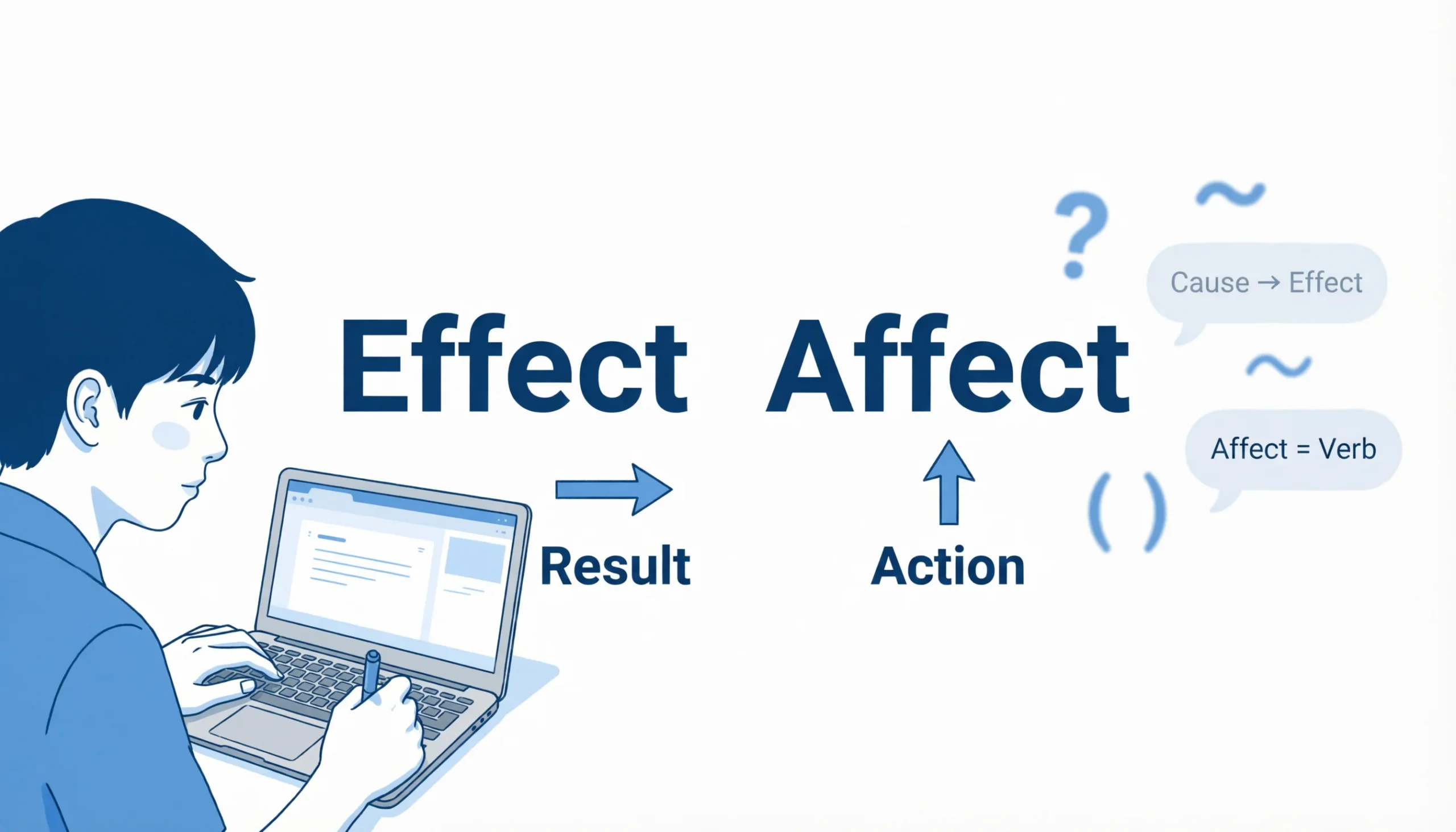
Many people get confused between “effect” and “affect”. They look similar, sound similar, and are often used in the same sentence. This makes them one of the most searched grammar questions in English.
The confusion usually happens when people write essays, emails, school assignments, or professional reports.
A small mistake can change the meaning of a sentence or make writing look less professional. That is why learners, students, bloggers, and even native speakers search for this keyword.
The main problem is simple: both words are linked to change or impact, but they are used in different ways.
One is mostly a verb, and the other is mostly a noun. But there are exceptions that make it even harder.
In this guide, you will learn the difference in a very simple way. You will also see examples, common mistakes, spelling rules, and real life usage.
By the end, you will clearly understand when to use effect and when to use affect without confusion.
Effect or Affect
Affect (verb) = to influence something
👉 Example: The weather affects my mood.
Effect (noun) = the result of something
👉 Example: The effect of the weather is sadness.
💡 Simple rule:
- Affect = Action
- Effect = End result
The Origin of Effect or Affect
Both words come from Latin.
- Affect comes from afficere, meaning “to act on” or “influence.”
- Effect comes from effectus, meaning “result” or “accomplishment.”
Over time, English adopted both words but gave them different grammar roles. This is why they are often confused today.
British English vs American English Spelling
Good news: “effect” and “affect” are spelled the same in both British and American English.
The difference is not spelling it is usage and meaning.
Comparison Table: Affect vs Effect
| Word | Part of Speech | Meaning | Example |
|---|---|---|---|
| Affect | Verb | To influence | Stress affects sleep. |
| Effect | Noun | Result | Stress has an effect on sleep. |
Which Spelling Should You Use?
- 🇺🇸 US English: Same rules, focus on verb vs noun
- 🇬🇧 UK English: Same rules, slightly more formal usage of “effect”
- 🌍 Global English: Follow grammar role, not region
👉 Best rule: Ignore region. Focus on meaning.
Common Mistakes with Effect or Affect
❌ Stress has a big affect on health
✔ Stress has a big effect on health
❌ The news effected me deeply
✔ The news affected me deeply
❌ What is the affect of pollution?
✔ What is the effect of pollution?
💡 Tip: If you can replace the word with “influence,” use affect. If you can replace it with “result,” use effect.
Effect or Affect in Everyday Examples
Emails
- The delay will affect delivery time.
- We noticed the effect of the delay.
News Writing
- The policy will affect farmers.
- The effect of the policy is debated.
Social Media
- Too much screen time affects sleep.
- The effect of social media is huge.
Formal Writing
- Climate change affects agriculture.
- The long term effect is serious.
Effect or Affect – Google Trends & Usage
Search interest shows that:
- “effect or affect difference” is highly searched worldwide
- Students and writers make up most of the audience
- Peak searches happen during exam seasons
This keyword is popular because English learners want a quick rule they can remember under pressure.
Comparison Table: Effect vs Affect Variations
| Form Type | Word | Example Sentence |
|---|---|---|
| verb | affect | Smoking affects health. |
| noun | effect | Smoking has an effect on health. |
| verb (past) | affected | She was affected by the news. |
| adjective | effective | This is an effective method. |
| verb (rare) | effecting | He is effecting change. |
FAQs
1. Is it “effect” or “affect” in a sentence?
Use affect for action and effect for result.
2. Can “effect” be a verb?
Yes, but it is rare and formal, meaning “to bring about.”
3. What is the easiest way to remember?
Affect = Action, Effect = End result.
4. Are effect and affect interchangeable?
No, they have different grammatical roles.
5. Which is more common?
“Affect” is more common in everyday speech.
6. Can both be used in one sentence?
Yes. Example: The medicine affects your body and has a strong effect.
7. Why are they confusing?
Because they sound similar and are used in related contexts.
Conclusion
Understanding effect or affect becomes easy when you remember one simple idea: one word shows action, and the other shows result.
Affect is usually a verb that describes influence. Effect is usually a noun that describes the outcome of that influence.
Many learners struggle because both words appear in similar topics like health, science, emotions, and daily communication. However, once you practice a few examples, the difference becomes clear and automatic.
The key is not memorizing rules but understanding usage in real sentences. If you are writing an email, essay, or social post, quickly ask yourself: Am I talking about action or result? That simple question will guide you every time.
With regular practice, you will stop mixing them and write more confidently. This small grammar fix can make your English look more professional, clear, and correct in any situation.

Hi, I’m Virginia Woolf, a language enthusiast passionate about exploring the power of words and their meanings. I specialize in helping readers choose the right words through clear comparisons, synonyms, and practical usage. My goal is to make vocabulary learning simple, engaging, and useful for everyday communication. picktheword.com