You’ve probably seen the symbol ≥ in math, exams, or even spreadsheets. But many people still stop and think: What does “greater than or equal to” really mean?
This keyword is commonly searched because users get confused between >, ≥, and =—especially when solving equations or writing conditions.
The phrase “greater than or equal to” helps you compare values. It shows that one number is either bigger than another or exactly the same.
This small symbol carries big meaning in math, coding, and daily problem solving.
People search this keyword to quickly understand the symbol, learn how to use it in equations, and avoid mistakes.
This guide gives you a clear answer, simple examples, and practical tips so you can use it with confidence.
Greater Than or Equal To – Quick Answer
a≥ba \geq ba≥b
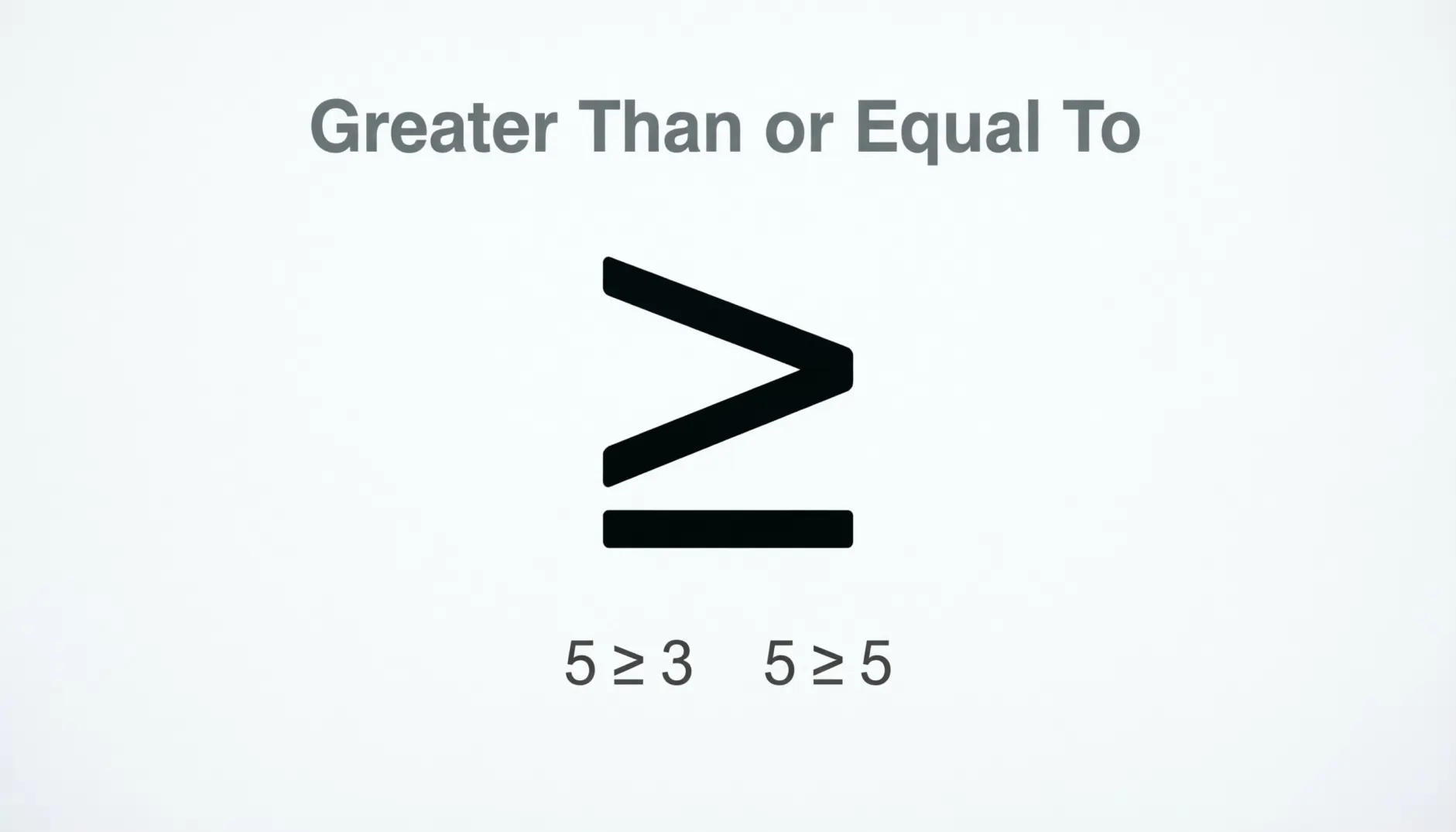
Greater than or equal to (≥) means one value is bigger than or exactly equal to another value.
Examples:
- 5 ≥ 3 → True (5 is greater than 3)
- 5 ≥ 5 → True (5 is equal to 5)
- 3 ≥ 5 → False (3 is smaller than 5)
👉 Simple rule:
If the number is not smaller, the statement is true.
The Origin of Greater Than or Equal To
The concept comes from basic comparison in mathematics. The symbols > (greater than) and < (less than) were first used in the 1600s by mathematicians like Thomas Harriot.
Later, the idea of equality (=) was combined with these symbols to create:
- ≥ (greater than or equal to)
- ≤ (less than or equal to)
This helped express conditions where two values could be equal or one could be larger.
There are no spelling differences here because this is a symbol based expression, not a word with variations.
British English vs American English Spelling
| Feature | British English | American English |
|---|---|---|
| Phrase | greater than or equal to | greater than or equal to |
| Symbol | ≥ | ≥ |
| Usage | Same | Same |
Which Spelling Should You Use?
You don’t need to choose. The phrase is universal.
Use based on context:
- Math & Science: Always use ≥
- Formal writing: Use the full phrase
- Global audience: Symbol is best
- Students: Learn both phrase and symbol
👉 Tip: Use the symbol (≥) for clarity and speed.
Common Mistakes with Greater Than or Equal To
1. Confusing ≥ with >
❌ 5 > 5 (False)
✅ 5 ≥ 5 (True)
2. Writing symbol backward
❌ ≤ instead of ≥
👉 Direction matters!
3. Ignoring equality
Some forget that equal values are allowed
4. Using wrong in equations
❌ x > 10 (when 10 should be included)
✅ x ≥ 10
Greater Than or Equal To in Everyday Examples
Emails
- “Applicants must be 18 or greater.” → Better: 18 or ≥ 18
News
- “Temperature will stay ≥ 30°C this week.”
Social Media
- “Score ≥ 90 to win!”
Formal Writing
- “The value must be greater than or equal to 100.”
Greater Than or Equal To – Google Trends & Usage Data
This keyword is popular worldwide, especially in:
- United States – students and coding users
- India & Pakistan – exam preparation
- UK – academic usage
Where it’s used:
- Math problems
- Programming (if conditions)
- Excel formulas
- Statistics
👉 Searches increase during exam seasons.
Comparison Table: Keyword Variations
| Term | Meaning | Symbol |
|---|---|---|
| Greater than | Bigger only | > |
| Equal to | Same value | = |
| Greater than or equal to | Bigger or same | ≥ |
| Less than | Smaller only | < |
| Less than or equal to | Smaller or same | ≤ |
FAQs
1. What does ≥ mean in math?
It means a number is greater than or equal to another number.
2. Is 5 ≥ 5 true?
Yes. Because both numbers are equal.
3. What is the difference between > and ≥?
- > means only greater
- ≥ means greater or equal
4. How do you type ≥ on keyboard?
- Windows: Alt + 242
- Mac: Option + . (varies by layout)
5. Where is ≥ used?
In math, coding, Excel, and statistics.
6. Is ≥ used in real life?
Yes, in exams, reports, and data conditions.
7. Can ≥ include equal values?
Yes. That’s its main purpose.
Conclusion
The symbol greater than or equal to (≥) is simple but powerful.
It allows you to compare numbers in a flexible way, covering both “greater than” and “equal to” in one step.
This makes it useful in math, coding, and real world situations like data analysis or rules.
There is no confusion in spelling across regions, making it a universal term.
The biggest mistakes happen when people forget that equality is included or mix it up with similar symbols like > or ≤.
To use it correctly, remember one rule: if the value is not smaller, then the statement is true. Practice with examples, and you’ll quickly master it.
If you’re a student or a professional, understanding this symbol helps you communicate clearly and solve problems faster.

Hi, I’m Virginia Woolf, a language enthusiast passionate about exploring the power of words and their meanings. I specialize in helping readers choose the right words through clear comparisons, synonyms, and practical usage. My goal is to make vocabulary learning simple, engaging, and useful for everyday communication. picktheword.com