If you are searching for the “Join or Die” snake, you are probably trying to understand what the famous snake cartoon means, who created it, and why it was important in American history.
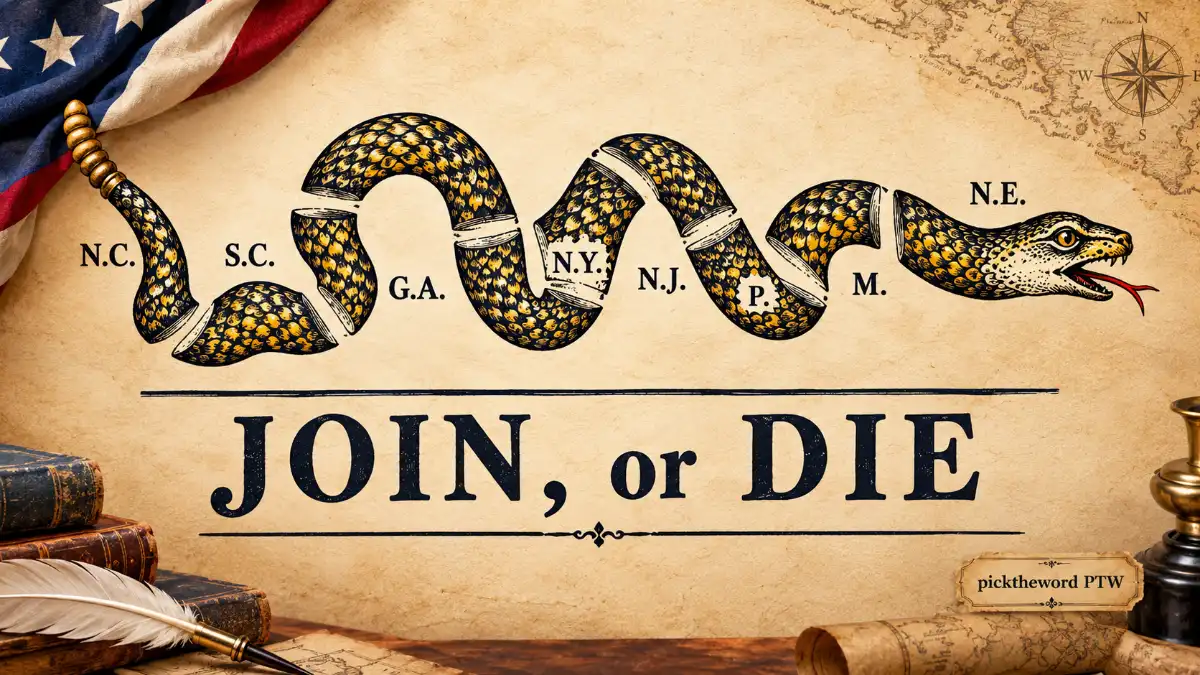
The image shows a snake divided into pieces, with each piece representing a British North American colony or region.
Quick Answer
The “Join, or Die” snake was a political cartoon published by Benjamin Franklin on May 9, 1754, in the Pennsylvania Gazette. It showed a snake cut into eight pieces to encourage the British colonies to unite against the French and their Native American allies during the growing conflict that became the French and Indian War.
The message was simple:
if the colonies stayed divided, they would be weak; if they joined together, they would be stronger.
What Does the “Join or Die” Snake Mean?
The snake represents the British colonies in North America. Franklin drew it as a snake that had been cut into separate pieces.
The words “JOIN, or DIE.” appear with the image.
The idea was that the colonies needed to cooperate rather than act separately. Franklin was concerned about French activity and fighting along the western frontier of the colonies. He wanted the colonies to work together for their common defense.
In very simple terms:
Join together, or you may be defeated separately.
The cartoon was therefore not originally a call for American independence. In 1754, the colonies were still part of the British Empire. Its first purpose was to encourage colonial unity and defense.
Who Created the “Join or Die” Snake?
The cartoon is generally attributed to Benjamin Franklin, who published it in his newspaper, the Pennsylvania Gazette, on May 9, 1754. The Library of Congress describes it as the first political cartoon published in an American newspaper.
Franklin also wrote an editorial that appeared with the image. The cartoon helped make his argument easier to understand because readers could immediately see the problem: the snake was broken into separate parts.
The image was also connected to discussions about colonial cooperation that soon led to the Albany Congress and the proposed Albany Plan of Union.
What Do the Snake’s Parts Represent?
The original snake has eight sections. These sections represent seven individual colonies plus New England as a group.
| Snake label | Colony or region |
|---|---|
| N.E. | New England |
| N.Y. | New York |
| N.J. | New Jersey |
| P. | Pennsylvania |
| M. | Maryland |
| V. | Virginia |
| N.C. | North Carolina |
| S.C. | South Carolina |
The four New England colonies Massachusetts, Connecticut, Rhode Island, and New Hampshire were grouped together as “N.E.”
Notice something important: the image does not show all thirteen colonies.
Delaware and Georgia are missing, while the four New England colonies are combined into one section. Historians have discussed several reasons for these choices, including the political organization of the colonies at the time.
Another interesting detail is that the segment marked “P.” represents Pennsylvania. For many years, people sometimes interpreted that letter as “R,” but Library of Congress conservation work determined that it was actually a P.
Why Is the Snake Cut Into Pieces?
The broken snake is the most important part of the cartoon.
Franklin was using the divided snake as a visual symbol for the divided colonies. Each section was separated from the others, just as the colonies often acted separately.
The message becomes easy to understand when you imagine putting the pieces back together:
- One piece alone is weak.
- Several disconnected pieces cannot act as one body.
- Joined pieces can form a complete snake.
- The colonies needed to cooperate to become stronger.
The image also drew on a popular belief that a snake cut into pieces could become whole again if its parts were put together before sunset.
So the picture was not simply decoration. The broken snake was the argument.
Is the “Join or Die” Snake a Map?
Yes, in an interesting way.
The snake’s sections roughly follow the geographic order of the colonies along the eastern coast of North America. Its shape can therefore be understood as a kind of visual or symbolic map of the colonies.
From the southern end toward New England, the labels represent:
South Carolina → North Carolina → Virginia → Maryland → Pennsylvania → New Jersey → New York → New England
This geographic arrangement makes the cartoon even more effective. Franklin was not showing a random snake. He was connecting the image directly to the physical locations of the colonies.
What Was Happening in 1754?
The cartoon appeared at an important moment.
Britain and France were competing for influence and territory in North America. Tensions were especially strong around the Ohio Valley and the western frontier. Fighting soon developed into what became known as the French and Indian War, part of the larger global conflict known as the Seven Years’ War.
Franklin believed the colonies would be better able to protect themselves if they worked together.
That is why the original meaning of “Join, or Die” was essentially:
Unite for protection, or risk being defeated because you are divided.
Was “Join or Die” About the American Revolution?
Not originally.
This is one of the most common points of confusion.
When Franklin published the cartoon in 1754, he was not telling the colonies to declare independence from Britain. He was encouraging them to cooperate in response to the French threat.
However, the image became important again more than a decade later.
During the growing conflict between the American colonies and Britain, colonists reused the “Join, or Die” message as a symbol of unity. The cartoon appeared in newspapers again in the 1760s and 1770s, sometimes with changes such as “Unite, or Die.”
So its meaning changed with the political situation.
1754:
Unite against the French threat.
1760s 1770s:
Unite against British policies and, eventually, for the revolutionary cause.
“Join or Die” vs. “Unite or Die”
You may see both phrases when studying this historical image.
“Join, or Die” is the wording associated with Franklin’s original 1754 cartoon.
Later versions sometimes changed the message to “Unite, or Die.” For example, The Pennsylvania Journal published a modified version in 1774 using “Unite, or Die.”
The meaning is very similar:
- Join = become part of one group.
- Unite = come together for a common purpose.
- Die = suffer destruction or defeat if unity is not achieved.
The later versions show how powerful the original image had become as a symbol of political unity.
Example Sentences About the “Join or Die” Snake
Here are natural examples you might use in schoolwork, essays, or history discussions:
- Formal:
The “Join, or Die” snake was published by Benjamin Franklin in 1754.
- Formal:
The cartoon encouraged the British colonies to unite for their common defense.
- Academic:
The segmented snake represents the political division among the colonies.
- Academic:
Franklin used the image to argue that colonial unity was necessary.
- Academic:
The eight sections of the snake represented seven colonies and the New England region.
- Informal:
The snake is basically saying that the colonies needed to stick together.
- Informal:
Franklin used a broken snake to show what could happen when people stay divided.
- Formal:
The cartoon later became an important symbol of colonial unity.
- Academic:
Although the original cartoon was not a call for independence, later versions were used during the American Revolution.
- Informal:
The message is easy to remember: stay divided and you become weaker.
- Academic:
The geographic arrangement of the snake’s segments reflects the locations of the colonies.
- Formal:
The “Join, or Die” cartoon is widely recognized as an important early example of American political cartooning.
Common Mistakes About the “Join or Die” Snake
Mistake 1:
Saying Franklin created it to demand independence
Incorrect:
“Benjamin Franklin created the snake cartoon to tell the colonies to fight for independence.”
Correct:
“Benjamin Franklin published the cartoon to encourage the colonies to unite against the French threat.”
Why?
The original cartoon appeared in 1754, decades before the Declaration of Independence.
Mistake 2:
Saying the snake represents all thirteen colonies
Incorrect:
“Each of the thirteen colonies has one piece of the snake.”
Correct:
“The original snake has eight sections representing seven colonies and New England as a group.”
Why?
New England represents four colonies together, while Delaware and Georgia do not appear.
Mistake 3:
Calling it only a map
Incorrect:
“It is simply a map of the colonies.”
Correct:
“It is a political cartoon that uses a map like a snake to communicate a message about colonial unity.”
The geographic design helps the viewer recognize the colonies, but the main purpose is political persuasion.
Mistake 4:
Thinking the snake itself is the main message
The snake is important, but the combination of the broken snake + colony labels + “Join, or Die” creates the complete message.
The image tells viewers that separate colonies are like separate pieces of a body. They need to cooperate to become stronger.
Why Did Franklin Use a Snake?
The snake was a powerful visual choice.
A snake could represent the colonies as one living creature, while the cuts represented political division. The image therefore communicated an idea that would have taken many sentences to explain in words.
It was also memorable.
Readers of the Pennsylvania Gazette did not need a long political explanation to understand the basic point. They could see a living creature broken into pieces and immediately connect that image with the idea of divided colonies.
The use of a rattlesnake also became significant in later American symbolism. During the Revolutionary period, the rattlesnake appeared in other political and military contexts, including the “Don’t Tread on Me” message.
Modern Understanding of the “Join or Die” Image
Today, the cartoon is mainly studied as an important piece of early American political history.
It is especially useful because it shows how political ideas can be communicated through images. Franklin did not simply write, “The colonies should cooperate.” Instead, he created a striking visual argument that people could quickly understand and remember.
The cartoon is now held and documented by institutions such as the Library of Congress, which identifies its publication date as May 9, 1754.
It is also widely recognized as one of the earliest and often described as the first political cartoons published in an American newspaper.
Quick Tips to Remember
- Benjamin Franklin → associated with the cartoon.
- 1754 → original publication date.
- Pennsylvania Gazette → newspaper where it appeared.
- Snake in pieces → divided colonies.
- “Join, or Die” → unite or face defeat.
- French and Indian War → original historical context.
- American Revolution → later reuse of the symbol.
- Eight sections → seven colonies + New England.
- New England → represents four colonies together.
- Original message ≠ independence → it first called for colonial unity.
A simple memory trick is:
Broken snake = broken colonies.
Joined snake = united colonies.
“Join, or Die” = unite before it is too late.
FAQ
What does the “Join or Die” snake represent?
It represents the British North American colonies and their need to work together. The broken snake symbolizes political division, while the words “Join, or Die” encourage unity.
Who made the “Join or Die” snake?
The cartoon is generally attributed to Benjamin Franklin, who published it in the Pennsylvania Gazette in 1754.
When was “Join or Die” published?
The original cartoon was published on May 9, 1754.
What do the letters on the snake mean?
The letters identify colonies or regions: N.E. for New England, N.Y. for New York, N.J. for New Jersey, P. for Pennsylvania, M. for Maryland, V. for Virginia, N.C. for North Carolina, and S.C. for South Carolina.
Was “Join or Die” created during the American Revolution?
No. It first appeared in 1754, before the American Revolution. Its original purpose was to encourage colonial cooperation during growing conflict with France. It was later reused during the revolutionary period.
Why are Delaware and Georgia missing?
The original cartoon did not include every colony. New England was grouped into one section, while Delaware and Georgia were left out. Historians have examined the political and geographic reasons behind the cartoon’s unusual arrangement.
Why is the “Join or Die” snake important?
It is important because it is an early and influential example of American political cartooning. More importantly, it shows how Franklin used a simple visual image to argue for political unity.
Conclusion
The “Join, or Die” snake is much more than a picture of a broken snake. Published by Benjamin Franklin in 1754, it represented the divided British colonies and urged them to cooperate against a common threat.
The most important point to remember is that the original cartoon was not a direct call for American independence. Its first purpose was colonial unity and defense. Later, however, the powerful image was reused as a symbol of unity during the growing conflict with Britain.
If you remember just one idea, remember this:
The broken snake represents divided colonies, and “Join, or Die” means that the colonies needed to unite to become stronger.

Hi, I’m Virginia Woolf, a language enthusiast passionate about exploring the power of words and their meanings. I specialize in helping readers choose the right words through clear comparisons, synonyms, and practical usage. My goal is to make vocabulary learning simple, engaging, and useful for everyday communication. picktheword.com