You’ve probably heard people argue about this at dinner tables, in school, or online is a tomato really a fruit, or is it a vegetable?
Both sides sound confident, and honestly, both are kind of right.
The confusion isn’t your fault. It comes from the fact that science and cooking use two completely different rulebooks to answer the same question.
Quick Answer
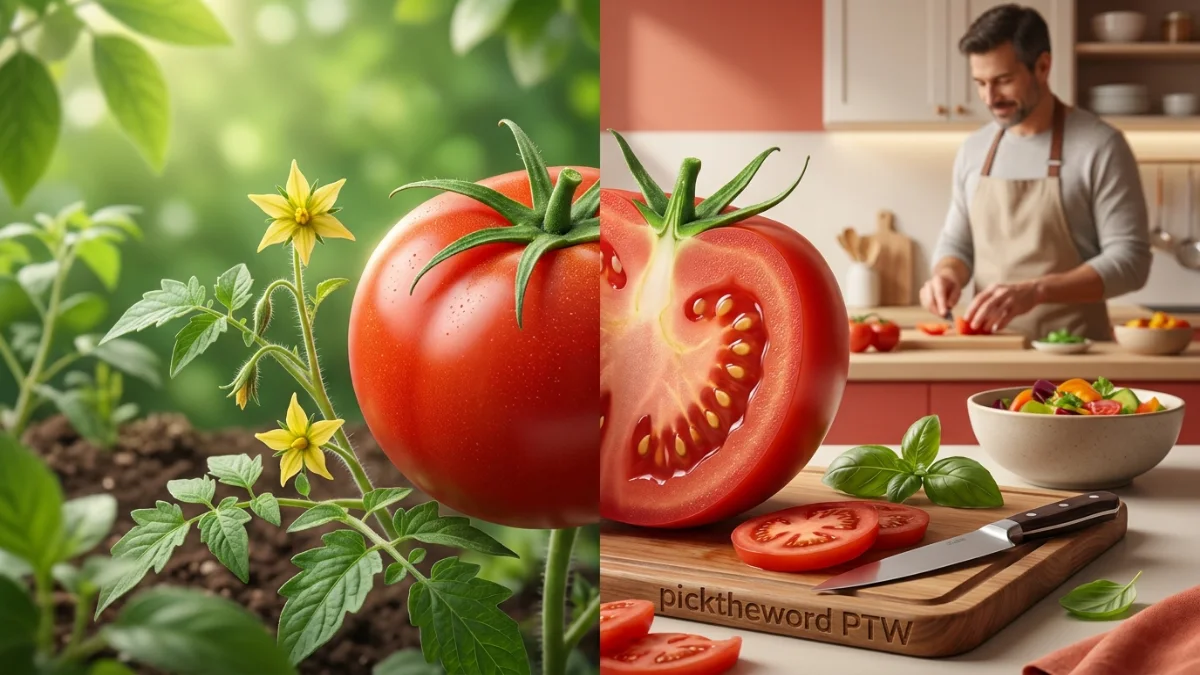
Botanically, a tomato is a fruit because it grows from a flower and holds the seeds of the plant. But in cooking and everyday language, a tomato is treated as a vegetable because of its savory taste and how it’s used in meals. So the short version is: fruit by science, vegetable by tradition and taste.
Why This Question Confuses So Many People
Most food arguments don’t come with an actual legal ruling attached but this one does. In 1893, the U.S. Supreme Court had to decide whether tomatoes should be taxed as vegetables under trade law. They ruled that, for everyday purposes, tomatoes count as vegetables because that’s how people eat and serve them, even though science says otherwise. That single decision is a big reason this debate still pops up generations later.
The real issue is that “fruit” and “vegetable” don’t mean the same thing to a scientist as they do to a chef. One side is talking about biology. The other is talking about flavor and cooking habits. Once you separate those two ideas, the whole mystery falls apart.
The Botanical Definition: Why Tomatoes Are Fruits
In botany, a fruit is simply the part of a plant that develops from a flower and contains the seeds. That’s it, no rule about sweetness, no rule about how it’s eaten. By that definition, tomatoes clearly qualify. They grow from the tomato plant’s flower, and the seeds sit right inside the flesh.
Using this same rule, several other foods people call “vegetables” are technically fruits too:
- Cucumbers
- Zucchini
- Bell peppers
- Pumpkins
- Eggplants
- Peas (the pods)
So tomatoes aren’t some rare exception; they belong to a whole group of foods that are botanically fruits but culturally treated as vegetables.
The Culinary Definition: Why We Call Tomatoes Vegetables
Cooking doesn’t follow plant science. Instead, it groups foods based on taste and how they’re used in a meal. Vegetables are usually thought of as savory, often eaten in main dishes, soups, salads, or side dishes. Fruits are usually sweet and eaten as snacks or desserts.
Since tomatoes taste savory rather than sweet, and they usually show up in sauces, salads, and sandwiches instead of fruit bowls, home cooks and chefs naturally call them vegetables. This isn’t wrong, it’s just a different system built around flavor and usage instead of biology.
Fruit vs. Vegetable: A Simple Comparison
| Category | Based On | Tomato’s Classification |
|---|---|---|
| Botany (Science) | How the plant grows the food | Fruit |
| Culinary (Cooking) | Taste and how it’s used in meals | Vegetable |
| Legal/Trade (Historical) | Everyday use and common sense | Vegetable |
Once you see it laid out this way, it’s clear both answers can be true at the same time they’re just answering different questions.
Common Confusion Points
“If it has seeds, doesn’t that automatically make it a fruit?”
Mostly yes, but people forget that plenty of “vegetables” we eat daily like cucumbers and peppers also have seeds and are technically fruits too. Tomatoes aren’t unique in this way; they just get the most attention.
“Why did the Supreme Court get involved with a food question?”
It wasn’t really about food facts, it was about trade taxes. Vegetables were taxed differently from fruits at the time, so the court needed a practical definition based on how people used tomatoes, not how botanists defined them.
“So is one answer more correct than the other?”
Not exactly. If you’re studying biology, “fruit” is the accurate scientific term. If you’re cooking, shopping, or talking casually, “vegetable” is the commonly accepted term. Context decides which one fits.
Usage Examples
Formal / Academic Writing
- “Botanically speaking, the tomato is classified as a fruit because it develops from the ovary of a flowering plant.”
- “Despite its scientific classification, the tomato is commonly categorized as a vegetable in culinary contexts.”
- “The 1893 Supreme Court ruling determined that tomatoes should be treated as vegetables for trade purposes.”
- “In plant biology, a fruit is defined by its role in seed development rather than by taste.”
Informal / Conversational Writing
- “Wait, tomatoes are actually fruits? I always thought they were vegetables.”
- “I still call tomatoes vegetables because that’s how my mom always cooked them.”
- “It’s wild that cucumbers and peppers are technically fruits too.”
- “My teacher explained that tomatoes are fruits in science class, but nobody puts them in a fruit salad.”
Everyday/Practical Usage
- “Add a chopped tomato to the vegetable stir fry.”
- “This recipe calls for two ripe tomatoes and one onion.”
- “At the farmer’s market, tomatoes are sold in the vegetable section.”
- “She grows tomatoes in her vegetable garden every summer.”
Notice how the “scientific” sentences use the word fruit, while the everyday cooking sentences naturally lean toward vegetables. Both are completely normal and correct in their own context.
Common Mistakes Learners Make
Mistake 1:
Assuming one answer is simply wrong
❌ “People who call tomatoes vegetables don’t know science.”
✅ “People call tomatoes vegetables based on cooking traditions, not scientific classification.”
This isn’t a mistake of fact, it’s a mistake of tone. Both classifications are valid; they just come from different fields.
Mistake 2:
Thinking sweetness always defines a fruit
❌ “Tomatoes can’t be fruits because they aren’t sweet.”
✅ “Sweetness isn’t part of the scientific definition of a fruit seed development is.”
Many learners assume “fruit” always means sweet, but that’s a culinary idea, not a biological one.
Mistake 3:
Believing tomatoes are the only confusing case
❌ “Tomatoes are the only vegetable that’s actually a fruit.”
✅ “Tomatoes are one of several foods, including peppers and cucumbers, that are botanically fruits but culinarily treated as vegetables.”
Similar or Confused Foods
- Cucumber:
Grows from a flower with seeds inside, technically a fruit, but used like a vegetable.
- Avocado:
Often mistaken for a vegetable because of its savory use, but it’s a fruit both scientifically and in food terms.
- Pumpkin:
Frequently used in savory cooking, yet it’s classified as a fruit botanically.
- Rhubarb:
The opposite situation: it’s technically a vegetable, but it’s usually treated and cooked like a fruit in desserts.
Modern Usage Preferences
In everyday English, especially in the U.S., U.K., and most English speaking countries, “vegetable” remains the standard word for tomatoes in recipes, grocery stores, and daily conversation. The scientific term “fruit” mostly shows up in classrooms, science writing, or trivia conversations. Neither usage is fading they simply serve different purposes depending on whether you’re cooking or studying biology.
Quick Tips to Remember
- Science looks at how a food grows; cooking looks at how it tastes and is used.
- If it has seeds and grew from a flower, it’s a fruit in biology no matter how it tastes.
- Savory and used in main dishes? Most people will call it a vegetable, tomato included.
- Remember cucumbers, peppers, and pumpkins tomatoes have plenty of company in this fruit vegetable mix up.
- When writing or speaking casually, “vegetable” is completely acceptable; save “fruit” for science based explanations.
FAQs
Is a tomato a fruit or a vegetable?
A tomato is a fruit by scientific definition because it grows from a flower and contains seeds, but it’s commonly called a vegetable in cooking due to its savory taste.
Why did the Supreme Court say tomatoes are vegetables?
In 1893, the court ruled tomatoes as vegetables for trade tax purposes, based on how people commonly used and served them, not on botanical classification.
What other vegetables are actually fruits?
Cucumbers, zucchini, bell peppers, pumpkins, eggplants, and pea pods are all botanically fruits, even though people usually call them vegetables.
Does sweetness decide if something is a fruit?
No. In biology, a fruit is defined by how it develops from a flower and holds seeds, not by whether it tastes sweet.
Is it wrong to call a tomato a vegetable?
No, it’s not wrong. It’s simply based on culinary tradition rather than scientific classification, and both usages are accepted depending on context.
Why do tomatoes get more attention than other fruit vegetables like cucumbers?
Mostly because of the famous Supreme Court case and the fact that tomatoes are used so heavily in savory cooking worldwide, making the contrast feel more surprising.
Should I say “fruit” or “vegetable” when talking about tomatoes?
Use “fruit” in science or academic contexts, and use “vegetable” in cooking, shopping, or everyday conversation both are correct in their own setting.
Conclusion
Tomatoes sit right at the crossroads of science and cooking, which is exactly why this question refuses to go away. Biologically, they’re fruits. In the kitchen and in everyday language, they’re vegetables. Neither side is wrong they’re just measuring different things.
Once you know the difference between botanical and culinary classification, you’ll never get stuck in this debate again.