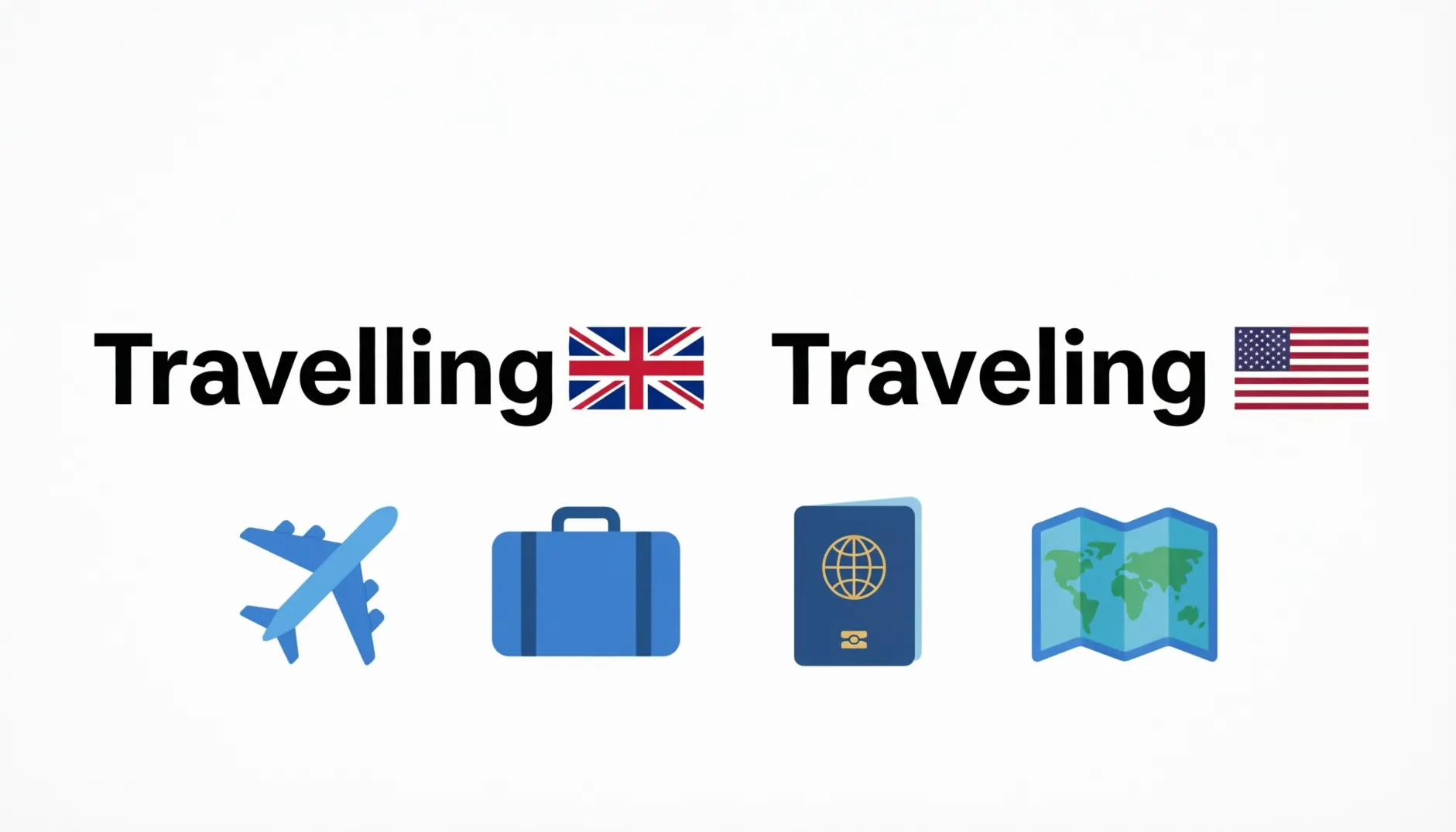
Have you seen both travelling and traveling and wondered which one is correct?
The good news is that both spellings are correct. The difference is not about grammar or meaning. It mainly depends on whether you use British English or American English.
Many English learners get confused because books, websites, movies, and social media often use different spellings.
This guide will help you understand when to use each one and avoid common mistakes.
Quick Answer
Travelling and traveling have the same meaning. Both refer to the act of going from one place to another.
- Travelling = Preferred in British English
- Traveling = Preferred in American English
Choose the spelling that matches the type of English you are using and stay consistent throughout your writing.
What Do Travelling and Traveling Mean?
Both words come from the verb travel, which means to move from one place to another for work, study, vacation, or other reasons.
Examples:
- I enjoy traveling during summer vacations.
- She is travelling across Europe this year.
- They spent months traveling around the world.
The meaning does not change regardless of which spelling you use.
Why Are There Two Different Spellings?
The difference comes from spelling conventions in different English speaking countries.
In British English, many words double the final consonant before adding ing when the stress pattern allows it.
Examples:
| British English | American English | Meaning |
|---|---|---|
| travelling | traveling | to go from one place to another |
| cancelled | canceled | stopped or called off |
| modelling | modeling | working as a model / making models |
| traveller | traveler | a person who travels |
American English often prefers a simpler spelling with a single l, while British English usually keeps the double ll.
Travelling vs Traveling: The Main Difference
The only real difference is regional preference.
| Word | Used Mainly In |
|---|---|
| Travelling | United Kingdom, Australia, New Zealand, Ireland, and many Commonwealth countries |
| Traveling | United States |
Examples:
British English
- We are travelling to London next week.
- She loves travelling by train.
American English
- We are traveling to New York next week.
- She loves traveling by train.
Both sentences are correct.
Which Spelling Should You Use?
The answer depends on your audience.
Use “Travelling” If:
- You write in British English.
- Your school follows British spelling rules.
- You are writing for readers in the UK, Australia, or similar regions.
Use “Traveling” If:
- You write in American English.
- Your audience is mainly in the United States.
- Your organization follows American style guides.
The most important rule is consistency.
For example, if you use American spelling, write:
- traveling
- traveler
- traveled
Do not mix them with British spellings in the same document.
Is One More Correct Than the Other?
No.
Neither spelling is more correct.
Many learners assume that one version is a mistake, but that is not true.
English has several accepted spelling differences between regions.
Examples
| British English | American English | Meaning |
|---|---|---|
| travelling | traveling | going from place to place |
| colour | color | hue or shade |
| favourite | favorite | most liked |
| centre | center | middle point or place |
| organise | organize | arrange or plan |
Just like these examples, travelling and traveling are both standard spellings.
How the Double “L” Rule Works
This spelling difference comes from a common rule about adding suffixes such as ing or ed.
In British English, words ending in l often double the letter before adding a suffix.
Examples:
- travel → travelling
- cancel → cancelling
- fuel → fuelling
In American English, the extra l is often removed.
Examples:
- travel → traveling
- cancel → canceling
- fuel → fueling
This is why both versions exist.
Examples of Travelling and Traveling in Different Types of Writing
Formal Writing
- The company is traveling internationally to meet clients.
- The delegation is travelling throughout Europe this month.
- Employees traveling abroad must complete the required documents.
- Researchers travelling overseas received additional funding.
Informal Writing
- I’m traveling with friends this weekend.
- We are travelling to the beach tomorrow.
- She loves traveling alone.
- Are you travelling during the holidays?
Academic Writing
- The study examined the experiences of students traveling abroad.
- Data were collected from participants travelling between countries.
- Traveling can improve cultural awareness and communication skills.
- Researchers analyzed the effects of travelling on mental well being.
12 Everyday Example Sentences
- I am traveling to Canada next month.
- She enjoys travelling by train.
- We spent the summer traveling across the country.
- They are travelling through Asia.
- Traveling helps people learn about new cultures.
- He loves travelling with his family.
- The team is traveling for an important competition.
- We were travelling when the storm began.
- She has been traveling for six months.
- My parents enjoy travelling during retirement.
- Traveling can be expensive without planning.
- They are travelling around the world together.
Common Mistakes Learners Make
Many mistakes happen because learners mix British and American spelling styles.
| Incorrect | Correct |
|---|---|
| I am travelling to New York. (in a fully American style document) | I am traveling to New York. |
| I am traveling to London. (in a fully British style document) | I am travelling to London. |
| Traveling and traveller in the same British document | Travelling and traveller |
| Travelling and traveler in the same American document | Traveling and traveler |
Why Learners Get Confused
- Both spellings appear online.
- Search engines show results from different countries.
- Movies, books, and websites use different English varieties.
- Spell checkers may follow different language settings.
Related Words and Spellings
When learning travelling and traveling, it helps to know other related forms.
| British English | American English | Meaning |
|---|---|---|
| traveller | traveler | a person who travels |
| travelled | traveled | went from place to place |
| travelling | traveling | the act of going from place to place |
| travelling abroad | traveling abroad | going to another country |
Examples:
- British: She is a frequent traveller.
- American: She is a frequent traveler.
Again, both are correct.
Modern Usage Preferences
Today, both spellings are widely accepted.
You may notice:
- American websites mostly use traveling.
- British websites mostly use travelling.
- International companies may use either style depending on their brand guidelines.
- Search engines understand both spellings.
Because English is used globally, readers generally recognize both forms without confusion.
Quick Tips to Remember
Easy Memory Trick
Think of it this way:
- British English likes double letters → travelling
- American English prefers simpler spellings → traveling
Simple Rule
- Writing in British English? Use travelling.
- Writing in American English? Use traveling.
Consistency Tip
Once you choose one style, use it throughout your entire document.
FAQ
Is travelling correct?
Yes. Travelling is the standard British English spelling.
Is traveling correct?
Yes. Traveling is the standard American English spelling.
Which spelling is more common?
Globally, both are common. In the United States, traveling is more common. In the UK and many Commonwealth countries, travelling is more common.
Why does British English use two Ls?
British spelling conventions often double the final l before adding endings such as ing and ed.
Should I use travelling or traveling in IELTS?
IELTS generally accepts both spellings. Just be consistent and avoid mixing British and American styles.
Is traveller or traveler correct?
Both are correct.
- Traveller = British English
- Traveler = American English
Can I mix both spellings in the same article?
It is not recommended. Choose one English style and use it consistently.
Conclusion
The confusion between travelling and traveling is easier to understand than it first appears. Both spellings are correct and have exactly the same meaning. The only difference is regional preference.
Use travelling when following British English and traveling when following American English. Whichever spelling you choose, stay consistent throughout your writing.
Once you remember that British English usually keeps the double l and American English often uses a single l, you’ll rarely make this mistake again.