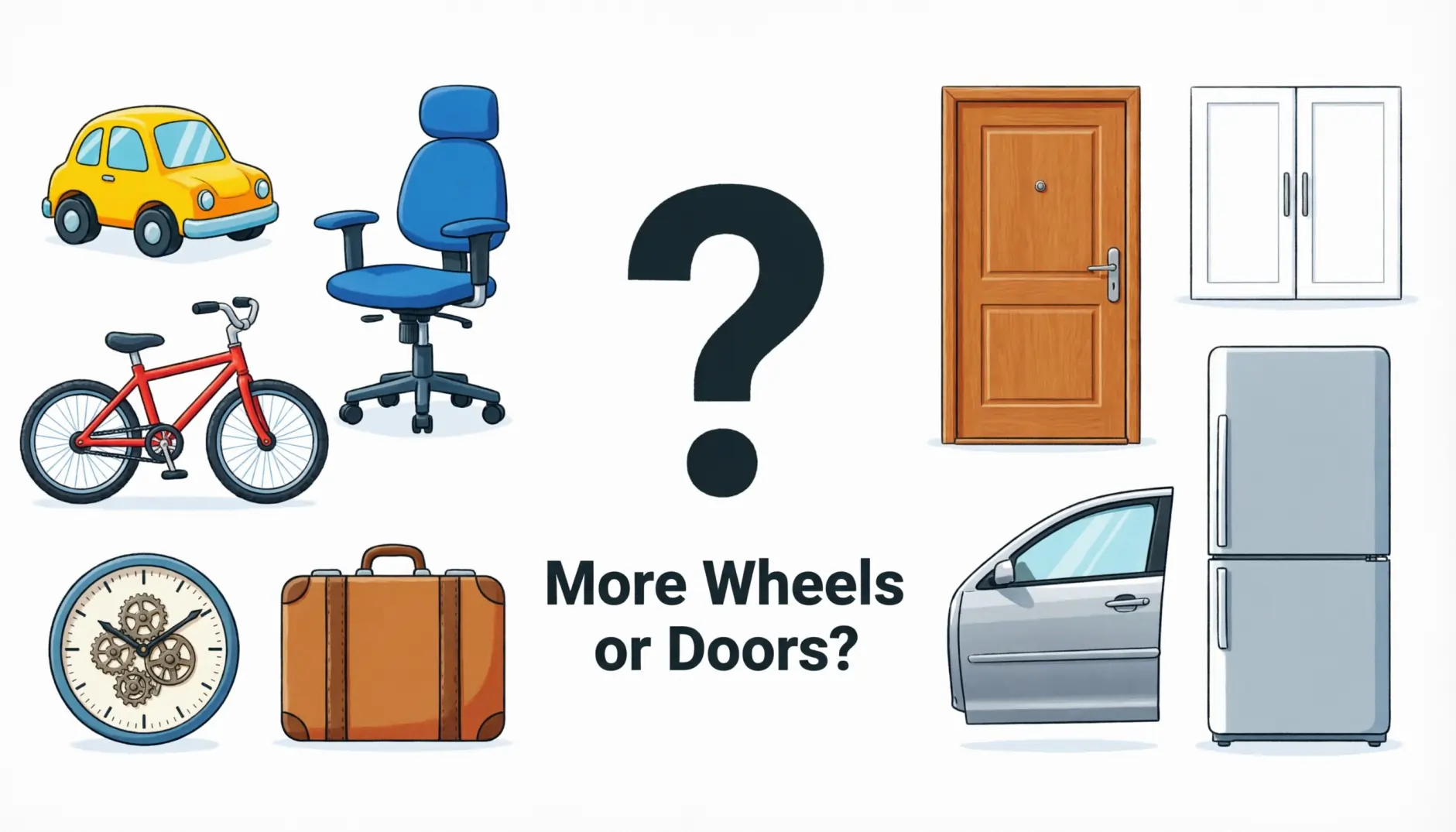
In 2026, a simple question broke the internet. Someone asked: Are there more wheels or doors in the world?
Within days, millions of people were arguing about it on Twitter, TikTok, and Reddit. Friends disagreed. Families debated at dinner tables. Even experts couldn’t agree.
But here’s the thing this isn’t just a fun internet debate. It’s actually a brilliant thinking exercise that teaches you how to look at the world differently.
And once you understand the logic behind each side, you’ll have a clear, confident answer ready. So let’s settle this once and for all.
Quick Answer
Most people who analyze this carefully believe wheels outnumber doors by a massive margin. When you count every tiny wheel on toys, office chairs, luggage, factory machines, and vehicles, the number runs into the hundreds of billions. Doors, while everywhere, simply can’t compete with that scale.
Where Did This Question Come From?
The debate started in March 2026 when a New Zealand man named Ryan Nixon posted a Twitter poll asking his followers which side they were on. He expected a few responses. Instead, the poll exploded. News outlets picked it up. Celebrities weighed in. The question trended globally.
Why did it go so viral? Because it sounds simple but isn’t. Everyone has a confident first reaction and then they start second-guessing themselves the moment someone makes a good point for the other side.
That’s what makes it such a fascinating question. It’s not about trivia. It’s about how you define things and how carefully you think.
Defining the Terms: What Counts as a Wheel or a Door?
Before you can answer this, you have to ask: What exactly counts?
This is where most debates fall apart. People argue past each other because they’re using different definitions.
What counts as a wheel?
- Car wheels and spare tires
- Bicycle wheels
- Wheels on office chairs (usually 5 per chair)
- Wheels on rolling suitcases
- Wheels on shopping carts and trolleys
- Toy car wheels (Hot Wheels alone has sold over 6 billion cars)
- Skateboard wheels
- Wheels inside clocks and watches (gears are wheels)
- Wheels on factory conveyor belts and machines
- Wheels on hospital beds and IV stands
- Steering wheels
- Spinning wheels in turbines and engines
- Wheels in fidget spinners and fans
What counts as a door?
- Front doors and back doors of homes
- Interior room doors
- Car doors
- Cabinet doors and kitchen cupboard doors
- Refrigerator doors
- Elevator doors
- Microwave doors
- Oven doors
- Washing machine doors
- Garage doors
- Safe doors
- Trap doors
Once you expand your thinking this way, the picture changes completely.
The Case for Wheels
Let’s look at the numbers, even roughly.
There are approximately 1.4 billion cars in the world. Each car has at least 4 wheels but don’t forget the spare tire in the boot. That’s 5 wheels per car just to start. Now add the steering wheel. That’s 6. Some people even count the wheels inside the engine and gear system, pushing that number higher.
So just from cars: 1.4 billion × 6 = 8.4 billion wheels from cars alone.
Now consider this:
- Hot Wheels toy cars the company has sold over 6 billion toy cars since 1968. Each has 4 wheels. That’s 24 billion wheels from one toy brand.
- Office chairs there are hundreds of millions of office chairs worldwide, each with 5 small wheels (called casters).
- Lego wheels Lego produces approximately 318 million tiny wheels per year. They may actually be the world’s largest wheel manufacturer by unit count.
- Rolling suitcases, hospital equipment, factory machines, bicycles, motorcycles, trucks all adding billions more.
By conservative estimates, the total number of wheels in the world could easily be in the hundreds of billions.
The Case for Doors
Door supporters make a strong argument too, and it’s worth taking seriously.
Think about how many doors are in a single house. A typical three-bedroom home might have:
- 1 front door
- 1 back door
- 3 bedroom doors
- 1 bathroom door
- 1 kitchen door
- Multiple cabinet doors (easily 10 20)
- Wardrobe doors
- Refrigerator door
- Microwave door
- Oven door
That’s easily 25 35 doors in one average home before you even leave the house.
Now multiply that by 8 billion people living in homes, apartments, and buildings worldwide. Add office buildings, schools, hospitals, shopping malls, and factories. Each of these structures has hundreds or thousands of doors.
Some estimates suggest the total number of doors in the world could be in the tens of billions. That’s genuinely impressive.
But here’s the problem for Team Door: the same expansion logic that gives doors a boost gives wheels an even bigger one. For every new building with 50 doors, there are factories full of machines, warehouses full of carts, and shelves full of toys all with wheels.
Breaking It Down: Simple Comparison
| Category | Estimated Wheels | Estimated Doors |
|---|---|---|
| Cars worldwide | 8+ billion | 5–6 billion (car doors) |
| Hot Wheels toys | 24+ billion | — |
| Office chairs | 1+ billion | — |
| Lego wheels (annual) | 318 million | — |
| Home cabinet doors | — | Tens of billions |
| Bicycles | 2+ billion wheels | — |
| Factory/industrial machines | Hundreds of billions | Millions |
The numbers are estimates, of course. Nobody has counted every wheel or door on Earth. But the weight of logic tilts firmly toward wheels.
Common Mistakes in This Debate
Mistake 1: Only thinking about cars and houses
Most people picture car wheels and home doors. That’s natural. But the moment you zoom out to toys, machines, furniture, and factory equipment wheels expand at a rate that doors simply can’t match.
Wrong thinking: “Cars have 4 wheels and 4 doors, so they’re equal.” Better thinking: “Cars have 4 doors but also a steering wheel, a spare tire, and possibly wheels in the engine system. Plus there are toy cars, office chairs, and luggage carts to think about.”
Mistake 2: Forgetting tiny wheels
A single clock can have dozens of gear-wheels inside it. A wristwatch has even more. When you count these, the wheel count skyrockets in a way most people never expect.
Mistake 3: Assuming doors win because buildings are huge
Yes, a skyscraper has hundreds of doors. But a single toy factory produces millions of wheel-equipped items every week. Scale matters differently for each category.
What Do Experts and Analysts Say?
When business analysts and math enthusiasts tackled this problem seriously, the majority landed on wheels. The key reason is manufacturing scale. The global toy industry alone produces items with wheels at a rate that outpaces new construction worldwide.
One widely shared analysis pointed out that Lego’s wheel production alone makes them arguably the biggest wheel manufacturer on the planet by unit count and that’s just one company making plastic toys.
The door camp has a fighting chance only if you define “door” very broadly including things like flaps, hatches, and lids. But even then, wheels have an equivalent expansion (gears, casters, rollers) that keeps them ahead.
Why This Question Is Actually Good for Your Brain
Here’s something most articles won’t tell you: this debate is a genuine exercise in critical thinking and semantic precision.
It teaches you to:
- Define your terms carefully before arguing a point
- Think at scale rather than just using personal experience
- Consider categories you’d normally overlook
- Revise your opinion when new evidence appears
These are exactly the skills that make someone a strong reader, writer, and thinker in English and in life.
Quick Tips to Remember
- Start with definitions. Any good debate begins with agreeing on what you’re actually counting.
- Think beyond the obvious. Wheels aren’t just on cars. Doors aren’t just on houses.
- Scale changes everything. A toy company making billions of four-wheeled cars flips the equation fast.
- The answer most analysts agree on: Wheels win largely thanks to toys, industrial machines, and small casters on everyday furniture.
- There’s no official count, so the “correct” answer depends partly on your definitions and that’s okay. The thinking matters more than the answer.
FAQ
Are there really more wheels than doors in the world?
Most careful analyses say yes. When you include toy wheels, gear wheels, casters on furniture, and industrial machinery, wheels far outnumber doors in sheer quantity.
Who started the wheels vs doors debate?
A New Zealander named Ryan Nixon posted a Twitter poll in March 2026. It went viral almost instantly and sparked a global conversation.
Does a steering wheel count as a wheel?
In most analyses, yes. A steering wheel is a wheel by definition it’s round, it rotates, and it’s called a wheel. That adds at least one extra wheel per vehicle.
Do cabinet doors count in the debate?
Yes, and this is actually a strong point for Team Door. A single kitchen can have 15 20 cabinet doors, which adds up fast across millions of homes.
What about Lego wheels?
Lego produces around 318 million wheels per year and may be the largest wheel manufacturer in the world by unit count. This single fact gives Team Wheel a huge boost.
Is there a definitive scientific answer?
No. Nobody has counted every wheel and door on Earth. But logical estimates based on manufacturing data, population, and vehicle counts strongly favor wheels.
Does a revolving door count as one door or many?
Great question and exactly the kind of definitional debate that makes this topic so interesting. Most people count it as one door. But technically, a standard revolving door has four panels, which some argue means four doors.
Conclusion
So, are there more wheels or doors in the world? Based on careful thinking and rough estimates, wheels almost certainly win and by a lot.
The moment you stop thinking only about cars and houses, and start considering toys, office chairs, factory machines, clocks, and luggage carts, the wheel count explodes into the hundreds of billions.
But honestly, the best part of this question isn’t the answer. It’s the thinking it forces you to do. You learn to define your terms. You learn to think at scale. You learn to question your first instinct.
And that, more than any trivia answer, is what makes this debate genuinely worth having.

Hi, I’m Virginia Woolf, a language enthusiast passionate about exploring the power of words and their meanings. I specialize in helping readers choose the right words through clear comparisons, synonyms, and practical usage. My goal is to make vocabulary learning simple, engaging, and useful for everyday communication. picktheword.com