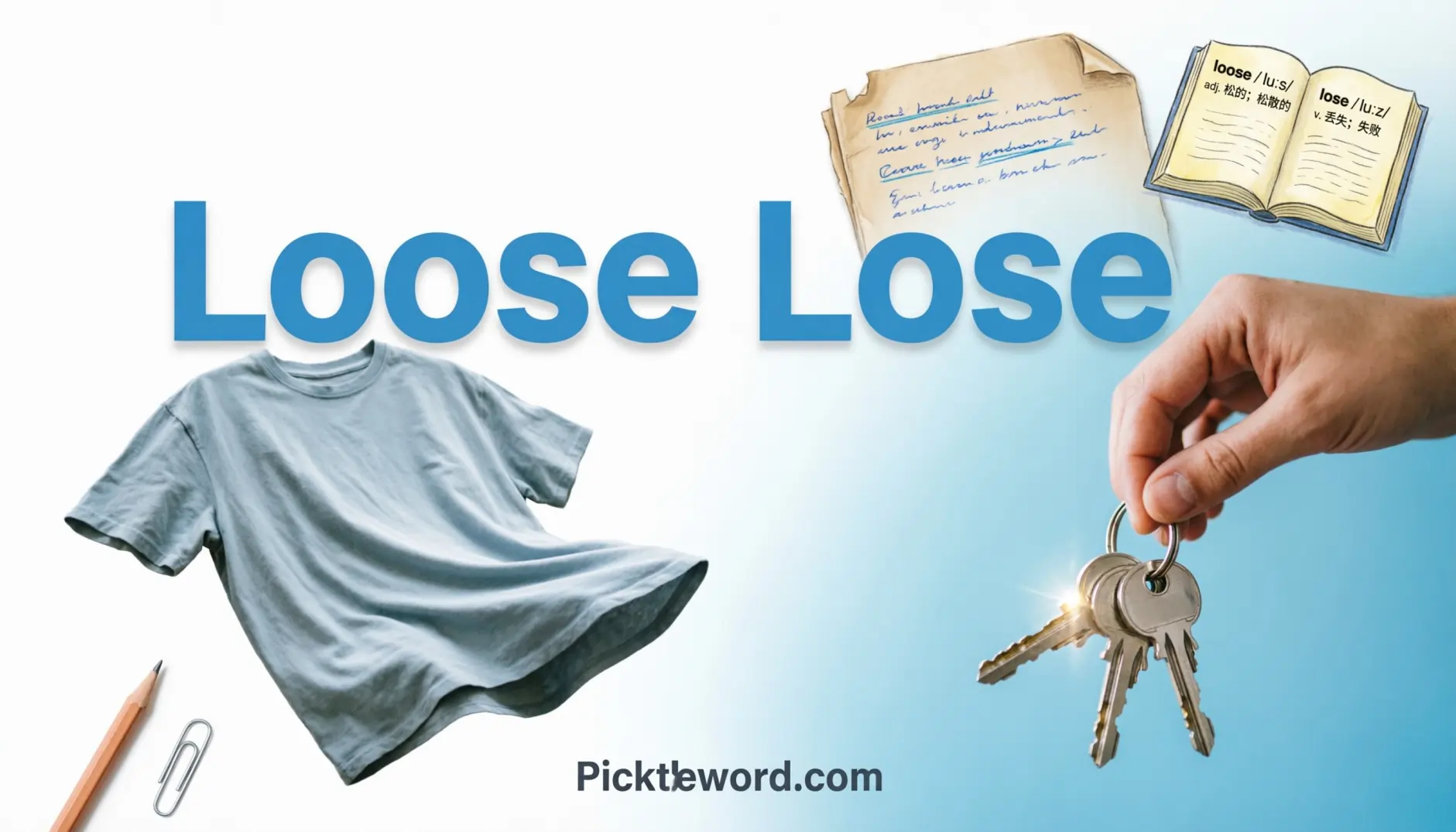
Do you sometimes write “I don’t want to loose my keys” instead of “lose my keys”? You are not alone. Many English learners and even native speakers confuse loose and lose because the words look very similar.
But these two words have completely different meanings. Using the wrong one can make your writing look confusing or incorrect, especially in emails, school assignments, social media posts, and professional communication.
In this guide, you will learn the difference between loose and lose in the easiest way possible. We will look at meanings, spelling patterns, examples, grammar tips, and memory tricks so you never mix them up again.
Quick Answer
Loose is usually an adjective that means not tight or free.
Example: My shirt is too loose.
Lose is a verb that means to misplace something or not win.
Example: I don’t want to lose my phone.
The easiest way to remember it is:
- Loose = extra “o” = extra space
- Lose = action verb
What Does “Loose” Mean?
The word loose usually describes something that is not tight, fixed, or secure.
It is most commonly used as an adjective.
Simple Meaning of Loose
- Not tight
- Free from attachment
- Relaxed
- Not controlled
Examples of Loose
- My shoes are too loose.
- The dog got loose from the yard.
- She wore a loose jacket.
- There is a loose screw in the chair.
Common Uses of Loose
| Usage | Meaning | Example |
|---|---|---|
| Clothing | Not tight | These jeans are loose. |
| Objects | Not fixed properly | The handle is loose. |
| Animals | Free or escaped | The horse is loose. |
| Hair | Not tied | She left her hair loose. |
Is “Loose” a Verb Too?
Yes, but it is less common.
As a verb, loose means to release something.
Example:
- The soldiers loosed the arrows.
This use is mostly found in old-fashioned or literary English.
What Does “Lose” Mean?
The word lose is a verb. It describes an action.
Simple Meaning of Lose
- To misplace something
- To fail to keep something
- To fail to win
- To become less of something
Examples of Lose
- I always lose my socks.
- Our team might lose the game.
- She wants to lose weight.
- Don’t lose hope.
Common Uses of Lose
| Usage | Meaning | Example |
|---|---|---|
| Misplacing items | Cannot find something | I lost my wallet. |
| Sports or games | Not winning | They lost the match. |
| Weight or money | Reduction | He lost five kilos. |
| Emotions or control | Stop having something | She lost her patience. |
Verb Forms of Lose
| Form | Example |
|---|---|
| Base verb | lose |
| Past tense (V2) | lost |
| Past participle (V3) | lost |
| Present participle | losing |
Examples:
- I lose things often.
- Yesterday, I lost my keys.
- She is losing confidence.
What Is the Main Difference Between Loose and Lose?
The biggest difference is grammar and meaning.
Loose vs Lose
| Word | Part of Speech | Meaning | Example |
|---|---|---|---|
| Loose | Adjective | Not tight | My shirt is loose. |
| Lose | Verb | Misplace or fail to win | Don’t lose your bag. |
Simple Trick
If the word describes something, use loose.
If the word shows an action, use lose.
Why Do People Confuse Loose and Lose?
There are several reasons why learners mix these words up.
1. They Look Similar
Both words have:
- The letters l-o-s
- Similar spelling patterns
Only one extra “o” changes the meaning completely.
2. Pronunciation Is Tricky
The pronunciation is different:
| Word | Pronunciation |
| Loose | “loos” |
| Lose | “looz” |
Even though lose has only one “o,” it sounds like it has a “z” sound.
3. Fast Typing Mistakes
People often type quickly online and accidentally write:
- loose weight instead of lose weight
This mistake is extremely common on social media.
Are Loose and Lose Interchangeable?
No. These words are not interchangeable.
Using the wrong word changes the meaning of the sentence.
Incorrect vs Correct Examples
| Incorrect | Correct |
| I don’t want to loose my phone. | I don’t want to lose my phone. |
| These pants are lose. | These pants are loose. |
| We might loose the game. | We might lose the game. |
| Her bracelet is lose. | Her bracelet is loose. |
Loose vs Lose in Everyday English
Understanding real-life usage helps learners remember grammar faster.
In Daily Conversation
- “Your shoelaces are loose.”
- “Be careful not to lose your passport.”
In School or Academic Writing
- “Students may lose marks for spelling mistakes.”
- “Avoid writing in a loose structure.”
In Workplace Communication
- “Do not lose the client files.”
- “There is a loose connection in the cable.”
On Social Media
Many people incorrectly write:
- Trying to loose weight
The correct version is:
- Trying to lose weight
British vs American English Usage
Good news: both British and American English use these words the same way.
There is no spelling difference between UK and US English here.
| Region | Loose | Lose |
| American English | Same spelling | Same spelling |
| British English | Same spelling | Same spelling |
| Canadian English | Same spelling | Same spelling |
| Australian English | Same spelling | Same spelling |
Which Form Is More Common Globally?
Both words are common worldwide because they have different meanings.
However:
- Lose appears more often in daily communication because people frequently talk about losing things, games, money, or weight.
- Loose is common when describing clothing, objects, or physical fit.
Audience-Based Recommendation
For international communication:
- Use lose only for actions.
- Use loose only for descriptions.
This helps avoid confusion in emails, blogs, and professional writing.
Natural Example Sentences
Here are practical examples for different situations.
- My backpack strap feels loose.
- I don’t want to lose my homework again.
- The team may lose the final match.
- Her ring became loose after weight loss.
- Please do not lose this document.
- The dog got loose and ran outside.
- He worked hard to lose weight.
- One of the buttons on my shirt is loose.
- You could lose your job if you are always late.
- The wires are loose, so the light keeps blinking.
- I always lose my pens at school.
- She likes wearing loose clothes in summer.
Common Mistakes Learners Make
English learners often repeat the same errors with these words.
Mistake 1: “Loose Weight”
❌ Incorrect:
- I want to loose weight.
✅ Correct:
- I want to lose weight.
Why?
Because losing weight is an action, so you need the verb lose.
Mistake 2: “Lose Clothes”
❌ Incorrect:
- I prefer lose clothes.
✅ Correct:
- I prefer loose clothes.
Why?
The word describes clothing, so you need the adjective loose.
Mistake 3: Mixing Pronunciation
Some learners pronounce both words the same way.
Correct pronunciation:
- Loose = soft “s” sound
- Lose = “z” sound
Similar or Confused Words
English has many confusing word pairs like loose and lose.
1. Lose vs Lost
| Word | Meaning |
| Lose | Present/future action |
| Lost | Past form of lose |
Examples:
- I might lose my bag.
- Yesterday, I lost my bag.
2. Loose vs Loosen
| Word | Type | Meaning |
| Loose | Adjective | Not tight |
| Loosen | Verb | Make less tight |
Examples:
- The rope is loose.
- Please loosen the rope.
3. Choose vs Chose
Many learners confuse these words because of similar spelling patterns.
| Word | Meaning |
| Choose | Present tense |
| Chose | Past tense |
4. Advice vs Advise
Another common grammar confusion:
- Advice = noun
- Advise = verb
Learning these patterns helps improve spelling accuracy in English.
Historical and Spelling Background
The confusion between loose and lose partly comes from English spelling history.
Loose
The word comes from older Germanic roots meaning:
- free
- unattached
- relaxed
The double “o” stayed in the spelling over time.
Lose
The word comes from Old English and originally related to:
- destruction
- failure
- being unable to keep something
English pronunciation changed over centuries, but the spelling stayed similar.
That is why the words still confuse many learners today.
Google Trends and Usage Patterns
Online searches for “loose or lose” are very common because people often see spelling mistakes on:
- social media
- blogs
- YouTube comments
- text messages
One of the most searched phrases is:
- “lose weight or loose weight”
This shows that many English users are unsure about the correct spelling.
Regional Preferences
There is no major regional spelling difference between:
- the UK
- the US
- Canada
- Australia
The confusion happens globally among both native and non-native speakers.
Modern Internet Usage
Today, grammar correction tools often highlight:
- loose when people mean lose
This mistake is especially common in casual online writing.
Quick Tips to Remember
These memory tricks make learning easier.
Loose has two “o” letters → extra space → not tight
Example:
- loose pants
- loose shoes
Lose means losing something
Both words relate to action:
- lose keys
- lose money
- lose a game
If you can replace the word with:
- “not tight” → use loose
- “misplace/fail” → use lose
Think of this sentence:
“If your pants are too loose, you may lose them.”
This funny sentence helps many learners remember the difference.
FAQ
Is it “lose weight” or “loose weight”?
The correct phrase is lose weight because “lose” is a verb meaning to reduce something.
What does “loose” mean?
Loose means not tight, free, or not securely attached.
Example:
- The screw is loose.
Can “loose” be used as a verb?
Yes, but it is rare in modern English. It can mean to release something.
Example:
- The hunter loosed the arrow.
Why do people confuse loose and lose?
People confuse them because the spellings are similar, but the pronunciation and meanings are different.
Which is more common: loose or lose?
Both are common, but lose appears more often in everyday communication because people frequently talk about losing things, games, or weight.
Conclusion
The difference between loose and lose is simple once you understand the grammar.
- Loose describes something that is not tight.
- Lose is an action that means failing to keep something or not winning.
Even advanced English learners sometimes confuse these words, so do not worry if you have made this mistake before. With practice, examples, and memory tricks, you will quickly learn to use both words correctly.
Remember this easy rule:
Loose = description
Lose = action
Using the correct word will make your writing clearer, more professional, and easier to understand.

Hi, I’m Virginia Woolf, a language enthusiast passionate about exploring the power of words and their meanings. I specialize in helping readers choose the right words through clear comparisons, synonyms, and practical usage. My goal is to make vocabulary learning simple, engaging, and useful for everyday communication. picktheword.com