Have you ever typed “wether” when you meant “whether“? You’re not alone. These two words look almost the same, but they have completely different meanings.
The good news is that most people only need the word “whether.” The word “wether” is very rare and is mainly used in farming.
In this guide, you’ll learn the difference, see plenty of examples, avoid common mistakes, and remember the correct spelling with simple tricks.
Quick Answer
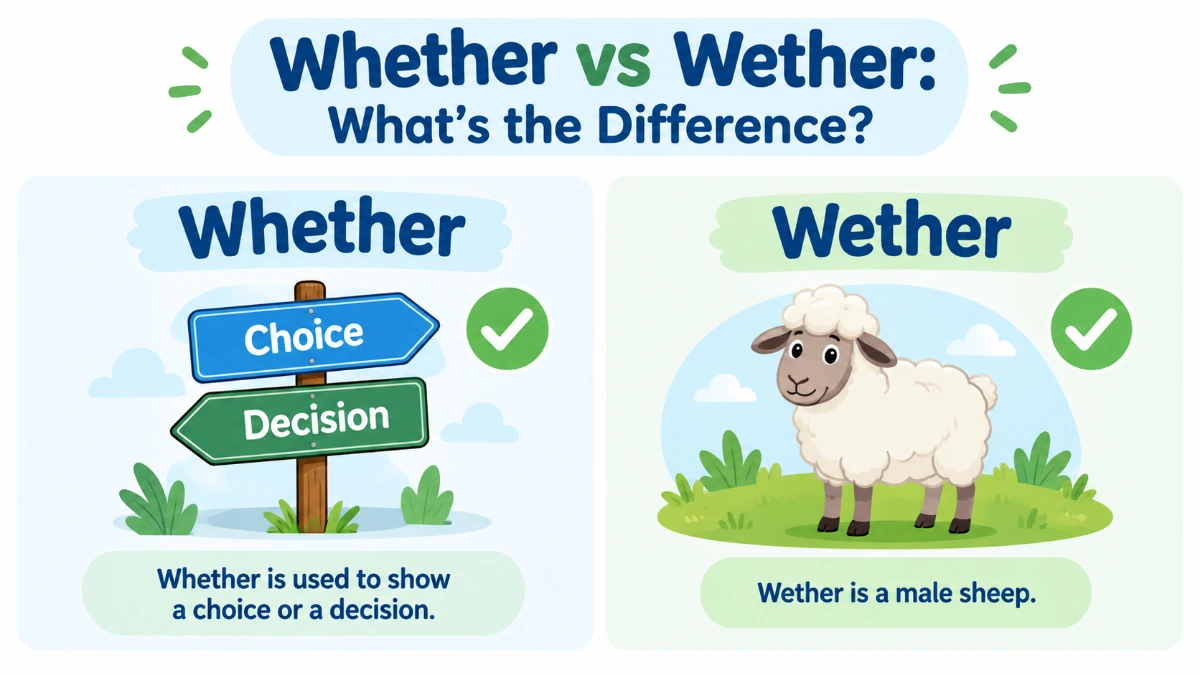
Whether is the correct word when you are talking about a choice, possibility, or uncertainty.
Wether is a noun that means a castrated male sheep. It is a farming term and is almost never used in everyday English.
Examples:
- ✅ I don’t know whether she will come.
- ✅ The farmer sold a wether at the market.
If you’re choosing between whether and wether in normal writing, you almost always want whether.
What Does “Whether” Mean?
Whether is a conjunction that introduces choices, alternatives, or uncertainty.
It often means:
- if
- which choice
- no matter which option
You use whether when there are two or more possibilities.
Examples:
- I can’t decide whether to stay or leave.
- She asked whether I liked coffee.
- We don’t know whether the train is late.
- Tell me whether you agree.
Think of whether whenever someone is making a decision or asking about different possibilities.
What Does “Wether” Mean?
Wether is a noun.
It means a castrated male sheep, usually one raised for wool or meat.
This word is mostly used by:
- Farmers
- Veterinarians
- Animal experts
- Agricultural writers
Most English learners will rarely see or use this word.
Examples :
- The wether grazed quietly in the field.
- The farmer separated the ewe from the wether.
- They raised several wethers on the farm.
Unless you’re writing about sheep or farming, you probably don’t need this word.
Whether vs Wether: The Main Difference
| WordPart of SpeechMeaningCommon? | |||
|---|---|---|---|
| Whether | Conjunction | Shows a choice, possibility, or uncertainty | Very common |
| Wether | Noun | A castrated male sheep | Rare |
A simple way to think about it:
- Whether = choice
- Wether = sheep
When Should You Use “Whether”?
Use whether whenever you’re talking about uncertainty or alternatives.
1. When Choosing Between Two Things
- I don’t know whether to study or sleep.
- Decide whether you want tea or coffee.
- She couldn’t choose whether to accept the offer.
2. After Verbs Like “Know,” “Ask,” and “Wonder”
These verbs often introduce uncertainty.
Examples:
- I wonder whether it will rain.
- She asked whether we were ready.
- They don’t know whether the meeting is canceled.
3. Before “Or Not”
This is one of the most common patterns.
Examples:
- Let me know whether or not you can come.
- I’m unsure whether or not it’s true.
- We haven’t decided whether or not to move.
Sometimes you can simply say:
- Let me know whether you can come.
Both are correct.
4. In Formal Writing
Formal English often prefers whether instead of if when introducing alternatives.
Example:
- Please confirm whether you received the email.
This sounds slightly more formal than:
- Please confirm if you received the email.
Can “Whether” and “If” Mean the Same Thing?
Sometimes.
These are both correct:
- I don’t know whether he’ll come.
- I don’t know if he’ll come.
But there are situations where whether is the better or only correct choice.
Use whether:
- before or not
- after a preposition
- when showing clear alternatives
Examples:
- ✅ It depends on whether we finish early.
- ❌ It depends on if we finish early.
- ✅ We discussed whether to travel.
- ❌ We discussed if to travel.
When in doubt, whether is usually the safer choice in formal writing.
Why Do People Confuse Whether and Wether?
The confusion happens because:
- They look almost identical.
- They sound nearly the same.
- Spell check may not catch the mistake because both are real English words.
However, they belong to completely different categories.
- Whether = grammar word
- Wether = animal
Usage Examples
Formal Writing
- Please indicate whether you accept the terms.
- The committee will decide whether the proposal is approved.
- Researchers examined whether the treatment was effective.
Informal Writing
- I don’t know whether I’ll be there.
- Tell me whether you’re free tonight.
- We’re still deciding whether to order pizza.
Academic Writing
- The study explored whether exercise improves memory.
- Scientists investigated whether climate affected migration.
- The report analyzed whether the policy achieved its goals.
Farming Example
- The veterinarian examined the wether before transport.
- The farmer kept one wether with the flock.
Common Mistakes
Here are mistakes learners often make.
| Incorrect | Correct | Why? |
|---|---|---|
| I don’t know wether to go. | I don’t know whether to go. | Talking about a choice, not a sheep. |
| Tell me wether you’re coming. | Tell me whether you’re coming. | Use whether for uncertainty. |
| The whether grazed in the field. | The wether grazed in the field. | Here you’re talking about an animal. |
| It depends on if we leave early. | It depends on whether we leave early. | Whether follows a preposition. |
Most spelling mistakes happen because people have heard the word but never noticed the different spellings.
Similar and Commonly Confused Words
Whether vs If
Both can introduce uncertainty, but whether is often preferred in formal English and is required in certain grammar patterns.
Weather vs Whether
These are commonly confused because they sound alike.
- Weather = rain, sun, wind, snow
- Whether = choice or uncertainty
Examples:
- The weather is beautiful today.
- I don’t know whether to go outside.
Wether vs Weather
These two words are completely unrelated.
- Weather = climate
- Wether = male sheep
Remember:
- Weather belongs in forecasts.
- Wether belongs on farms.
Is “Wether” Ever Used in Modern English?
Yes, but very rarely.
You’ll mostly find wether in:
- farming books
- livestock guides
- veterinary writing
- agricultural discussions
For everyday conversations, emails, school assignments, and business writing, you’ll almost always use whether instead.
Quick Tips to Remember
Here are a few easy memory tricks.
- Whether = choice. Both contain the letter H, which can remind you of having a choice.
- Wether = sheep. Think of the shorter word as a special farming term.
- If your sentence could mean “if,” you almost certainly need whether.
- If your sentence mentions livestock or farming, wether might be correct.
- When writing formally, choose whether instead of if when introducing alternatives.
FAQs
Is “wether” a real English word?
Yes. It means a castrated male sheep and is mainly used in agriculture.
Which spelling is correct: whether or wether?
It depends on the meaning. For choices or uncertainty, use whether. For the farming term, use wether.
Why does spell check not fix “wether”?
Because wether is a correctly spelled English word, even though it’s rarely used.
Can I use “if” instead of “whether”?
Sometimes. However, whether is preferred in formal writing and required in certain grammar situations, such as after prepositions or before or not.
Is “whether or not” always necessary?
No. Often you can simply write whether.
- Let me know whether you can come.
- Let me know whether or not you can come.
Both are correct.
What is the easiest way to remember the difference?
Remember this:
- Whether = choice
- Weather = climate
- Wether = sheep
Is “wether” commonly used?
No. Most native English speakers rarely use it unless they’re discussing farming or livestock.
Conclusion
Although whether and wether differ by just one letter, they have completely different meanings.
Use whether when talking about choices, uncertainty, or alternatives. This is the word you’ll use in almost every piece of everyday English.
Use wether only when referring to a castrated male sheep, a specialized farming term that most learners will rarely need.
Whenever you’re unsure, ask yourself one simple question:
Am I talking about a choice or a sheep?
If it’s a choice, the correct word is whether.