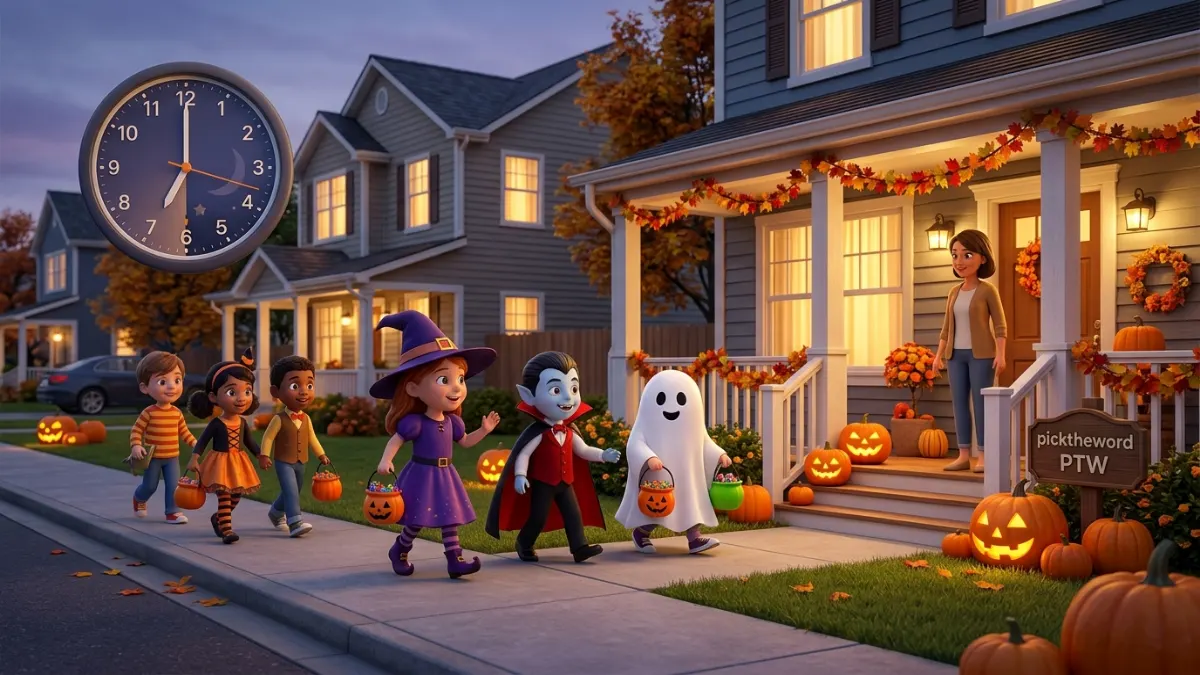
If you are wondering what time trick or treating starts and ends, you are not alone. Many families ask about trick or treat hours because the schedule can be different from one town, neighborhood, or event to another.
In most places, trick or treating happens on Halloween evening, October 31, usually starting around 5:30 or 6:00 p.m. and ending around 8:00 or 9:00 p.m.
However, there is no single nationwide time that applies everywhere. Some communities set official hours, while others simply follow local tradition.
Quick Answer
There is no universal trick or treating schedule. In many neighborhoods, children go door to door from about 5:30 to 6:00 p.m. until 8:00 to 9:00 p.m. on Halloween. Always check your local town, school, community group, or neighborhood for official hours.
What Are Trick or Treat Hours?
Trick or treat hours are the usual or officially announced times when children go from house to house asking for Halloween candy.
During this time, children often wear costumes and visit homes in their neighborhood. They knock on the door or ring the bell and say, “Trick or treat!” The person answering the door usually gives them candy or another small treat.
The important thing to remember is that trick or treat hours are not the same everywhere.
For example:
- One town may allow trick or treating from 5:00 to 7:00 p.m.
- Another may suggest 6:00 to 8:00 p.m.
- A neighborhood may continue until 9:00 p.m.
- A local Halloween event may have completely different hours.
So, if you need the exact time for your area, look for a local announcement rather than relying only on a general Halloween schedule.
What Time Does Trick or Treating Usually Start?
In many communities, trick or treating starts between 5:00 and 6:30 p.m.
The exact starting time can depend on several things:
- The age of the children
- Sunset time
- Local rules
- School schedules
- Weather
- Neighborhood traditions
- Whether Halloween falls on a weekday or weekend
Younger children often go out earlier. This gives them enough daylight and allows them to finish before it gets too late.
Older children and teenagers may start later, especially when they are attending parties or other Halloween events first.
A common practical schedule might look like this:
| Time | What may happen |
|---|---|
| 4:30 to 5:00 p.m. | Families get costumes ready |
| 5:00 to 6:00 p.m. | Some young children begin |
| 6:00 to 8:00 p.m. | Peak trick or treating time |
| 8:00 to 9:00 p.m. | Many children finish |
| After 9:00 p.m. | Most door to door activity has ended |
These are general times, not universal official rules.
What Time Does Trick or Treating End?
Trick or treating often ends around 8:00 or 9:00 p.m.
There is usually no need to keep visiting houses late at night. Many families with young children have already gone home by then.
If you are giving out candy, a useful rule is to follow the behavior of your neighborhood. If children are still coming to your door at 8:30 p.m., your community may have later trick or treating habits.
If your local government has announced official hours, those times should come first.
Some communities also have special Halloween events that finish at a specific time. These events may have their own schedule even if regular neighborhood trick or treating continues.
Are Trick or Treat Hours the Same Everywhere?
No. Trick or treat hours can vary widely by location.
There is no single set of hours that every city, state, or country follows.
Some towns publish official Halloween hours for safety and organization. Others do not publish specific hours and leave the timing to individual neighborhoods.
This means a search for “trick or treat hours” without a location can only give you a general answer.
If you want the exact schedule, search for your:
- City or town
- County
- Neighborhood
- School district
- Community association
- Local Halloween event
For example:
Instead of searching only for “trick or treat hours,” search for “trick or treat hours in [your city]”.
That is much more likely to give you the correct local information.
Why Do Trick or Treat Hours Vary?
Several practical reasons can affect Halloween hours.
Sunset and Daylight
Many younger children start before it gets completely dark. Families may prefer daylight because it makes walking and crossing streets easier.
Children’s Ages
Young children often finish earlier. Older children may stay out longer.
Local Safety Rules
Some communities establish specific hours to help organize Halloween activities and reduce very late night door to door visits.
Weather
Cold, rain, strong winds, or other bad weather can change when families go out.
School Schedule
When Halloween falls on a school night, some families may finish earlier so children can get home and prepare for the next school day.
Neighborhood Tradition
Even without official rules, neighborhoods often develop their own usual schedule.
How Can I Find the Exact Trick or Treat Hours?
If you need the exact hours for this year, use local sources.
Start with your city or town’s official website. You can also check local government social media pages, community announcements, schools, libraries, or neighborhood associations.
A local Halloween event may also publish its own schedule.
Try searches such as:
- “trick or treat hours near me”
- “trick or treat hours in [city]”
- “[city] Halloween trick or treat 2026”
- “[town] Halloween hours”
- “[neighborhood] trick or treat time”
Be careful with old Halloween posts. A schedule from a previous year may not apply to the current year.
Trick or Treat Hours vs. Halloween Party Hours
These terms can sound similar, but they do not mean the same thing.
Trick or treat hours refer to the time children go from house to house asking for candy.
Halloween party hours refer to the schedule of a specific party or event.
For example:
- Trick or treating: 6:00 to 8:00 p.m.
- School Halloween party: 5:30 to 7:30 p.m.
- Community Halloween festival: 4:00 to 8:00 p.m.
A town may have several Halloween activities happening at different times.
Natural Examples of “Trick or Treat Hours”
Here are some examples showing how the phrase is used naturally.
- Formal writing:
“Residents should follow the official trick or treat hours announced by the city.”
- Formal writing:
“Parents are encouraged to accompany young children during the designated trick or treat hours.”
- Informal writing:
“Do you know the trick or treat hours for our neighborhood?”
- Informal writing:
“What time are the kids going trick or treating tonight?”
- Informal writing:
“We usually start trick or treating around six.”
- Academic or informational writing:
“Trick or treat hours may vary depending on local policies and community practices.”
- Academic or informational writing:
“Families often choose earlier trick or treat hours for younger children.”
- “The town announced trick or treat hours from 5:30 to 8:00 p.m.”
- “Check the local website for this year’s trick or treat hours.”
- “Our neighborhood usually has trick or treat hours in the early evening.”
- “The weather may affect the usual trick or treat hours.”
- “We finished trick or treating before nine o’clock.”
Notice that “trick or treat” is normally written without hyphens when it is the phrase children say: “Trick or treat!”
When it works as a compound adjective or noun before another word, “trick or treat” is commonly hyphenated, as in “trick or treat hours” or “trick or treating.”
Common Mistakes About Trick or Treat Hours
Mistake 1:
Assuming There Is One Official National Time
Incorrect:
“Trick or treating always starts at 6 p.m.”
Better:
“Trick or treating often starts around 5:30 or 6 p.m., but local hours vary.”
Why?
Different communities may set different schedules.
Mistake 2:
Treating General Times as Local Rules
Incorrect:
“The trick or treat hours are 6 to 9 p.m. everywhere.”
Correct:
“Many communities use evening hours, but exact times depend on the location.”
Mistake 3:
Using an Old Schedule
Incorrect:
“Last year’s Halloween hours must be the same this year.”
Correct:
“Check the current year’s local Halloween announcement.”
Mistake 4:
Confusing “Trick or Treat” With “Trick or Treat”
Incorrect:
“The children shouted trick or treat at the door.”
Better:
“The children shouted, ‘Trick or treat!’ at the door.”
But:
Correct:
“The town announced its trick or treat hours.”
The punctuation depends on how the phrase is being used.
Trick or Treat, Trick or Treat, or Trick or Treating?
These forms are closely related, but they have different uses.
| Form | Typical use | Example |
|---|---|---|
| trick or treat | The phrase children say | “Trick or treat!” |
| trick or treat | Compound term before a noun | “trick or treat hours” |
| trick or treating | The activity | “We went trick or treating.” |
| trick or treating | Usually not preferred | Avoid this form |
The phrase “trick or treat” is an expression.
The word “trick or treating” describes the activity of going from house to house for Halloween treats.
So, these sentences are natural:
- “The children said, ‘Trick or treat!’”
- “What are the trick or treat hours?”
- “We went trick or treating after dinner.”
Modern Usage Preferences
In modern everyday English, “trick or treating” is the most natural term for the activity.
People commonly say:
- “What time does trick or treating start?”
- “When does trick or treating end?”
- “What are the trick or treat hours?”
- “Are there official trick or treat hours?”
The phrase “trick or treat hours” without hyphens may also appear in searches, signs, and informal writing because people often leave out hyphens in search queries.
For polished writing, however, “trick or treat hours” is a clear and natural form.
Quick Tips to Remember
Here are a few easy ways to remember the correct usage.
1. Think “phrase vs. activity.”
- “Trick or treat!” = what children say.
- “Trick or treating” = what children do.
2. Remember that local times matter.
There is no universal trick or treat schedule.
3. Expect evening hours.
A general starting point is around 5:30 to 6:00 p.m., with many families finishing around 8:00 to 9:00 p.m.
4. Check the current year.
Halloween schedules can change from year to year.
5. Search with your location.
“Trick or treat hours in [city]” is much more useful than a general search.
FAQ
What are the usual trick or treat hours?
Many communities have trick or treating in the early evening, often around 5:30 or 6:00 p.m. to 8:00 or 9:00 p.m. Exact hours vary by location.
What time does trick or treating start?
It commonly starts between 5:00 and 6:30 p.m., although some places may start earlier or later.
What time does trick or treating end?
Many families finish by 8:00 or 9:00 p.m. However, local traditions and official rules may differ.
Is there a universal trick or treat time?
No. There is no single trick or treat schedule that applies to every community.
What time should I turn off my porch light?
A common signal that a home is no longer giving out candy is to turn off the porch light. The exact timing is up to the household and local tradition.
What is the correct spelling: trick or treat or trick or treat?
Use “trick or treat” when quoting the phrase children say. Use “trick or treat” when it forms a compound term, such as “trick or treat hours.” Use “trick or treating” for the activity.
How do I find trick or treat hours near me?
Check your city or town’s official website, local community announcements, school notices, or neighborhood groups. Searching for “trick or treat hours in [your location]” can also help.
Conclusion
The main thing to remember about trick or treat hours is that there is no one schedule for every place. In many neighborhoods, children start around 5:30–6:00 p.m. and finish around 8:00–9:00 p.m., but local rules and traditions can be different.
If you are planning Halloween activities, check your local announcement for the most accurate time. And when writing about the activity, remember the simple difference: “Trick or treat!” is what children say, while “trick or treating” is what they do.
A little attention to the local schedule and the spelling can make Halloween much easier to plan.

Hi, I’m Virginia Woolf, a language enthusiast passionate about exploring the power of words and their meanings. I specialize in helping readers choose the right words through clear comparisons, synonyms, and practical usage. My goal is to make vocabulary learning simple, engaging, and useful for everyday communication. picktheword.com