If you have seen someone ask, “Yay or nay?”
You may wonder what these unusual looking words mean.
The phrase is actually very simple:
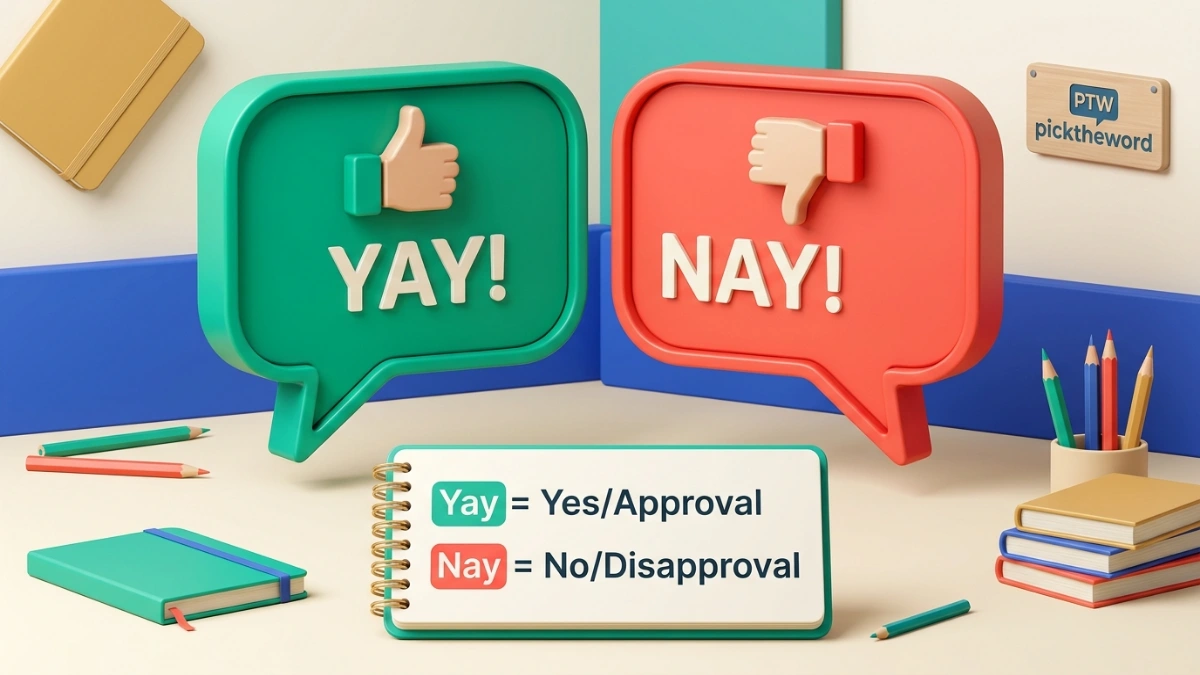
“Yay” means yes or approval, while “nay” means no or disapproval. It is usually used when someone wants a quick opinion or decision.
Quick Answer
“Yay or nay?” means “Yes or no?” or “Do you approve or not?”
It is an informal expression used to ask for someone’s opinion, choice, or approval.
For example:
Should we order pizza tonight yay or nay?
Here, the speaker is simply asking:
“Do you agree with ordering pizza?”
What Does “Yay or Nay” Mean?
The phrase yay or nay is an informal way to ask someone to choose between approval and disapproval.
- Yay = yes, approval, agreement, or support
- Nay = no, disagreement, or rejection
The expression is especially common in casual conversations, social media, polls, and situations where people want a fast answer.
Examples
- New hairstyle yay or nay?
- Should I buy this jacket? Yay or nay?
- Yay! We won the game.
- I vote nay on that idea.
The exact meaning depends on the situation. Sometimes yay simply means “I like it,” while nay means “I don’t like it.”
Yay vs. Nay: What’s the Difference?
The easiest way to understand the phrase is to think of it as a simple yes/no choice.
| Word | Basic meaning | Shows |
|---|---|---|
| Yay | Yes | Approval or excitement |
| Nay | No | Disapproval or rejection |
For example:
“Should we go to the beach tomorrow yay or nay?”
- Yay → Yes, let’s go.
- Nay → No, I don’t think we should.
There is one small point worth remembering:
yay can also express excitement.
Yay! It’s Friday!
In this sentence, yay does not mean simply “yes.” It expresses happiness or excitement.
How to Use “Yay or Nay” in a Sentence
The phrase is most often used as a quick question.
1. Asking for an opinion
This dress yay or nay?
The speaker wants to know whether the other person likes the dress.
2. Asking for approval
Should we add another example to the presentation? Yay or nay?
The speaker wants a decision.
3. Asking about a plan
Movie tonight? Yay or nay?
This means:
Do you want to watch a movie tonight or not?
4. Asking about a purchase
New shoes yay or nay?
This means:
Do you think I should buy these shoes?
You can put the phrase at the beginning or end of a question:
- Yay or nay: Should we leave early?
- Should we leave early, yay or nay?
The second version is more casual.
“Yay” Has Another Common Meaning
One reason learners sometimes get confused is that yay has more than one common use.
Yay = approval
Yay or nay on this idea?
Here, yay means yes or I approve.
Yay = excitement
Yay! We finally finished!
Here, yay means something like “Great!” or “I’m happy!”
So, don’t assume that yay always means “yes.”
Its meaning comes from context.
Is “Nay” the Same as “No”?
Usually, nay means no, especially when someone is voting or giving an opinion.
However, nay is somewhat more formal or old fashioned than ordinary no in many contexts.
For example:
The members voted nay.
This means that they voted against something.
You may also see nay in the expression:
Nay, I disagree.
This sounds old fashioned and is not common in everyday conversation.
In “yay or nay?
However, nay is widely understood as the opposite of yay.
Yay or Nay: 12 Natural Examples
Here are examples showing how people use the phrase in different situations.
Informal conversation
- Should we get ice cream after dinner yay or nay?
- New haircut: yay or nay?
- How about a road trip this weekend? Yay or nay?
- I found this shirt online. Yay or nay?
- Yay! We finally have a day off.
Work or formal situations
- The team needs a quick yay or nay on the proposed schedule.
- Please give us your yay or nay before Friday.
- The committee members voted yay on the proposal.
- We need a final yay or nay before moving forward.
These uses are understandable, but in very formal writing, approve/disapprove, yes/no, or for/against may sound more professional.
Academic writing
- The survey asked participants for a simple yay or nay response.
- The study did not reduce the participants’ opinions to a simple yay or nay choice.
- Students were asked to indicate whether they supported or opposed the proposal.
The last example is more suitable for academic writing because yay or nay is generally informal.
Formal, Informal, and Academic Usage
Not every situation is suitable for yay or nay.
| Situation | Is “yay or nay” suitable? | Better alternative |
|---|---|---|
| Talking with friends | Yes | |
| Text messages | Yes | |
| Social media | Yes | |
| Casual workplace chat | Usually | Yes/no |
| Formal email | Sometimes | Approve/disapprove |
| Academic paper | Usually no | Support/oppose |
| Legal or official document | No | For/against or approve/reject |
For example, you might text a friend:
Dinner at 8? Yay or nay?
But in a formal email, you could write:
Please let me know whether you approve the proposed schedule.
This sounds more professional.
Common Mistakes With “Yay or Nay”
Mistake 1:
Thinking “yay” means only “yes”
Incorrect assumption:
Yay always means yes.
Better understanding:
Yay can mean approval, but it can also express excitement.
Yay! We passed the test!
This expresses happiness rather than answering a yes/no question.
Mistake 2:
Using “nay” in every situation
Although nay means no in many contexts, ordinary speakers usually say no in everyday conversation.
Instead of:
Nay, I don’t want coffee.
Most people would naturally say:
No, I don’t want coffee.
Nay works especially well as the opposite of yay in a quick opinion or voting style question.
Mistake 3:
Confusing “yay” with “yea”
These words look and sound similar, but they are not exactly the same.
- Yay → expresses excitement or approval
- Yea → can mean “yes,” especially in voting or formal/old fashioned contexts
- Yeah → informal form of “yes”
For example:
Yay! We won!
The vote was 20 yea and 5 nay.
Yeah, I’ll come with you.
This distinction is useful because yay, yea, and yeah are often confused.
Mistake 4:
Writing “yea or nay” when you mean “yay or nay”
You may sometimes see “yea or nay” in voting contexts. That is different from the casual expression “yay or nay?”
If you’re asking a friend whether they like something, “yay or nay?” is the natural choice.
Yay, Yea, Yeah, and Nay Compared
These four words can be confusing because they are related in meaning or sound.
| Word | Meaning | Typical use |
|---|---|---|
| Yay | Excitement or approval | Casual speech, reactions |
| Yea | Yes / in favor | Voting, formal or traditional contexts |
| Yeah | Yes | Everyday informal speech |
| Nay | No / against | Voting, opinions, “yay or nay” |
Simple examples
Yay:
Yay! We’re going on vacation!
Yea:
The vote was 15 yea and 3 nay.
Yeah:
Yeah, that sounds good.
Nay:
I vote nay on that proposal.
Remember: yay and yea are not simply different spellings of the same word.
Is “Yay or Nay” Grammatically Correct?
Yes. “Yay or nay?” is a grammatically acceptable informal expression.
It is actually a shortened question. The full meaning could be:
Do you say yay or nay?
or:
Is your answer yay or nay?
In everyday English, speakers often leave words out when the meaning is obvious.
For example:
Coffee?
can mean:
Would you like some coffee?
Likewise:
Yay or nay?
can simply mean:
Do you approve or disapprove?
Is “Yay or Nay” Formal or Informal?
“Yay or nay” is mainly informal.
It is perfectly natural in:
- Text messages
- Friendly conversations
- Social media posts
- Casual polls
- Informal discussions
- Lighthearted workplace conversations
For formal communication, choose clearer alternatives such as:
- Yes or no
- Approve or reject
- Support or oppose
- For or against
- Accept or decline
For example:
Casual:
New logo yay or nay?
Professional:
Do you approve the proposed logo?
Both communicate the same basic idea, but the second is more appropriate for formal communication.
Why Do People Say “Yay or Nay”?
The phrase is popular because it is short, catchy, and easy to understand.
Instead of asking:
Do you approve of this idea, or do you disagree with it?
someone can simply ask:
Yay or nay?
It also gives the question a playful or relaxed tone. That’s why you often see it in social media captions and casual conversations.
For example:
Thinking about getting bangs. Yay or nay?
This invites people to quickly share their opinions.
Quick Tips to Remember
Here are a few easy ways to remember the difference:
- Yay = positive → approval or excitement.
- Nay = negative → rejection or disagreement.
- Yay or nay? = Yes or no?
- Use yay for excitement: “Yay! We won!”
- Use nay mainly as the opposite of yay or in voting style language.
- Yeah is an informal “yes,” but it is not the same word as yay.
- Yea is commonly connected with voting and means “yes/in favor.”
- In formal writing, use approve/disapprove or support/oppose instead of yay/nay.
A useful memory trick is:
YAY = “I like it!”
NAY = “Not for me!”
FAQ
1. What does “yay or nay” mean?
“Yay or nay?” means “Yes or no?” or “Do you approve or disapprove?” It is usually informal.
2. Is “yay” the same as “yes”?
Not always. Yay can mean approval, but it can also express excitement or happiness.
3. Is “nay” the opposite of “yay”?
Yes, in the expression “yay or nay,” yay represents approval and nay represents disapproval.
4. Is “yay or nay” formal English?
No. It is mainly informal English. In formal writing, use phrases such as approve or disapprove or for or against.
5. What is the difference between “yay” and “yea”?
Yay commonly expresses excitement or approval. Yea means yes or “in favor,” especially in voting or traditional formal language.
6. What is the difference between “yay” and “yeah”?
Yeah is an informal way to say yes. Yay usually expresses excitement or approval.
7. Can I use “yay or nay” in a sentence?
Yes.
For example:
Should we go out for dinner tonight yay or nay?
This means:
Should we go out for dinner tonight, yes or no?
Conclusion
“Yay or nay” is a simple informal expression meaning “yes or no” or “approve or disapprove.” Yay shows approval or excitement, while nay shows rejection or disagreement.
Use it freely in casual conversations, texts, social media, and informal polls. For formal or academic writing, choose clearer expressions such as yes/no, approve/reject, or support/oppose.
And don’t confuse yay with yea or yeah. They may look or sound similar, but they have different uses.
The easiest rule to remember is:
yay = positive, nay = negative.