Do you often wonder whether to write loosing or losing? You are not alone.
Many English learners mix up these two words because they look very similar and sound somewhat alike.
The good news is that in most everyday situations, losing is the correct word. People often write loosing by mistake when they actually mean losing.
Understanding the difference is simple once you know what each word means.
Quick Answer
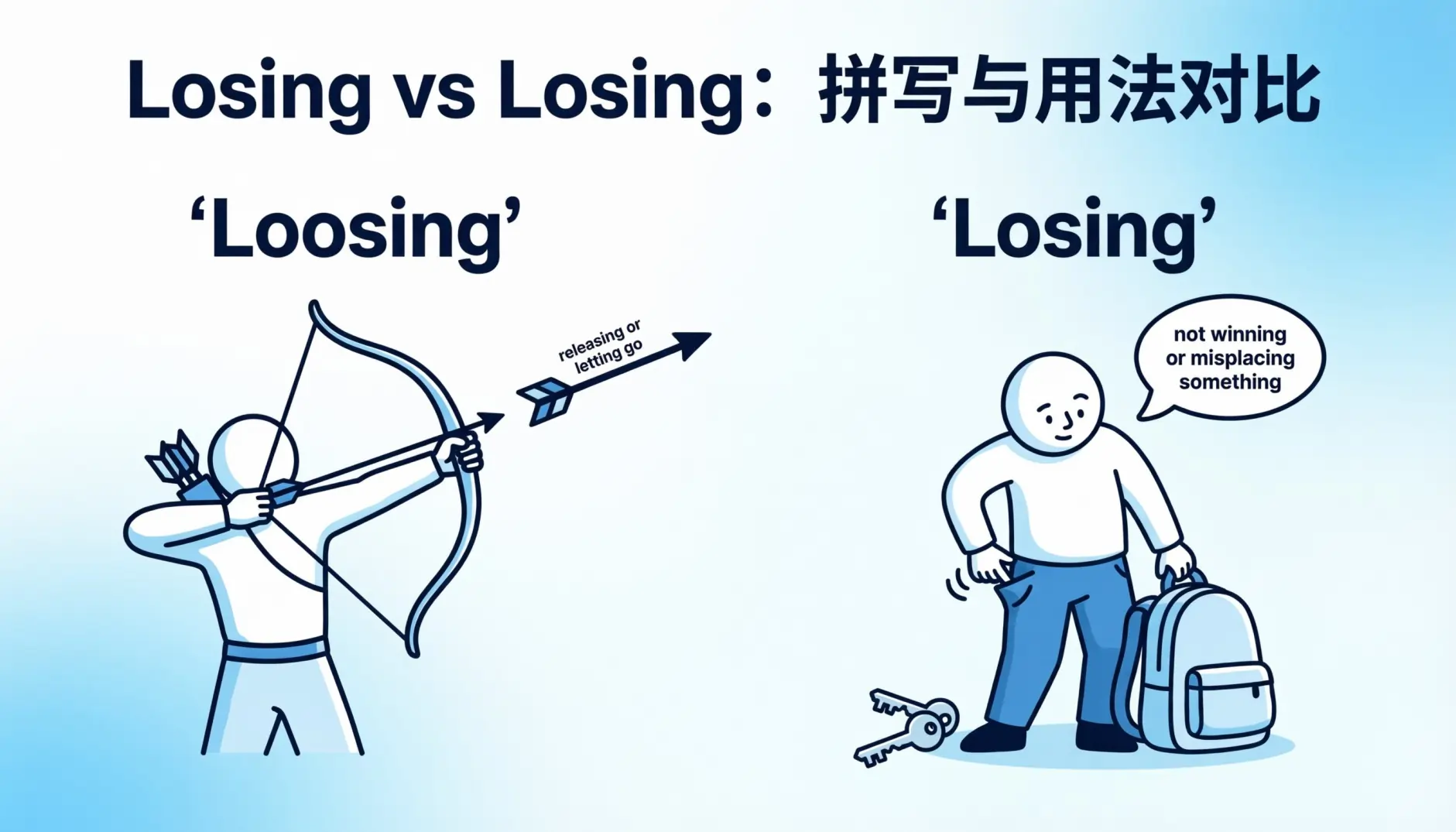
Losing means failing to keep, win, or find something.
Loosing means releasing, letting go, or making something loose.
✅ I am losing my keys again. (Correct)
❌ I am loosing my keys again. (Incorrect)
In everyday English, losing is far more common than loosing.
What Does “Losing” Mean?
Losing is the present participle of the verb lose.
It means:
- Not winning
- Misplacing something
- No longer having something
- Becoming less of something
Examples
- She is losing weight.
- We are losing money on this project.
- The team is losing the match.
- I keep losing my phone.
- He is losing confidence.
In all these examples, something is being lost, reduced, or not won.
What Does “Loosing” Mean?
Loosing comes from the verb loose, which means to release, untie, free, or let go.
This word is much less common in everyday English.
Examples
- The soldier was loosing arrows at the target.
- They were loosing the ropes from the boat.
- The hunter was loosing his dogs.
These examples use the idea of releasing or setting something free.
In modern everyday writing, most people rarely need the word loosing.
Loosing vs Losing: What Is the Difference?
| Word | Meaning | Common Usage |
|---|---|---|
| Losing | Not winning, misplacing, or no longer having something | Very common |
| Loosing | Releasing, freeing, or letting go | Rare |
| Lose | Base verb meaning to fail to keep or win | Common |
| Loose | Adjective meaning not tight | Common |
Simple Comparison
- I am losing my patience. ✅
- I am loosing my patience. ❌
- The archer is loosing arrows. ✅
- The archer is losing arrows. ❌ (changes the meaning)
For most learners, if you mean “not winning” or “not keeping something,” use losing.
Why Do People Confuse Loosing and Losing?
There are several reasons:
1. Similar Spelling
The words differ by only one extra “o.”
- losing
- loosing
A small spelling difference can easily cause mistakes.
2. Confusion With “Loose” and “Lose”
Many learners know the words:
- loose = not tight
- lose = fail to keep
Because loose has two “o”s, people sometimes incorrectly think losing should also have two “o”s.
3. Fast Typing
Many spelling mistakes happen when people type quickly and accidentally add an extra “o.”
Simple Grammar Rule
Think about the base word first.
If the base word is “lose”
Use:
- lose
- losing
- lost
Examples:
- I lose my keys.
- I am losing my keys.
- I lost my keys.
If the base word is “loose”
Use:
- loose
- loosing
Examples:
- The knot is loose.
- He is loosing the knot.
This simple rule helps prevent most mistakes.
Usage Examples in Different Types of Writing
Formal Writing
- The company is losing market share.
- Investors are losing confidence in the proposal.
- The organization is losing valuable employees.
Informal Writing
- I keep losing my sunglasses.
- Are we losing again?
- She’s losing interest in the show.
Academic Writing
- The experiment was losing accuracy over time.
- Researchers observed the species losing habitat.
- The country is losing agricultural land each year.
Additional Everyday Examples
- He is losing sleep because of stress.
- We are losing customers every month.
- She hates losing arguments.
- The team is losing badly.
- My phone keeps losing signal.
- They are losing valuable time.
- The athlete is losing energy.
- I am losing track of the conversation.
Common Mistakes Learners Make
Mistake 1
❌ I am loosing my wallet.
✅ I am losing my wallet.
Why? You mean “misplacing,” not “releasing.”
Mistake 2
❌ Our team is loosing the game.
✅ Our team is losing the game.
Why? The team is not winning.
Mistake 3
❌ She is loosing weight.
✅ She is losing weight.
Why? Weight is being reduced, not released.
Mistake 4
❌ We are loosing money.
✅ We are losing money.
Why? Money is being lost.
Mistake 5
❌ I’m loosing my mind.
✅ I’m losing my mind.
Why? This common expression uses the verb “lose.”
How to Remember the Difference
Memory Trick :1
Think of:
Lose → Losing
Both words have only one “o.”
- lose
- losing
Memory Trick :2
Think of:
Loose → Loosing
Both words have two “o”s.
- loose
- loosing
Memory Trick :3
Ask yourself:
“Am I talking about not winning or not keeping something?”
If yes, choose losing.
Similar and Commonly Confused Words
Lose vs Loose
This is one of the most common spelling mistakes in English.
| Word | Meaning |
|---|---|
| Lose | Fail to keep or win |
| Loose | Not tight |
Examples:
- Don’t lose your keys.
- Your shirt is loose.
Lost vs Loose
| Word | Meaning |
|---|---|
| Lost | Past tense and past participle of lose; unable to find something or no longer having it |
| Loose | Not tight, firmly fixed, or securely attached |
Examples:
- I lost my wallet.
- My belt feels loose.
Losing vs Loss
| Word | Type |
|---|---|
| Losing | Verb form |
| Loss | Noun |
Examples:
- The company is losing money.
- The company reported a loss.
Modern Usage Preferences
In modern English, losing is dramatically more common than loosing.
Most internet searches, social media posts, emails, and school assignments that use loosing actually mean losing.
Unless you are writing about releasing something, such as arrows, ropes, animals, or restraints, you probably want losing.
Quick Tips to Remember
- Losing = not winning or not keeping something.
- Loosing = releasing or letting go.
- Most everyday situations require losing.
- If you mean “misplacing,” use losing.
- If you mean “setting free,” use loosing.
- Remember: lose → losing (one “o”).
- Remember: loose → loosing (two “o”s).
FAQ
Is it losing or loosing weight?
Losing weight is correct because weight is being reduced or lost.
Is it losing my mind or loosing my mind?
Losing my mind is correct. This is a common English expression.
Why do people spell losing as loosing?
People often confuse lose and loose because the words look similar and have related pronunciations.
Is loosing a real word?
Yes. Loosing is a real word that means releasing, freeing, or letting go of something.
Which word is more common?
Losing is much more common in modern English.
Is “our team is loosing” correct?
Usually no. If you mean the team is not winning, the correct phrase is our team is losing.
How can I quickly remember the difference?
Match the base words:
- lose → losing
- loose → loosing
This simple pattern prevents most mistakes.
Conclusion
The difference between loosing and losing is easier than it first appears. Losing means not winning, misplacing something, or no longer having it, while loosing means releasing or letting something go.
Because losing is used in most everyday situations, it is usually the word people want. Whenever you are unsure, think about the meaning first. If something is being lost, choose losing. If something is being released, choose loosing.
With a little practice, you’ll never confuse these two words again.