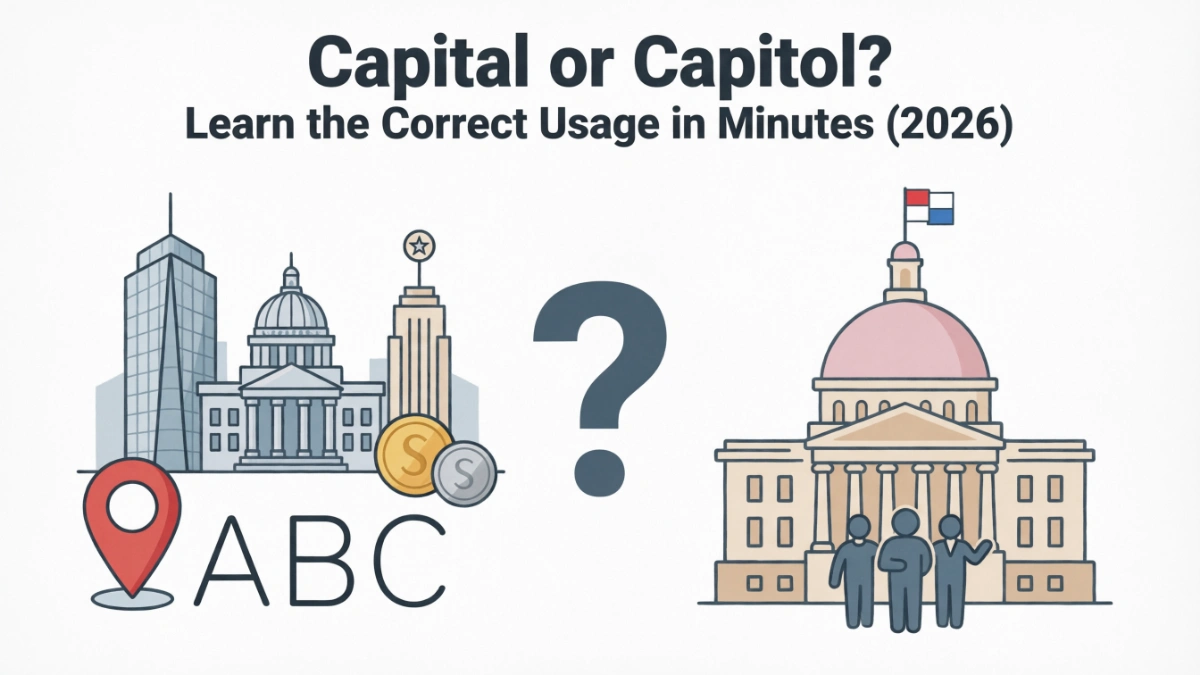
Do you write capital or capitol?
You are not alone.
Many English learners confuse these two words because they sound exactly the same. They are classic homophones words with the same pronunciation but different meanings and spellings.
For example:
- “Washington, D.C. is the of the United States.”
- “The lawmakers met inside the building.”
Which word fits each sentence?
Understanding the difference between capital and capitol is important for school writing, exams, business communication, and everyday English.
In this guide, you will learn the meanings, usage rules, examples, common mistakes, and easy memory tricks to remember them forever.
Quick Answer
Capital usually means a city, money, or something important.
Capitol refers only to a government building where lawmakers meet.
Examples:
- Islamabad is the capital of Pakistan.
- The senators met inside the Capitol building.
Use capital for cities and importance.
Use capitol only for government buildings.
What Does “Capital” Mean?
The word capital has several meanings in English. It is much more common than capitol.
1. Capital = A Main City
A capital city is the most important city in a country or state. It is usually where the government works.
Examples:
- Paris is the capital of France.
- Ottawa is the capital of Canada.
- Tokyo is the capital of Japan.
2. Capital = Money or Wealth
In business and economics, capital means money used for investment or business growth.
Examples:
- The company raised enough capital to expand.
- Small businesses often need more capital.
3. Capital = Very Important
Sometimes capital means something extremely important or excellent.
Examples:
- Time management is of capital importance.
- That was a capital idea.
4. Capital Letters
In grammar, capital letters are uppercase letters.
Examples:
- Always begin a sentence with a capital letter.
- Names should start with capitals.
What Does “Capitol” Mean?
The word capitol has only one main meaning.
A capitol is a building where lawmakers meet and government business happens.
Examples:
- The tourists visited the Capitol building.
- Protesters gathered near the state capitol.
In the United States, the most famous example is the United States Capitol in Washington, D.C.
Because the meaning is very specific, capitol is used much less often than capital.
What Is the Difference Between Capital and Capitol?
Here is the simplest way to understand the difference.
| Word | Meaning | Example |
|---|---|---|
| Capital | City, money, importance, or uppercase letter | London is the capital of England. |
| Capitol | Government building | The meeting took place at the Capitol. |
Easy Rule
- Capital = many meanings
- Capitol = only a government building
Why Do People Confuse Capital and Capitol?
People confuse these words because:
- They sound exactly the same
- Their spellings are very similar
- Both words connect to government topics
- Both appear in news and academic writing
For example:
- “The capital city”
- “The Capitol building”
Since both may appear in political discussions, learners often mix them up.
Are Both Words Correct?
Yes.
Both capital and capitol are correct English words.
However, they are not interchangeable.
You cannot replace one with the other because their meanings are different.
Incorrect:
- Washington, D.C. is the capitol of the United States.
Correct:
- Washington, D.C. is the capital of the United States.
Incorrect:
- The lawmakers met in the capital building.
Correct:
- The lawmakers met in the Capitol building.
Historical Background of Capital and Capitol
The two words come from related Latin roots.
- Capital comes from the Latin word caput, meaning “head.”
- Capitol comes from the Capitoline Hill in ancient Rome, where important government buildings stood.
Over time, English kept both spellings with different meanings.
That is why the words still look similar today.
British vs American English Usage
Both British and American English use these words in the same way.
There is no major spelling difference between UK and US English for these terms, but their usage frequency can vary slightly.
| Region | Capital Usage | Capitol Usage |
|---|---|---|
| United States | Very common | Common in political contexts |
| United Kingdom | Very common | Less common |
| Canada | Very common | Used for government buildings |
| Australia | Very common | Rare but understood |
Which Version Is More Common Globally?
Capital is far more common worldwide because it has many meanings.
Capitol is mostly used in American political contexts.
When Should You Use “Capital”?
Use capital when talking about:
Cities
- The capital of Italy is Rome.
- Canberra is Australia’s capital.
Money and Finance
- Investors provided capital.
- The business lacks working capital.
Importance
- Safety is of capital importance.
- Communication skills are capital in leadership.
Grammar
- Use a capital letter after a period.
- Proper nouns need capitals.
When Should You Use “Capitol”?
Use capitol only when referring to:
- A legislative building
- A government meeting place
- A state or national government structure
Examples:
- The governor spoke at the capitol.
- School groups toured the Capitol.
Usage Examples in Real Life English
Here are natural examples in different contexts.
Formal Writing
- Islamabad is the capital of Pakistan.
- The senator addressed reporters at the Capitol.
Informal Writing
- I forgot to use a capital letter.
- We visited the capitol during our trip.
Academic Writing
- Capitals often serve as political centers.
- The Capitol represents American democracy.
Workplace Communication
- The company needs more capital this year.
- Officials gathered inside the capitol building.
Emails and Text Messages
- Please use capital letters for headings.
- We saw the Capitol on vacation!
Social Media
- “Paris is my favorite capital city.”
- “Amazing photos from the Capitol today.”
Example Sentences Using Capital and Capitol
- Madrid is the capital of Spain.
- The company invested fresh capital into marketing.
- Please write your name in capital letters.
- The capital city attracts many tourists.
- The president arrived at the Capitol early.
- Visitors waited outside the capitol building.
- Education is of capital importance.
- The business owner needed more capital.
- We learned about the Capitol in history class.
- Always start sentences with a capital letter.
- Berlin became the capital after reunification.
- Lawmakers debated the issue inside the Capitol.
Common Mistakes Learners Make
Here are mistakes English learners commonly make.
| Incorrect | Correct | Why? |
|---|---|---|
| The capitol of France is Paris. | The capital of France is Paris. | Cities use capital |
| Use capitol letters. | Use capital letters. | Grammar uses capital |
| The senators met in the capital. | The senators met in the Capitol. | Government building uses Capitol |
| The business needs capitol. | The business needs capital. | Money/finance uses capital |
Why These Mistakes Happen
Learners usually:
- Spell by sound instead of meaning
- Forget the building specific meaning of “capitol”
- See both words in political news
Similar or Commonly Confused Words
English has many confusing homophones like these.
Principal vs Principle
- Principal = head of a school
- Principle = rule or belief
Stationary vs Stationery
- Stationary = not moving
- Stationery = paper and office supplies
Affect vs Effect
- Affect = influence
- Effect = result
Compliment vs Complement
- Compliment = praise
- Complement = something that completes
Learning these pairs improves your spelling and vocabulary accuracy.
Google Trends and Usage Patterns
In general English searches, capital is searched much more often than capitol because it has many meanings.
People commonly search for:
- Capital cities
- Capital letters
- Business capital
- Financial capital
The word capitol becomes more popular during political events, elections, government debates, or news about the United States Capitol.
In global English usage:
- Capital appears in education, travel, grammar, business, and geography.
- Capitol mainly appears in political news and history topics.
Quick Tips to Remember Capital vs Capitol
Think about the letter “O” in capitol.
A capitol is a building, and the “O” looks like a dome.
Many capitol buildings have domes.
If you mean a city, money, or letters → use capital.
If you mean a government building → use capitol.
“Capital city” is a very common phrase.
You almost never say “capitol city.”
Simple Grammar Rules
Remember these easy rules:
- Capital has many meanings.
- Capitol only means a government building.
- Both words are nouns.
- They are not interchangeable.
- Context tells you which one to use.
Audience Based Recommendations
For Students
Use capital in geography and grammar lessons.
For Business Professionals
Use capital when discussing finance or investment.
For Travelers
Use capital for cities and destinations.
For Political Writers
Use capitol only for legislative buildings.
FAQs
Is it capital city or capitol city?
The correct phrase is capital city.
Example:
- Cairo is the capital city of Egypt.
What does capitol mean in English?
A capitol is a government building where lawmakers meet.
Why are capital and capitol confusing?
They sound the same and have similar spellings, but they have different meanings.
Is Capitol always capitalized?
When referring to a specific building like the United States Capitol, it is usually capitalized.
Can capital mean money?
Yes. In business and economics, capital means money or financial resources.
Conclusion
The difference between capital and capitol is actually simple once you know the meanings.
Use capital for:
- Cities
- Money
- Importance
- Uppercase letters
Use capitol only for government buildings where lawmakers meet.
A quick memory trick can help:
- CapitOl → think of a building with a dOme.
- Everything else → capital.
With practice and real examples, you will use both words correctly and confidently.

Hi, I’m Virginia Woolf, a language enthusiast passionate about exploring the power of words and their meanings. I specialize in helping readers choose the right words through clear comparisons, synonyms, and practical usage. My goal is to make vocabulary learning simple, engaging, and useful for everyday communication. picktheword.com