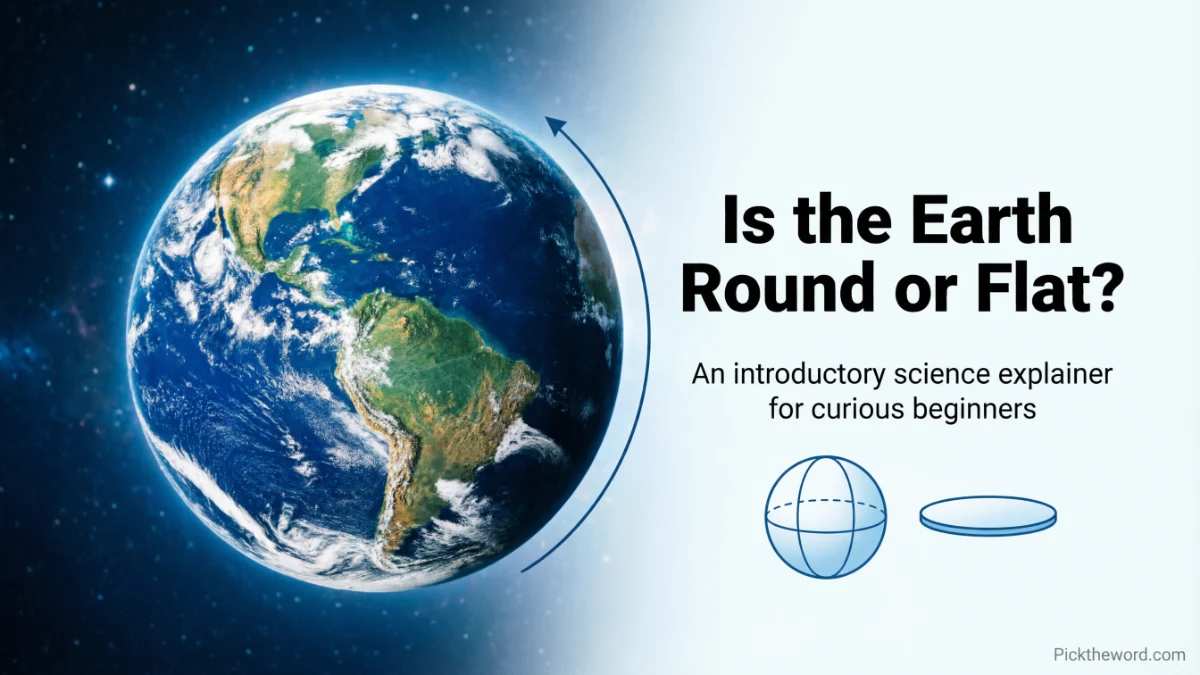
Many people ask this question online: “Is the Earth round or flat?”
Some videos, social media posts, and old stories make the topic confusing for learners and young readers.
In daily life, the ground around us looks flat. When we stand outside, we cannot easily see the Earth’s curve. Because of this, many people wonder what shape our planet really is.
Understanding the Earth’s shape matters because it helps us learn about:
- Science
- Geography
- Space
- Navigation
- Day and night
- Seasons
In this guide, you will learn the simple scientific answer, why confusion happens, and how people discovered the Earth’s true shape long ago.
Quick Answer
The Earth is round, but not a perfect ball. Scientists describe it as an oblate spheroid, which means it is slightly flat at the top and bottom and wider in the middle.
People know this from:
- Satellite images
- Space travel
- Gravity studies
- Ship movement over the horizon
For example, astronauts can clearly see the curved Earth from space.
What Does “Round Earth” Mean?
When people say the Earth is round, they usually mean:
- The Earth is shaped like a sphere
- It is not flat like a plate or map
- It curves in all directions
However, the Earth is not a perfect smooth sphere.
The Real Shape of Earth
The Earth is slightly:
- Flattened near the North Pole and South Pole
- Wider around the equator
This happens because the Earth spins.
Simple Shape Comparison Table
| Shape | Description |
|---|---|
| Flat | Like a sheet of paper |
| Sphere | Like a basketball |
| Oblate spheroid | Slightly squashed sphere like Earth |
The term oblate spheroid is the scientific name for Earth’s shape.
Why Do Some People Think the Earth Is Flat?
This confusion happens for several reasons.
1. The Ground Looks Flat
When we walk outside, the Earth feels flat because:
- The planet is extremely large
- Humans see only a tiny part of it
The curve is too small to notice easily from the ground.
2. Social Media and Videos
Online platforms sometimes spread:
- False scientific claims
- Misleading videos
- Conspiracy theories
These can confuse learners who do not check trusted sources.
3. Old Historical Beliefs
Thousands of years ago, some ancient cultures believed the Earth was flat because they did not have modern technology.
But later, scientists and explorers collected strong evidence showing the Earth is round.
How Do Scientists Know the Earth Is Round?
Scientists use many kinds of evidence.
Satellite Images
Today, satellites take clear photos of Earth from space. These images show a curved planet.
Space Travel
Astronauts have seen Earth directly from space for many years.
Ships and the Horizon
When a ship sails away:
- The bottom disappears first
- The top disappears last
This happens because of Earth’s curve.
Earth’s Shadow During Lunar Eclipses
During a lunar eclipse, Earth creates a round shadow on the Moon.
Only a round object always creates a circular shadow from every angle.
Time Zones
Different countries have different times because Earth rotates.
If Earth were flat:
- Sunrise and sunset would happen everywhere at the same time
But they do not.
Is the Earth Perfectly Round?
No, the Earth is not perfectly round.
It is:
- Slightly wider in the middle
- Slightly flatter at the poles
Why Does This Happen?
The Earth spins very fast.
This spinning pushes the middle outward slightly.
Easy Example
Think about spinning pizza dough:
- The center spreads outward
- The shape becomes wider in the middle
Earth behaves in a similar way.
What Is the Difference Between “Round” and “Flat”?
Here is a simple comparison.
| Feature | Round Earth | Flat Earth |
|---|---|---|
| Scientific support | Supported by science | Not supported by science |
| Evidence | Proven through satellites | No scientific proof |
| Gravity | Explains gravity correctly | Cannot fully explain gravity |
| Space observations | Matches astronomy and space data | Conflicts with observations |
| Scientific acceptance | Accepted worldwide by scientists | Considered a conspiracy theory |
Scientists around the world agree that the Earth is round.
How Did Ancient People Discover the Earth Is Round?
People have known the Earth is round for a very long time.
Ancient Greek Observations
Greek thinkers noticed:
- Different stars appeared in different places
- Ships disappeared over the horizon
These observations suggested a curved Earth.
Eratosthenes’ Famous Experiment
A Greek scholar named Eratosthenes even estimated Earth’s size more than 2,000 years ago.
He compared shadows in two cities and discovered:
- The Earth had curvature
- The planet was enormous
This was a major scientific achievement.
Why Does Earth’s Shape Matter?
Understanding Earth’s shape helps in many real-world areas.
Navigation
Pilots and sailors use Earth’s curve for travel routes.
GPS Technology
GPS satellites work because scientists understand Earth’s shape and position in space.
Weather and Climate
Earth’s shape affects:
- Seasons
- Climate zones
- Sunlight distribution
Space Exploration
Rocket launches and satellite systems depend on accurate Earth measurements.
Is “Round Earth” a Scientific Fact?
Yes. The round Earth model is supported by:
- Physics
- Astronomy
- Geography
- Space science
Millions of observations and experiments confirm it.
This is why schools, universities, and scientific organizations teach the round Earth model worldwide.
Why Does the Earth Feel Flat If It Is Round?
This is one of the most common questions.
The Earth Is Extremely Large
The Earth is about 40,000 kilometers around. Humans are very small compared to the planet.
Because of this:
- The curve appears tiny at ground level
- Large areas seem flat
Similar Example
An ant walking on a basketball may think the surface feels flat because the curve is gradual.
Humans experience Earth in a similar way.
British vs American English Usage
The topic itself is scientific, but some vocabulary differs between countries.
Common Vocabulary Differences
| American English | British English |
|---|---|
| Math | Maths |
| Color | Colour |
| Center | Centre |
| Kilometer | Kilometre |
Which Version Is More Common Globally?
Both American and British English are widely used online.
However:
- American English is common in scientific websites and media
- British English is common in UK education systems
Audience Recommendations
| Audience | Recommended Style |
|---|---|
| International blogs | American English |
| UK school readers | British English |
| Mixed global audience | Keep language simple and neutral |
Usage Examples in Different Situations
Here are natural examples showing how people discuss this topic.
Formal Writing
- Scientists agree that the Earth is round.
- Satellite evidence confirms Earth’s curved shape.
- The Earth is an oblate spheroid rather than a perfect sphere.
Informal Writing
- I used to wonder if the Earth was flat.
- The planet looks flat from the ground, but it is actually round.
- Videos online sometimes confuse people about Earth’s shape.
Academic Writing
- Ancient astronomers observed evidence of Earth’s curvature.
- Gravity helps maintain Earth’s spherical form.
- Modern space exploration provides direct visual proof of Earth’s shape.
Emails and Workplace Communication
- Please include Earth science topics in tomorrow’s lesson plan.
- The presentation explains why the Earth is round.
Social Media and Text Messages
- I just watched a documentary about how astronauts see Earth from space.
Common Mistakes Learners Make
Many learners become confused by online discussions.
Incorrect vs Correct Examples (Earth Shape)
| Incorrect | Correct | Why? |
|---|---|---|
| The Earth are flat. | The Earth is round. | “Earth” is singular, so it takes is |
| Earth is a perfect circle. | Earth is close to a sphere. | Earth is not perfectly round |
| Flat Earth is scientifically proven. | Round Earth is scientifically proven. | Scientific evidence supports a round Earth |
Why Learners Get Confused
Common reasons include:
- Misleading internet content
- Poor scientific understanding
- Confusing visuals
- Literal interpretation of maps
Remember: maps are flat drawings of a round planet.
Similar or Confused Words
Some related words also confuse learners.
Sphere vs Circle
| Word | Meaning |
|---|---|
| Circle | Flat 2D shape |
| Sphere | Round 3D object |
Earth is a sphere-like object, not a circle.
Globe vs Earth
A globe is a small model of Earth.
Planet vs World
These words are often interchangeable in casual English, but:
- “Planet” is more scientific
- “World” is more general
Google Trends and Usage Patterns
Many people search:
- “Is the Earth round or flat?”
- “Proof the Earth is round”
- “Why does Earth look flat?”
- “Flat Earth theory explained”
Interest often increases when:
- Viral videos spread online
- Space missions appear in the news
- Science topics trend on social media
Educational websites usually explain the topic using simple scientific evidence.
Quick Tips to Remember
Here are some easy memory tricks.
Simple Memory Rules
- Round Earth = accepted science
- Flat Earth = unsupported theory
- Earth is not perfectly round
- Maps are flat, but Earth is curved
Easy Trick
Think of:
- A basketball = round Earth
- A paper sheet = flat surface
The Earth is much closer to a basketball shape.
Regional Usage Tip
In both British and American English:
- “The Earth is round” is the standard phrase
FAQs
Is the Earth completely round?
No. The Earth is slightly flat at the poles and wider at the equator. Scientists call this shape an oblate spheroid.
Why does the Earth look flat?
The Earth is extremely large, so its curve is difficult to notice from the ground.
Can astronauts see the Earth’s curve?
Yes. Astronauts and satellites clearly show Earth’s curved shape from space.
Who first proved the Earth was round?
Ancient Greek scholars provided early evidence. Later scientists and explorers confirmed it further.
Is the flat Earth theory accepted by scientists?
No. Modern science strongly supports the round Earth model through experiments and observations.
Conclusion
The Earth is round, not flat. More accurately, it is an oblate spheroid, meaning it is slightly wider in the middle and flatter at the poles.
Scientists have confirmed this through:
- Space travel
- Satellite images
- Gravity research
- Astronomy
- Navigation systems
Although the Earth may look flat from where we stand, modern science clearly shows that our planet is round. Learning the real facts helps us better understand geography, space, and the world around us.