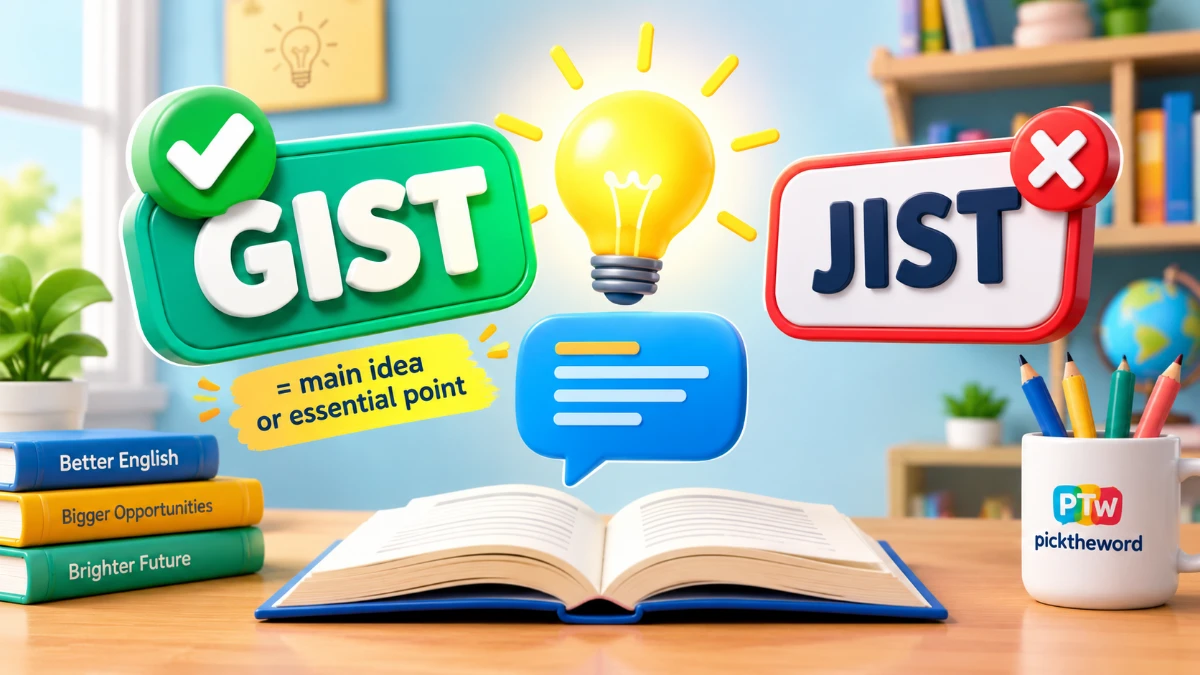
If you are wondering whether the correct spelling is “jist” or “gist,” you are not alone. These words can be confusing because gist is pronounced with a soft “j” sound at the beginning.
The good news is simple:
“Gist” is the correct spelling when you mean the main idea or most important part of something. “Jist” is usually a misspelling.
Quick Answer:
Jist or Gist?
Gist is the correct spelling.
Use gist when you want to talk about the main point, basic meaning, or general idea of something.
- Correct: I understood the gist of the conversation.
- Incorrect: I understood the jist of the conversation.
The word gist is pronounced with a sound like the beginning of “just,” which is one reason people sometimes spell it as jist.
What Does “Gist” Mean?
Gist means the main idea, basic meaning, or most important point of something.
You do not need to know every detail to understand the gist. If you understand the gist of a conversation, article, story, or speech, you understand what it is mainly about.
For example:
I didn’t read the whole report, but I got the gist.
This means the person did not read every detail but understood the main point.
Another example:
Can you give me the gist of the movie?
Here, the speaker wants a short explanation of what the movie is mainly about.
Simple definition
Gist = the main idea or most important point.
You can think of it as the big picture rather than all the small details.
Why Do People Write “Jist”?
The confusion comes mainly from pronunciation.
The word gist begins with a soft g sound. This is the same type of sound you hear in words such as giant, general, and gym.
Because gist sounds similar to a word beginning with “j,” some learners naturally write jist.
However, pronunciation does not always tell us how to spell an English word.
For example:
- gist → correct
- jist → generally incorrect when meaning “main idea”
The spelling gist is the standard form used in modern English.
Gist vs. Jist: The Difference
For the meaning “main idea,” there is no standard modern distinction between gist and jist.
| Word | Correct? | Meaning |
|---|---|---|
| gist | Yes | Main idea or essential point |
| jist | No, in standard English | Usually a misspelling of “gist” |
So if you are writing an email, school assignment, report, article, or professional message, use gist.
Example:
Wrong:
I didn’t understand the jist of his argument.
Correct:
I didn’t understand the gist of his argument.
The second sentence uses the standard spelling.
How to Use “Gist” in a Sentence
Gist is usually used as a noun. It often appears in the expression “the gist of.”
For example:
I understood the gist of the lesson.
Here, the gist means the main idea of the lesson.
You can also use phrases such as:
- the gist of the story
- the gist of the conversation
- the gist of the article
- the gist of the argument
- the gist of the message
- the gist of the report
- get the gist
- understand the gist
A useful pattern to remember is:
the gist of + noun
For example:
I got the gist of the email.
This means you understood the main point of the email.
Natural Examples of “Gist”
Here are examples showing how gist works in different situations.
Everyday and informal English
- I didn’t catch every word, but I got the gist of what she said.
- Can you tell me the gist of the movie?
- I read the message quickly and understood the gist.
- He explained the gist of the problem to me.
Formal writing
- The report explains the gist of the proposed changes.
- The manager summarized the gist of the discussion.
- The document gives readers the gist of the new policy.
- She understood the gist of the client’s concerns.
Academic writing
- Students should understand the gist of the passage before studying its details.
- The researcher summarized the gist of the argument in the introduction.
- Reading the abstract can help you understand the gist of the research paper.
- The lecture was difficult, but I understood the gist of the professor’s explanation.
Notice that gist works in both casual and formal English. It is not a slang word.
Common Mistakes With “Gist”
The most common mistake is simply spelling gist as jist.
Mistake 1
Incorrect:
I understand the jist of the article.
Correct:
I understand the gist of the article.
Mistake 2
Incorrect:
What is the jist of your argument?
Correct:
What is the gist of your argument?
Mistake 3
Incorrect:
She gave me the jist of the meeting.
Correct:
She gave me the gist of the meeting.
Mistake 4
Incorrect:
I didn’t get the jist.
Correct:
I didn’t get the gist.
Why is this mistake so common?
English spelling can be surprising. The g in gist has a soft sound, so it is easy to connect the pronunciation with the letter j.
The important thing to remember is that the standard spelling is always gist when you mean “main idea.”
Gist in Formal, Informal, and Academic English
The word gist can be used in many types of English.
Informal English
It sounds completely natural in everyday conversation:
I didn’t read the whole article, but I got the gist.
Formal English
It can also appear in professional communication:
The summary provides the gist of the proposed agreement.
Academic English
You may see it when discussing reading and comprehension:
Students should identify the gist of the passage before analyzing its supporting details.
However, in very formal academic writing, words such as main idea, central argument, or principal point may sometimes be more precise.
For example:
The central argument of the study is that early education improves long term learning outcomes.
So gist is correct, but the best word depends on how precise and formal you want to sound.
Similar and Confused Words
Learners sometimes confuse gist with other words that have related meanings.
Gist vs. Main idea
These are very similar.
Gist means the general or essential meaning.
The main idea directly identifies what something is mainly about.
I understood the gist of the article.
I understood the main idea of the article.
Both sentences are correct.
Gist vs. Summary
A summary is a shortened version of something.
The gist is the central idea or general meaning.
For example:
someone might give you a summary of a 20 page report. The summary could contain several important points, while the gist could be expressed in just one sentence.
Gist vs. Point
Point can mean the specific idea someone is trying to communicate.
What’s your point?
Gist usually refers to the overall or central meaning.
I understand the gist of your explanation.
Gist vs. Just
Just is a completely different word.
It can mean “only,” “recently,” or “fair/fair minded,” depending on the sentence.
I just arrived.
She is just a leader.
Do not confuse gist with just, even though their pronunciation can sound somewhat similar in some accents.
Is “Jist” Ever Correct?
For standard modern English, if you want to say “main idea,” use “gist.”
You may occasionally see jist online, in informal writing, or as a spelling mistake. That does not make it the standard spelling.
If you are writing something for school, work, a website, an exam, or a professional audience, choose gist.
The safest rule
If you mean “main idea,” spell it G I S T.
British vs. American English: Is There a Difference?
No important British American spelling difference exists here.
Both British English and American English use:
gist
For example:
- British English: I understood the gist of the article.
- American English: I understood the gist of the article.
So you do not need to choose between gist and jist based on the country or variety of English.
Gist is the standard spelling in both.
Quick Tips to Remember the Correct Spelling
Here are a few easy ways to remember gist.
1. Remember “G = gist”
When you mean main idea, think:
G = Gist = General idea
This is not the exact dictionary definition, but it is a useful memory trick.
2. Think of “gist” as the “big picture”
If someone asks:
What is the gist?
They are asking:
What is the main idea?
3. Don’t spell by sound
English has many words whose spelling is not obvious from pronunciation. Gist is one of them.
The soft “g” sound does not mean the word begins with j.
4. Use “the gist of”
This common phrase makes the correct spelling easier to remember:
the gist of the story
the gist of the conversation
the gist of the article
FAQs
Is “jist” a correct English word?
Jist is not the standard spelling when you mean “the main idea” or “essential point.” Use gist instead.
What is the meaning of “gist”?
Gist means the main idea, general meaning, or most important point of something.
How do you pronounce “gist”?
The word gist begins with a soft “g” sound, similar to the beginning of words such as “giant” and “gym.”
Is it “the gist” or “the jist”?
The correct phrase is “the gist.”
I understand the gist of your message.
Is “gist” formal or informal?
Gist can be used in both everyday and formal English. It is a standard English word, not simply slang.
Can I use “gist” in academic writing?
Yes. Gist is acceptable in academic writing, especially when discussing the general meaning of a passage or argument. However, terms such as main idea or central argument may be more precise in some academic contexts.
Why do people spell “gist” as “jist”?
Because the g in gist has a soft sound that is similar to the sound represented by j in many English words. This makes jist an understandable spelling mistake, but gist is the standard spelling.
Conclusion
If you are choosing between jist or gist, the answer is simple:
use “gist.”
Gist means the main idea, general meaning, or most important point of something. It is used in everyday, professional, and academic English.
Remember:
GIST = main idea
JIST = usually a misspelling
So write:
I understand the gist of the conversation.
Not:
I understand the jist of the conversation.
Once you remember the spelling G I S T, this common English confusion becomes easy to avoid.

Hi, I’m Virginia Woolf, a language enthusiast passionate about exploring the power of words and their meanings. I specialize in helping readers choose the right words through clear comparisons, synonyms, and practical usage. My goal is to make vocabulary learning simple, engaging, and useful for everyday communication. picktheword.com