Have you ever wondered where energy goes when something stops working?
For example:
When a phone battery dies, the energy has not simply disappeared. It has changed into other forms.
The phrase “energy cannot be created or destroyed” expresses this basic idea. It is a simple way to describe the law of conservation of energy, one of the most important ideas in science.
Quick Answer
“Energy cannot be created or destroyed” means that energy does not appear from nothing or completely disappear. Instead, it changes from one form to another.
For example:
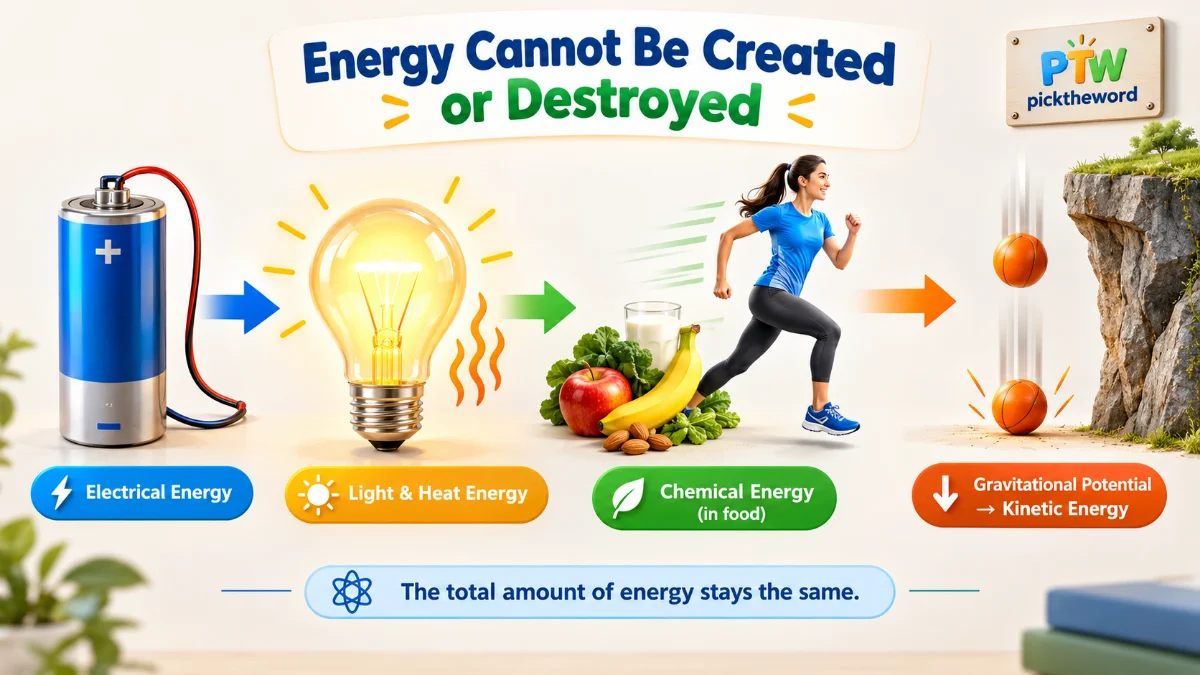
When you switch on a light, electrical energy changes into light energy and heat energy. The energy is transformed rather than lost.
What Does “Energy Cannot Be Created or Destroyed” Mean?
The phrase means that the total amount of energy stays the same, although energy can change form or move from one object to another.
This idea is called the law of conservation of energy.
Think about energy like money in a bank account. You can move money from one account to another or spend it on something, but you cannot make money appear from nowhere just by moving it around. In a similar way, energy can be transferred or transformed.
Common forms of energy include:
- Light energy: energy carried by light
- Heat (thermal) energy: energy related to temperature
- Electrical energy: energy associated with electricity
- Chemical energy: energy stored in substances such as food and fuel
- Kinetic energy: energy of movement
- Potential energy: stored energy due to position or condition
- Sound energy: energy carried by sound waves
When something happens, one type of energy may become another type.
For example:
Chemical energy in food → movement energy + heat
When you eat food, your body uses the chemical energy stored in it. Some becomes energy for movement, while some is released as heat.
The important point is that the energy has not been magically created or destroyed. It has been transformed.
Why Do We Say “Cannot Be Created or Destroyed”?
The wording comes from the idea that the amount of energy in a closed system remains constant.
A simple way to remember it is:
Energy in = energy out, when all forms of energy are counted.
Sometimes it looks as though energy has disappeared. Usually, it has simply changed into a form that is harder to notice.
For example:
Imagine a moving bicycle.
You stop pedaling, and eventually the bicycle stops. It may seem as if the bicycle’s movement energy has disappeared.
But where did it go?
Some of the kinetic energy was transformed into thermal energy because of friction between the tires, road, chain, and other parts. A small amount may also become sound.
So the energy was not destroyed. It was converted into other forms.
This is why scientists often say that energy is transferred or transformed, rather than lost.
Simple Examples of Energy Changing Form
Here are some everyday examples that make the idea easier to understand.
| Situation | Energy transformation |
|---|---|
| Turning on a lamp | Electrical → light + heat |
| Eating food | Chemical → movement + heat |
| Driving a car | Chemical → movement + heat + sound |
| Dropping a ball | Potential → kinetic + heat/sound |
| Using a battery | Chemical → electrical |
| A plant growing | Light → chemical energy |
| A toaster working | Electrical → heat |
| Playing music | Electrical → sound + heat |
Example 1: A Light Bulb
When you turn on a light bulb, electrical energy enters the bulb.
The bulb changes some of that electrical energy into light and some into heat.
The electrical energy has not vanished.
Example 2: A Battery
A battery stores chemical energy. When you use the battery, chemical energy is converted into electrical energy.
That electrical energy can then power a phone, toy, flashlight, or other device.
Example 3: A Falling Object
A book sitting on a high shelf has gravitational potential energy because of its position.
When it falls, that stored energy changes into kinetic energy, the energy of movement.
When the book hits the floor, some of that energy becomes sound, heat, and deformation.
Natural Example Sentences
Here are examples of how this idea can be used in different types of writing.
Formal Writing
- Energy cannot be created or destroyed; it can only be transferred or transformed.
- The principle that energy cannot be created or destroyed is known as the law of conservation of energy.
- When electrical energy enters the device, it is transformed into other forms of energy.
- The experiment demonstrates that energy cannot simply disappear from a system.
Informal Writing
- Energy doesn’t just disappear when you stop using something.
- When your phone battery dies, the energy has changed into other forms rather than being destroyed.
- The energy from the food you eat helps your body move and stay warm.
- When you turn on a fan, electrical energy becomes movement and a little heat and sound.
Academic Writing
- The law of conservation of energy states that the total energy of an isolated system remains constant.
- Energy may change from one form to another while the total amount remains conserved.
- Friction transforms some kinetic energy into thermal energy.
- The apparent loss of energy is often explained by its conversion into heat, sound, or other less noticeable forms.
Common Mistakes
Because the phrase sounds simple, learners sometimes misunderstand what it actually says.
Mistake 1:
“Energy disappears.”
❌ The energy was destroyed when the machine stopped.
✅ The energy was transformed into other forms, such as heat and sound.
Why?
A machine stopping does not mean all its energy has vanished. Some of its energy has been transferred or changed.
Mistake 2:
“Energy is never lost.”
This sentence can be confusing.
In everyday language, we often say that energy is “lost.” In science, however, energy is not destroyed. It may become less useful for the particular job we want it to do.
For example:
A car’s engine releases heat. That heat is still energy, even though it cannot easily be used to make the car move.
Mistake 3:
Confusing “created” with “changed”
❌ The light bulb creates light energy from nothing.
✅ The light bulb transforms electrical energy into light and heat.
The bulb changes the form of energy rather than creating energy from nothing.
Mistake 4:
Thinking energy is the same as electricity
Electricity is only one way energy can be transferred or used. Energy also exists in chemical, thermal, kinetic, potential, light, and other forms.
Energy Cannot Be Created or Destroyed vs. Energy Is Lost
These expressions can sound contradictory.
You may hear someone say:
“Energy is lost through friction.”
In casual speech, this usually means that useful energy is lost.
Scientists use more precise language. The energy has not actually disappeared. Friction converts kinetic or mechanical energy into thermal energy.
So these two statements have different levels of precision:
| Expression | Meaning |
|---|---|
| “Energy is lost” | Common everyday expression |
| “Energy is destroyed” | Incorrect under the conservation law |
| “Energy is transformed” | Scientifically precise |
| “Energy is transferred” | Scientifically precise |
A good learner should understand the everyday expression but use “transformed” or “transferred” when precision matters.
What Is the Law of Conservation of Energy?
The law of conservation of energy says that energy cannot be created or destroyed. It can only be transferred between objects or transformed from one form into another.
Imagine a closed system containing 100 units of energy.
If some energy changes from chemical energy into heat and movement, the total is still 100 units when every form is included.
A simple formula is:
Total energy before = Total energy after
This law is useful in physics, chemistry, engineering, biology, and many other areas of science.
It helps scientists understand what happens to energy during processes such as:
- Burning fuel
- Moving objects
- Generating electricity
- Heating water
- Photosynthesis
- Digestion
- Charging and using batteries
Is “Energy Cannot Be Created or Destroyed” Always True?
For basic science and everyday learning, this is the correct principle to remember.
However, there is an important detail: scientists usually discuss conservation of energy in terms of a system. Energy can enter or leave a system, so you need to define what you are measuring.
For example:
If you are studying a phone, electrical energy enters the phone from its charger. The phone then transforms that energy into light, sound, heat, chemical energy, and other forms.
If you look only at the phone, it may appear that energy has been “created” when the charger is connected. But the energy actually came from outside the system.
This is why defining the system is important in scientific calculations.
“Energy Cannot Be Created or Destroyed” in Simple English
If the phrase feels too technical, remember this simpler version:
Energy can change, but it does not simply appear or disappear.
For example:
Food → body movement + heat
Fuel → movement + heat + sound
Electricity → light + heat
Sunlight → chemical energy in plants
The arrows show energy transformation.
Once you understand this idea, many science examples become easier to follow.
Quick Tips to Remember
Here are a few easy memory tricks.
1. Remember “change, not vanish”
Energy can change form, but it does not simply vanish.
2. Think of a battery
A battery does not make energy from nothing. It changes stored chemical energy into electrical energy.
3. Ask “Where did it go?”
If something appears to lose energy, ask:
“What form did the energy change into?”
The answer is often heat, sound, movement, or another form.
4. Use “transformed” in science writing
Instead of saying:
❌ The energy disappeared.
Try:
✅ The energy was transformed into another form.
5. Remember the short rule
Energy changes form; it does not simply disappear.
FAQ
What does “energy cannot be created or destroyed” mean?
It means energy cannot appear from nothing or completely disappear. It can be transferred from one object to another or transformed into a different type of energy.
What is the law of conservation of energy?
It is the scientific principle that the total amount of energy in an isolated system remains constant. Energy can change form or move between objects.
Can energy be lost?
Energy cannot be destroyed, but it can become less useful for a particular purpose. For example, useful movement energy can be transformed into heat through friction.
Can energy be created?
Energy is not created from nothing. What may look like newly created energy usually comes from another form or enters the system from somewhere else.
What happens to energy when a moving object stops?
Its kinetic energy is transformed into other forms, often including heat and sound. Friction is one common reason this happens.
Is “energy cannot be created or destroyed” grammatically correct?
Yes. It is a grammatically correct sentence. “Cannot” is written as one word, and “created or destroyed” uses parallel past participles after “can.”
What is another way to say “energy cannot be created or destroyed”?
A more complete scientific version is: “Energy can neither be created nor destroyed; it can only be transferred or transformed.”
Conclusion
“Energy cannot be created or destroyed” means that energy does not simply appear or disappear. Instead, it is transferred from one place to another or transformed from one form into another.
A light bulb changes electrical energy into light and heat. Food changes chemical energy into movement and heat. A falling object changes potential energy into kinetic energy and eventually other forms.
The easiest rule to remember is:
Energy changes form; it does not simply vanish.
If you use this idea when studying physics or explaining everyday examples, you will have a strong understanding of the law of conservation of energy.

Hi, I’m Virginia Woolf, a language enthusiast passionate about exploring the power of words and their meanings. I specialize in helping readers choose the right words through clear comparisons, synonyms, and practical usage. My goal is to make vocabulary learning simple, engaging, and useful for everyday communication. picktheword.com