Chose and choose come from the same verb, but they are used at different times.
This small difference can easily confuse English learners, especially when talking about decisions.
Quick Answer
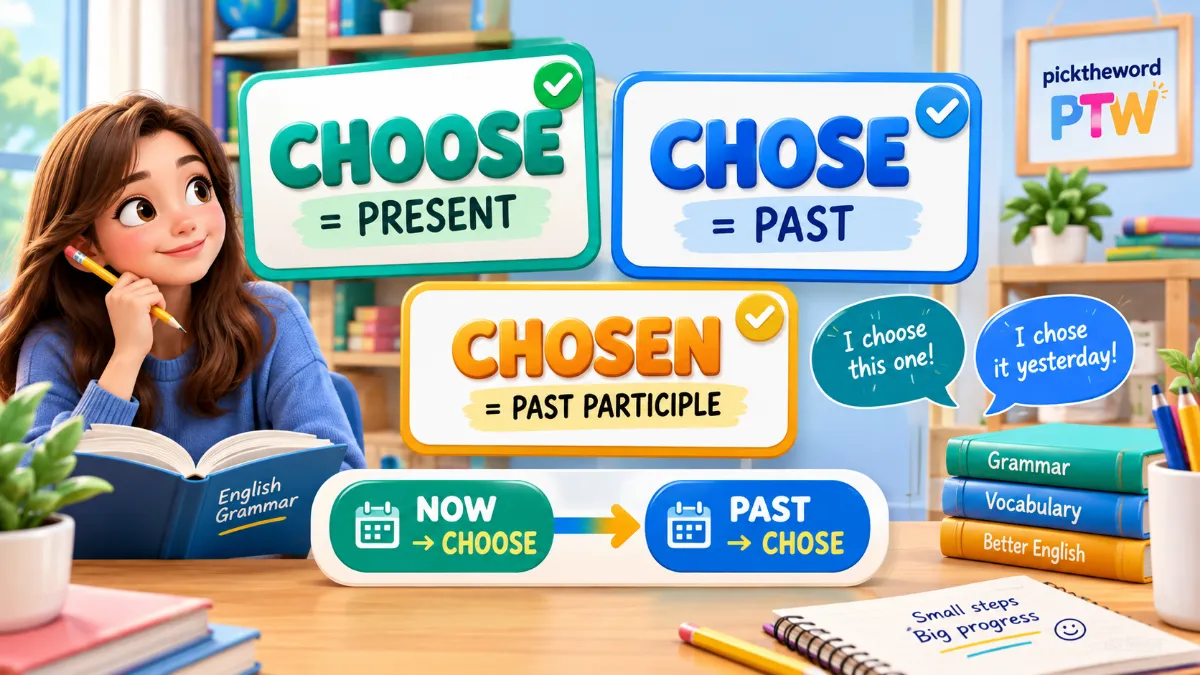
Choose is the present tense: I choose what I want.
Chose is the past tense: I chose what I wanted yesterday.
The easiest rule is:
Choose = now or regularly; chose = already happened.
Choose vs. Chose: The Main Difference
The verb choose means to pick one person or thing from two or more options.
It has several forms:
| Verb form | Word | Example |
|---|---|---|
| Base/present | choose | I choose the blue shirt. |
| Past | chose | I chose the blue shirt yesterday. |
| Past participle | chosen | I have chosen the blue shirt. |
| ing form | choosing | I am choosing a shirt. |
The most common confusion is between choose and chose.
Think about when the action happens:
- Choose → the decision is happening now, or it happens regularly.
- Chose → the decision happened in the past.
- Chosen → usually used with have, has, or had, or in passive sentences.
When to use “choose”
Use choose for a present decision, a regular action, or something that is generally true.
Examples:
- I choose tea instead of coffee every morning.
- You can choose any seat you like.
- I always choose the cheaper option.
- We need to choose a topic for our project.
You can also use choose after modal verbs such as can, will, should, must, and may:
- You can choose one.
- We should choose carefully.
- She will choose tomorrow.
- You must choose before Friday.
Notice that we do not say “can chose” or “will chose.” After these modal verbs, use the base form choose.
When to use “chose”
Use chose when the decision happened in the past.
Common past time words include yesterday, last week, last year, earlier, before, and two days ago.
Examples:
- I chose the red dress yesterday.
- She chose a different university last year.
- They chose the best candidate.
- We chose pizza for dinner.
If the choice is finished and you are talking about a past event, chose is usually the correct word.
Choose, Chose, or Chosen?
A third form often causes even more confusion:
Chosen
Chosen is the past participle, not the simple past.
Compare:
- I chose this book yesterday. ✅
- I have chosen this book. ✅
- I have chose this book. ❌
A simple way to remember it:
choose → chose → chosen
You can think of them as three stages:
choose → present
chose → past
chosen → past participle
For example:
- Today, I choose a book.
- Yesterday, I chose a book.
- I have chosen a book.
Natural Examples of Choose and Chose
Here are examples in different types of English so you can see how the words work in real sentences.
Everyday and informal English
- I choose coffee when I need to stay awake.
- Which one do you choose?
- She chose the black shoes yesterday.
- We chose to stay home last night.
- You can choose whatever you want.
- He chose the movie we watched on Saturday.
Formal writing
- The committee chose a new leader after a long discussion.
- Students may choose one subject from the available options.
- The company chose a different strategy last year.
- Applicants can choose between two interview dates.
Academic writing
- The researchers chose participants from several different groups.
- Students should choose a research topic that interests them.
The important point is not whether the sentence is formal or informal. The tense determines whether you need to choose or chose.
Common Mistakes With Choose and Chose
Learners often make these mistakes because they choose and chose look and sound different.
Mistake 1:
Using “chose” for the present
❌ I chose this one because I like its color.
If you are making the choice now, use choose:
✅ I choose this one because I like its color.
However, if the choice happened earlier, chose is correct:
✅ I chose this one yesterday because I liked its color.
Mistake 2:
Using “choose” for the past
❌ Yesterday, I choose the blue shirt.
Because yesterday tells us the action happened in the past:
✅ Yesterday, I chose the blue shirt.
Mistake 3:
Using “chose” after “will”
❌ I will chose a new phone tomorrow.
After will, use the base form:
✅ I will choose a new phone tomorrow.
Mistake 4:
Using “chose” after “have”
❌ I have chose a new topic.
After have, you normally need the past participle:
✅ I have chosen a new topic.
Mistake 5:
Confusing “choose” with “choice”
Choose is a verb.
Choice is a noun.
- I need to choose a restaurant.
- I have a difficult choice to make.
You choose something, but you make a choice.
Similar and Confused Words
Understanding a few related words can make this topic much easier.
Choose vs. choice
Choose = verb
Choice = noun
- Please choose a color.
- That was a difficult choice.
Choose vs. pick
Pick and choose often have the same meaning.
- Please choose one.
- Please pick one.
Pick is very common in everyday conversation, while choose can sound slightly more neutral or formal.
Chose vs. chosen
This is an important difference.
Chose can stand alone as the simple past:
She chose the blue dress.
Chosen normally needs a helping verb in active sentences:
She has chosen the blue dress.
Not:
She has chose the blue dress. ❌
Choosing
Choosing is the ing form.
- I am choosing a gift.
- They were choosing a restaurant.
- Choosing the right words is important.
Modern Usage: Is “Choose” or “Chose” More Common?
Both words are completely standard in modern English. Neither is an old fashioned or regional spelling.
The difference is grammatical rather than British vs. American.
Both British and American English use:
- choose for the present/base form
- chose for the simple past
- chosen for the past participle
So you do not need to change the word based on whether you are writing for someone in the UK or the US.
The same basic pattern works in both varieties of English:
I choose this one.
I chose this one yesterday.
I have chosen this one.
Quick Tips to Remember
If you often mix up these words, try these simple memory tricks.
1. Look for a past time word
Words such as yesterday, last night, last year, ago, and earlier often point to chose.
I chose it yesterday.
2. After “will,” use choose
Remember:
will choose
Not:
will + chose ❌
3. After “have/has/had,” think chosen
I have chosen.
She had chosen.
4. Remember the three forms
Choose → Chose → Chosen
Say the sequence to yourself when you are unsure.
5. Ask yourself: “When did the choice happen?”
If it is happening now or is a regular action → choose.
If it happened in the past → chose.
If it comes after have, has, or had → usually chosen.
FAQs
Is it “I chose” or “I choose”?
Both can be correct, depending on the time.
Use I choose for the present:
I choose the blue one.
Use I chose for the past:
I chose the blue one yesterday.
Is “chose” past tense?
Yes. Chose is the simple past tense of choose.
Present: I choose.
Past: I chose.
Past participle: I have chosen.
Is “chosen” the past tense of choose?
Not exactly. Chose is the simple past tense. Chosen is the past participle.
She chose the dress yesterday.
She has chosen the dress.
Is “choose” present or past?
Choose is the base form and present tense form of the verb.
I choose.
But it is also used after helping verbs such as will, can, should, and must:
I will choose later.
Which is correct: “I have chose” or “I have chosen”?
What I have chosen is correct.
The structure is:
have/has + chosen
I have chosen a new topic.
What is the difference between “choose” and “choice”?
Choose is a verb, while choice is a noun.
I need to choose a dress.
I need to make a choice.
What is the easiest way to remember chose vs. choose?
Remember this:
Choose = now
Chose = before
Chosen = have/has/had
This is not a rule for every possible sentence, but it is an excellent starting point for beginners.
Conclusion
The difference between choose and chose is simple once you focus on time.
Use choose for the present or after words such as will, can, should, and must. Use chose when the decision happened in the past. When you use have, has, or had, you will usually need chosen instead.
The key pattern to remember is:
choose → chose → chosen
So, if you are deciding now, you choose. If you decided yesterday, you chose. If the decision is completed with have/has/had, you have chosen.