Have you ever typed cancelling and wondered if it should be canceling instead? You’re not alone. This is one of the most common spelling questions in English because both versions are actually correct.
The confusion comes from the fact that different English speaking countries follow different spelling conventions.
If you’re writing for an international audience, school assignment, blog, or workplace, knowing which version to use can help you sound more natural and professional.
Quick Answer
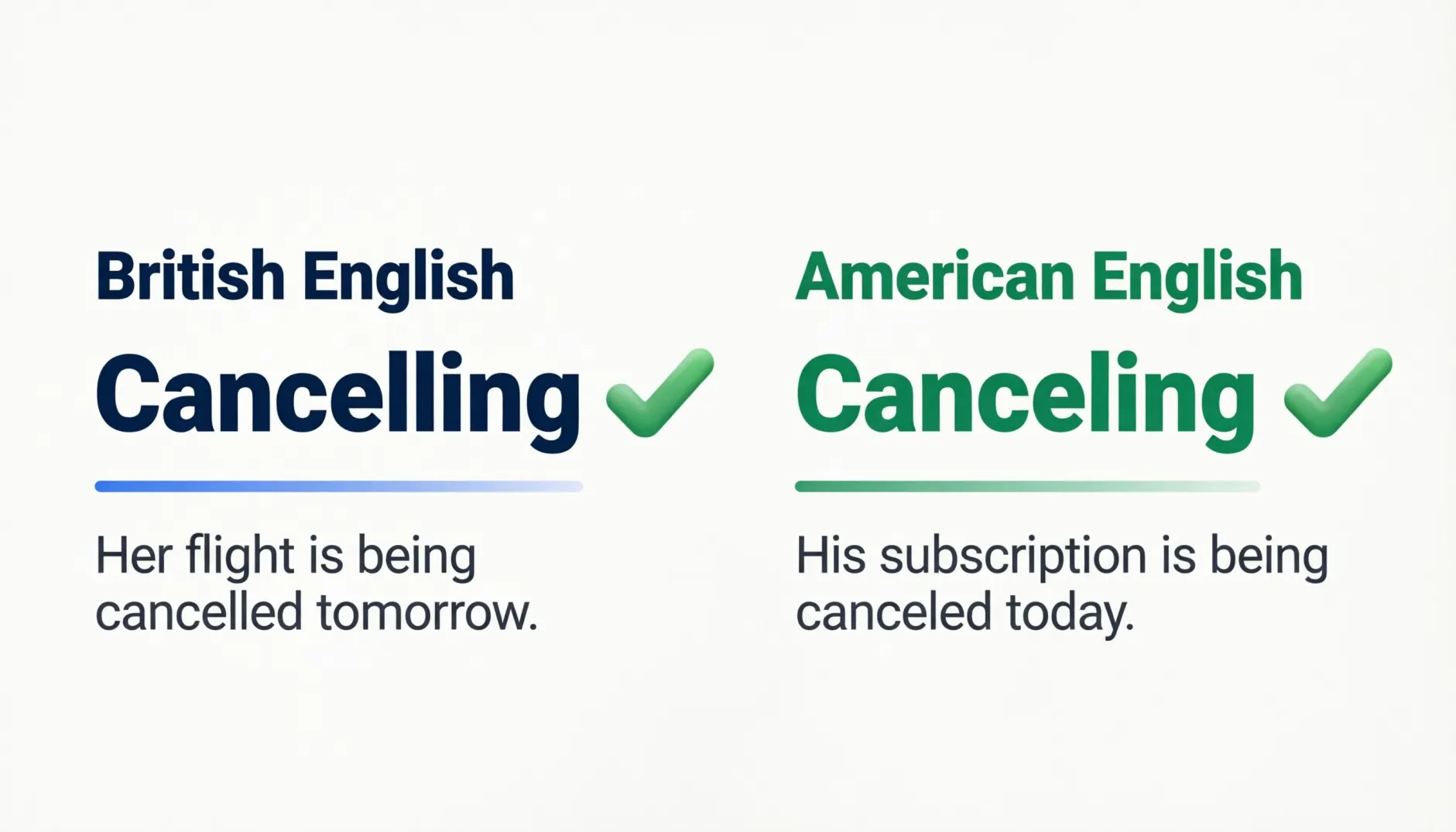
Both “cancelling” and “canceling” are correct.
- Cancelling is the preferred spelling in British English.
- Canceling is the preferred spelling in American English.
Examples:
- British English: The airline is cancelling flights due to bad weather.
- American English: The airline is canceling flights due to bad weather.
Choose the version that matches the type of English you are using and stay consistent throughout your writing.
What Do “Cancelling” and “Canceling” Mean?
Both words are the present participle and gerund form of the verb cancel.
Cancel means:
- To decide that something will not happen
- To stop a planned event, service, or agreement
- To call something off
Examples:
- We had to cancel the meeting.
- They canceled the trip.
- The school canceled classes because of snow.
When changing cancel into its ing form, English speakers use either cancelling or canceling, depending on regional spelling rules.
Why Are There Two Different Spellings?
| British English | American English |
|---|---|
| cancelling | canceling |
| cancelled | canceled |
| traveller | traveler |
| travelling | traveling |
| labelled | labeled |
British English often doubles the final l before adding endings like ing or ed.
American English usually keeps a single l.
This is why British writers use cancelling, while American writers prefer canceling.
British English vs American English
British English
In British English, the final l is normally doubled before adding ing or ed.
Examples:
- cancel → cancelling
- cancel → cancelled
- travel → travelling
- model → modelling
Example sentence:
The company is cancelling several projects this year.
American English
In American English, the final l is usually not doubled.
Examples:
- cancel → canceling
- cancel → canceled
- travel → traveling
- model → modeling
Example sentence:
The company is canceling several projects this year.
The meaning stays exactly the same.
The Grammar Rule Behind It
The difference is based on spelling conventions, not grammar.
When adding ing to many verbs, English sometimes doubles the final consonant.
For British English:
- cancel → cancelling
For American English:
- cancel → canceling
There is no difference in pronunciation.
Both are pronounced the same way.
Is One Spelling More Correct Than the Other?
No.
Neither spelling is more correct.
The right choice depends on your audience.
Use cancelling if you are writing:
- For the UK
- For Australia
- For New Zealand
- For many Commonwealth countries
Use canceling if you are writing:
- For the United States
- For American schools
- For American businesses
- For American publications
Consistency is more important than choosing one version over the other.
Usage Examples
Formal Writing
- The organization is cancelling all scheduled events until further notice.
- The airline is canceling several flights due to weather conditions.
- Management is cancelling the contract after reviewing the agreement.
- The university is canceling classes for the day.
Informal Writing
- We’re cancelling our weekend plans.
- I’m canceling my gym membership next month.
- She keeps cancelling dinner at the last minute.
- Are you canceling the party?
Academic Writing
- Researchers considered cancelling the study because of limited data.
- The administration announced it was canceling the program.
- The committee discussed cancelling future meetings.
- The institution is canceling outdated policies.
12 Example Sentences
- The airline is cancelling flights because of heavy fog.
- The airline is canceling flights because of heavy fog.
- We are cancelling our vacation plans this year.
- They are canceling the concert due to safety concerns.
- She regrets cancelling the appointment.
- He is canceling his subscription today.
- The school is cancelling outdoor activities.
- The company is canceling several projects.
- I dislike cancelling plans at the last minute.
- They discussed canceling the meeting.
- The event organizers are cancelling the show.
- The manager is canceling tomorrow’s presentation.
Common Mistakes Learners Make
Mistake 1: Thinking One Version Is Wrong
❌ Canceling is incorrect.
✅ Canceling is correct in American English.
Mistake 2: Mixing Styles
❌ The company is cancelling flights and has canceled reservations.
✅ The company is cancelling flights and has cancelled reservations. (British)
✅ The company is canceling flights and has canceled reservations. (American)
Mistake 3: Changing Spellings Within the Same Document
❌ cancelling, canceled, cancelling
✅ cancelling, cancelled, cancelling
✅ canceling, canceled, canceling
Keeping the same style throughout your writing looks more professional.
Related Forms of the Word “Cancel”
Here are other forms that follow the same spelling pattern.
| British English | American English |
|---|---|
| cancelled | canceled |
| cancelling | canceling |
| cancellation | cancellation |
| canceller | canceler |
This surprises many learners.
Similar or Commonly Confused Words
Many English words follow the same British American pattern.
Travelling vs Traveling
- British: travelling
- American: traveling
Labelled vs Labeled
- British: labelled
- American: labeled
Modelled vs Modeled
- British: modelled
- American: modeled
Fuelled vs Fueled
- British: fuelled
- American: fueled
Learning these patterns makes it easier to recognize regional spelling differences.
Modern Usage Preferences
Today, both spellings appear frequently online.
However:
- American websites strongly prefer canceling.
- British websites strongly prefer cancelling.
- International companies often choose one style guide and use it consistently.
If you’re unsure which spelling to use, think about where your readers are located.
Quick Tips to Remember
Memory Trick :1
Think:
- UK = Double L
- US = Single L
Memory Trick :2
If you write travelling, you will probably write cancelling too.
If you write traveling, you will probably write canceling too.
Memory Trick :3
The meaning never changes.
Only the regional spelling changes.
Simple Rule
- British English → cancelling
- American English → canceling
FAQs
Is cancelling correct?
Yes. Cancelling is the standard British English spelling.
Is canceling correct?
Yes. Canceling is the standard American English spelling.
Which spelling should I use in school assignments?
Use whichever spelling style your teacher, school, or country prefers.
Do cancelling and canceling have different meanings?
No. Both words have exactly the same meaning.
Which spelling is more common worldwide?
Both are widely used, but usage depends on region. British English favors cancelling, while American English favors canceling.
Is cancelled or canceled correct?
Both are correct. Cancelled is British English, and canceled is American English.
How do I know which version to choose?
Choose the spelling that matches your audience and use it consistently throughout your writing.
Conclusion
The confusion between cancelling and canceling is easy to understand because both spellings are correct. The only real difference is regional preference. British English uses cancelling, while American English uses canceling.
Neither spelling changes the meaning or pronunciation of the word. As long as you choose the version that fits your audience and stay consistent, you’ll be using the word correctly every time.