Have you ever put an egg in a glass of water and wondered, “Do eggs float or sink?” You may have heard that fresh eggs sink while older eggs float, but what does this simple test really tell you? The answer has to do with the air pocket inside the egg, which becomes larger as the egg ages.
The egg float test is a quick and easy way to get an idea of an egg’s freshness. However, a floating egg does not automatically mean it is rotten or unsafe to eat. In this guide, you’ll learn why eggs float or sink, what each position means, how to perform the egg float test correctly, and what other signs can help you decide whether an egg is still good to use.
Quick Answer
Fresh eggs usually sink in water, while older eggs may float. As an egg gets older, air enters through its shell and the air pocket inside becomes larger. This makes the egg more buoyant, so it can begin to stand upright or float. However, a floating egg is not automatically rotten.
Why Do Eggs Float or Sink?
The main reason an egg floats or sinks is density.
An object sinks when it is denser than the liquid around it. It floats when it is less dense than the liquid.
A fresh egg contains a relatively small air cell inside its shell. Most of the egg is made up of water, protein, fat, and other substances, so the egg is dense enough to sink in ordinary water.
As an egg ages, changes happen inside the shell. The shell may look solid, but it contains thousands of tiny pores. Over time, moisture and gases can move through these pores.
The egg gradually loses some moisture and gases, while air enters and the air pocket becomes larger.
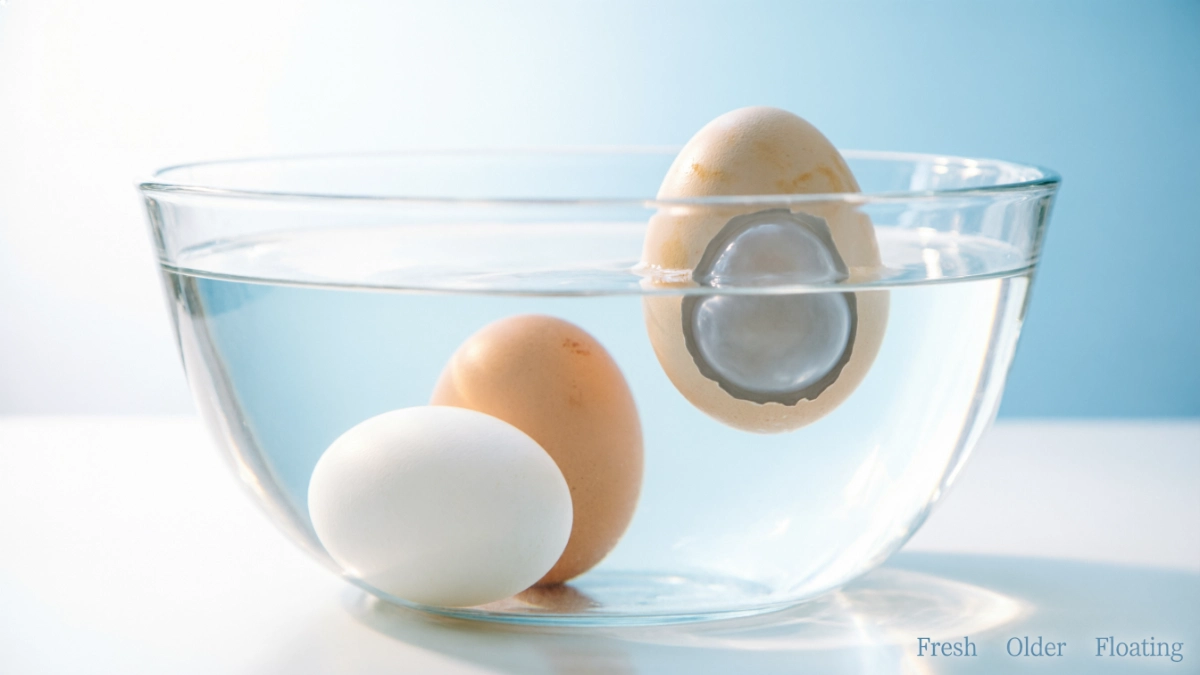
This larger air pocket makes the egg less dense overall. Eventually, the egg may:
- Lie flat on the bottom → usually a very fresh egg
- Stand upright on the bottom → an older egg
- Float near the surface → a still older egg
This is why the simple water test is often called the egg float test or egg freshness test.
What Does It Mean When an Egg Sinks?
When an egg sinks to the bottom of a bowl or glass of water, it generally means the egg is relatively fresh.
A very fresh egg usually sinks and lies flat on its side.
As the egg becomes older, its internal air cell grows. The egg may still sink, but its wider end can begin pointing upward.
For example:
| What the egg does in water | What it usually means |
| Sinks and lies flat | Very fresh |
| Sinks but stands upright | Older but may still be usable |
| Stands on one end | Quite old |
| Floats | Very old; check carefully before using |
It is important to remember that this test mainly tells you about age and density, not food safety.
A sinking egg can still be unsafe if it has been contaminated or stored improperly. Likewise, a floating egg is not automatically spoiled.
What Does It Mean When an Egg Floats?
A floating egg is generally an older egg.
The reason is simple: the air cell inside the egg becomes larger over time. The larger air pocket reduces the egg’s overall density, allowing it to float more easily.
But there is a common misunderstanding here:
Floating does not automatically mean rotten.
Many people learn the rule “sink = good, float = bad,” but that is too simple.
An egg that floats should be treated as an older egg. If you are unsure about its condition, crack it into a separate bowl and inspect it before adding it to other ingredients.
Look for:
- An unusual or unpleasant smell
- Strange discoloration
- Mold
- An unusual appearance
- A damaged or leaking shell
If the egg smells rotten or looks abnormal after cracking, throw it away.
When in doubt, it is safer not to eat it.
Why Do Older Eggs Float?
The answer comes down to the air cell inside the egg.
When an egg is laid, it is warm. As it cools, the contents contract slightly and an air pocket forms between the inner and outer shell membranes, usually at the wider end of the egg.
Over time, the egg loses moisture through tiny pores in the shell. The internal air cell becomes larger.
You can think of it like a small balloon inside the egg.
A fresh egg has a relatively small air space, so the egg remains dense and sinks. An older egg has a larger air space, which makes the whole egg less dense.
Eventually, the egg can become buoyant enough to float.
So the basic process is:
Fresh egg → small air cell → higher density → sinks
Older egg → larger air cell → lower density → may float
This is the main scientific explanation behind the egg float test.
Does a Floating Egg Mean It Is Bad?
No. A floating egg is not automatically bad or rotten.
This is one of the most important points to understand.
The float test is better understood as an age test, not a perfect safety test.
An older egg can float because its air cell has grown. That does not necessarily mean harmful bacteria are present.
At the same time, an egg that sinks is not guaranteed to be safe. Food safety also depends on factors such as how the egg was handled, stored, and whether the shell has been damaged.
If you test an egg and it floats, do not simply assume it is rotten. Instead, consider its storage history and inspect it carefully after cracking it into a separate container.
If it has a strong rotten smell or looks abnormal, discard it.
How to Do the Egg Float Test
The egg float test is very easy to perform.
What You Need
You only need:
- An egg
- A clear glass, bowl, or container
- Enough water to completely cover the egg
Step 1: Fill the Container
Fill a clear container with enough water to cover the egg completely.
Step 2: Place the Egg in the Water
Gently place the egg into the water.
Do not drop it from a height because you could crack the shell.
Step 3: Watch What Happens
Look at the position of the egg.
If it sinks and lies flat, it is generally quite fresh.
If it sinks but points upward, it is older.
If it floats, it is older still and should be checked carefully before use.
Step 4: Do Not Rely on the Test Alone
The water test is only one clue.
If you are deciding whether an egg is safe to eat, also consider the egg’s storage conditions, expiration or best-before information where applicable, shell condition, smell, and appearance.
Does the Egg Float Test Really Work?
Yes, the basic science behind the test is real. An egg’s air cell becomes larger as the egg ages, which changes its density and affects whether it floats.
However, the test has limitations.
It does not give you an exact age for the egg. It also cannot detect every type of contamination or determine food safety by itself.
For that reason, it is better to think of the test this way:
The float test can help estimate an egg’s age, but it is not a complete food-safety test.
This distinction is especially important because people sometimes use the test as the only reason to decide whether an egg is safe.
Does a Fresh Egg Always Sink?
A fresh egg will usually sink in ordinary fresh water.
However, the exact behavior can vary depending on the egg, its age, and the water conditions.
For example, an egg may sit differently in the water rather than immediately lying perfectly flat.
The important idea is that fresh eggs are generally denser than water, so they tend to sink.
If you are testing eggs, look at the overall position rather than expecting every fresh egg to behave in exactly the same way.
What Happens If You Put an Egg in Salt Water?
You may have noticed that an egg behaves differently in salt water.
Salt water is denser than ordinary fresh water. Because the surrounding liquid has a higher density, it can provide more buoyant force.
As a result, an egg that sinks in fresh water may float in sufficiently salty water.
This does not mean the egg suddenly became fresher or older.
It simply demonstrates an important science principle:
The density of the liquid matters too.
This is why the traditional egg float test is normally performed using plain water, not salty water.
Why Does an Egg Stand Upright in Water?
Sometimes an egg does not lie flat and does not completely float. Instead, it stands on one end.
This usually happens because the egg has become older and its internal air cell has grown.
The wider end of the egg contains the air cell. As this space becomes larger, it changes the egg’s balance in the water.
So an egg that stands upright is generally older than one that lies flat.
It does not necessarily mean the egg is spoiled.
Think of the test as a rough age indicator:
Flat → fresher
Upright → older
Floating → oldest
But again, age and safety are not exactly the same thing.
Egg Float Test vs. Other Ways to Check an Egg
The water test is convenient, but it should not be the only thing you consider.
Here is a simple comparison:
| Method | What it can tell you | Main limitation |
| Float test | Gives a rough idea of age | Does not prove safety |
| Smell test | Can reveal obvious spoilage | Should be done after cracking carefully |
| Visual inspection | Can reveal unusual color or mold | Cannot detect every safety problem |
| Shell inspection | Shows cracks or damage | An intact shell does not guarantee safety |
| Storage information | Helps assess how the egg was handled | Dates and storage conditions vary |
A combination of these clues is more useful than relying on one test alone.
What Does a Fresh Egg Look Like When Cracked?
When you crack a fresh egg into a bowl, the egg white is usually relatively thick, and the yolk tends to sit higher and hold its shape well.
As eggs age, the white becomes thinner and the yolk may spread more easily.
This is another reason people sometimes compare the egg’s appearance after cracking it.
However, appearance alone is not a perfect safety test either.
If an egg has an offensive or rotten smell, that is a strong reason to discard it.
It is also wise to crack questionable eggs into a separate bowl rather than directly into a recipe. This prevents one bad egg from contaminating the rest of your ingredients.
Common Mistakes About Eggs That Float or Sink
There are several common misunderstandings about the egg float test.
Mistake 1: “A floating egg is definitely rotten.”
Not necessarily.
A floating egg is generally older because its internal air cell has grown. Floating alone does not prove spoilage.
Mistake 2: “A sinking egg is always safe.”
Not necessarily.
The water test mainly relates to the egg’s age and density. It cannot identify every food-safety problem.
Mistake 3: “Every egg should lie flat if it is fresh.”
Usually, but not as an absolute rule.
Eggs can behave somewhat differently depending on their age and other conditions.
Mistake 4: “Salt water gives a better freshness test.”
No.
Salt changes the density of the water, so it changes the way the egg floats. Plain water is more useful for the traditional float test.
Mistake 5: “You can tell an egg is safe just by looking at it.”
Not always.
Some food-safety risks cannot be seen, smelled, or detected through the float test.
Natural Example Sentences
The topic can also appear in everyday, formal, and academic English. Here are some natural examples.
Informal Writing
- Do eggs float or sink when they are fresh?
- My egg sank, so I think it is still fairly fresh.
- This egg is floating, so I am going to check it carefully.
- I tested the eggs in a glass of water before using them.
- Why does an old egg float in water?
Formal Writing
- The water test can provide a simple indication of an egg’s age.
- An egg may float as the air cell inside the shell becomes larger over time.
- A floating egg should not automatically be classified as spoiled.
Academic or Educational Writing
- An egg sinks when its average density is greater than the density of the surrounding water.
- As an egg ages, changes in its internal air cell can reduce its overall density.
- Salt water can cause an egg to float because salt increases the density of the surrounding liquid.
- The egg float test demonstrates the relationship between density and buoyancy.
Similar or Confused Terms
People often use several expressions when talking about this topic. They are related, but they are not always identical.
Egg Float Test
Egg float test is the common name for placing an egg in water to see whether it sinks, stands, or floats.
Example:
I used the egg float test to check how old the eggs were.
Egg Freshness Test
Egg freshness test is a broader term. It can refer to the float test or other methods used to assess an egg’s freshness.
Example:
The water test is a simple egg freshness test.
Fresh Egg
A fresh egg is an egg that has not aged significantly and generally has a smaller internal air cell.
Old Egg
An old egg has been stored for a longer period and usually has a larger internal air cell.
An old egg is not automatically a rotten egg.
Spoiled Egg
A spoiled egg is an egg that has deteriorated and should not be eaten.
This is different from simply being old.
That distinction is important:
Old does not always mean spoiled.
Is “Eggs Float or Sink” Grammatically Correct?
If you are asking the question in English, “Do eggs float or sink?” is the most natural question.
You could also say:
- Do eggs float or sink in water?
- Will an egg float or sink?
- Why do some eggs float?
- Why does an old egg float?
- How can you tell if an egg is fresh?
The phrase “eggs float or sink” can work as a topic or search phrase, but in a complete question, adding “Do” makes the grammar natural.
For example:
❌ Eggs float or sink?
✅ Do eggs float or sink?
The second version is the standard question structure.
Quick Tips to Remember
Here are a few easy ways to remember what the egg test means.
Remember the Three Positions
Flat = fresher
Upright = older
Floating = oldest
This is a simple way to remember the general pattern.
Remember the Air Pocket
Think:
Older egg = bigger air pocket = easier to float.
The larger air cell is the key reason an older egg becomes more buoyant.
Do Not Remember “Float = Rotten”
Instead, remember:
Float = older, not automatically rotten.
That small change in wording prevents one of the most common misunderstandings.
Use Plain Water
If you want to perform the traditional float test, use plain water. Salt changes the density of the water and can change the result.
Check More Than One Sign
Do not depend entirely on whether an egg sinks or floats. Consider storage, shell condition, smell, and appearance too.
FAQ
Do eggs float or sink in water?
Fresh eggs generally sink, while older eggs may stand upright or float. This happens because the air cell inside an egg becomes larger as the egg ages.
Is an egg bad if it floats?
Not necessarily. A floating egg is usually older, but floating alone does not prove that the egg is rotten or unsafe. Check its condition and storage history before deciding what to do with it.
Why does an old egg float?
An old egg floats because its internal air cell becomes larger over time. This reduces the egg’s overall density, making it more buoyant in water.
Do fresh eggs float or sink?
Fresh eggs generally sink and lie flat on the bottom of a container filled with plain water.
What does it mean if an egg stands upright in water?
An egg that stands upright is generally older than an egg that lies flat. Its internal air cell has grown, changing its balance and buoyancy.
Can a rotten egg sink?
Yes. The float test is not a perfect way to identify spoilage. An egg’s position in water mainly gives information about its age and density, so a sinking egg should not automatically be considered safe.
Does salt water make eggs float?
Yes, sufficiently salty water can make an egg float because salt increases the density of the water. This is why plain water is normally used for the traditional egg float test.
Conclusion
So, do eggs float or sink? Fresh eggs generally sink, while older eggs may stand upright or float.
The reason is the air cell inside the egg. As an egg ages, moisture and gases move through the shell, and the internal air pocket becomes larger. This makes the egg less dense and more likely to float.
The most important thing to remember is that a floating egg does not automatically mean a rotten egg. The float test is mainly a rough indicator of age, not a complete food-safety test.
For an easy memory trick, remember:
Fresh eggs sink. Older eggs rise. Floating means the egg is old not automatically bad.
When you are unsure about an egg, pay attention to its storage history and condition, and discard it if it has an obvious unpleasant smell or unusual appearance.