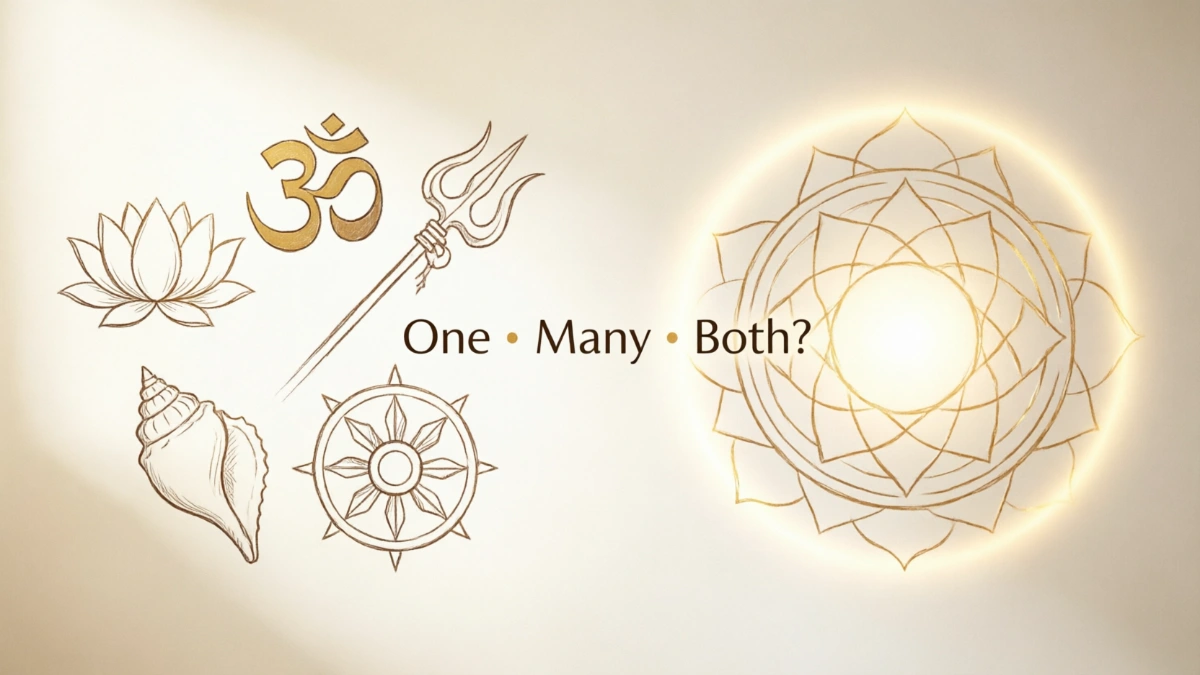
Is Hinduism monotheistic or polytheistic? The answer is not as simple as choosing one label. Hinduism is a broad and diverse religious tradition, and different Hindu schools understand God, gods, and ultimate reality in different ways.
Some Hindus worship one chosen deity, such as Vishnu, Shiva, or Devi, as the highest form of the divine. Others worship several deities. Some philosophical traditions focus on Brahman, the ultimate reality beyond individual forms and names.
This is why Hinduism can sometimes look polytheistic to an outside observer while also containing ideas that sound monotheistic or even beyond the usual monotheism-versus-polytheism categories.
Quick Answer
Hinduism is often described as polytheistic because it includes many gods and goddesses, but that description is incomplete. Many Hindu traditions teach that the different deities can be understood as different manifestations or forms of one ultimate reality, called Brahman. Other traditions focus strongly on one supreme deity.
So, Hinduism is not simply monotheistic or polytheistic. It is a diverse tradition that includes monotheistic, polytheistic, henotheistic, monistic, and other ways of understanding the divine.
What Does Monotheistic Mean?
Before deciding where Hinduism fits, it helps to understand the word monotheistic.
A monotheistic religion believes in one God. The word comes from two Greek roots:
- mono = one
- theos = god
In a simple definition, monotheism means belief in one supreme God.
For example, Judaism, Christianity, and Islam are commonly classified as monotheistic religions. Although these religions have important theological differences, they each teach belief in one God.
A simple example of a monotheistic belief would be:
There is one supreme God who is the ultimate creator and ruler of the universe.
The important point is that monotheism does not simply mean that a person mainly worships one God. It generally means that only one God is recognized as the supreme divine being.
This distinction becomes important when discussing Hinduism.
What Does Polytheistic Mean?
Polytheism means belief in or worship of multiple gods or goddesses.
The word comes from:
- poly = many
- theos = god
A polytheistic religious system may have many deities with different names, personalities, stories, powers, and roles.
Hinduism is often called polytheistic because Hindu traditions include many well-known deities, including:
- Shiva
- Vishnu
- Brahma
- Lakshmi
- Saraswati
- Parvati
- Durga
- Kali
- Ganesha
- Hanuman
- Krishna
- Rama
However, simply listing Hindu deities does not fully explain how Hindus understand them.
For many Hindus, these gods and goddesses are not necessarily understood as completely separate gods competing with one another.
Why Is Hinduism Hard to Classify?
The main reason is that Hinduism is not one single belief system with one central creed.
Hinduism developed over thousands of years and contains many philosophical schools, religious traditions, scriptures, practices, and forms of worship.
A Hindu may worship:
- Shiva as the supreme deity.
- Vishnu as the supreme deity.
- Krishna as the supreme form of God.
- Devi or Shakti as the supreme divine power.
- A chosen deity while respecting other deities.
- Brahman as the ultimate reality beyond individual forms.
Because of this diversity, asking, “Does Hinduism believe in one God or many gods?” can be a little like asking for one answer that represents every Hindu tradition.
There is no single answer that accurately describes every Hindu.
What Is Brahman in Hinduism?
One of the most important ideas for understanding this question is Brahman.
In many Hindu philosophical traditions, Brahman refers to the ultimate reality or highest spiritual reality.
Brahman should not be confused with Brahma, the deity traditionally associated with creation in Hindu traditions.
The words look similar, but they refer to different concepts.
| Term | Meaning |
| Brahman | Ultimate reality in many Hindu philosophical traditions |
| Brahma | A deity associated with creation |
| Brahmin | A traditional social and priestly class in Hindu society |
Different Hindu schools explain Brahman in different ways.
For example, Advaita Vedanta teaches a non-dual understanding in which ultimate reality, Brahman, is the highest truth. Individual forms of the divine may be understood in relation to this ultimate reality.
Other Hindu traditions place greater emphasis on a personal God.
This is one reason a simple “one God versus many gods” classification can miss the deeper ideas within Hindu philosophy.
Are Hindu Gods Different Gods or Forms of One Reality?
This depends on the Hindu tradition and the individual believer.
Some Hindus understand different deities as different manifestations, forms, or expressions of the divine.
For example, a person might worship Shiva while recognizing Vishnu, Devi, Ganesha, or other deities as sacred.
In another tradition, a devotee may regard Vishnu or Krishna as the supreme God and understand other deities within that theological framework.
Similarly, Shakta traditions can regard Devi or Shakti—the divine feminine power—as supreme.
Therefore, the relationship between the many Hindu deities and ultimate reality is interpreted in different ways.
This is an important distinction: the presence of many divine names and forms does not automatically mean that every Hindu believes in many completely separate supreme gods.
Is Hinduism Polytheistic?
Yes, Hinduism can be described as polytheistic, especially when referring to traditions involving the worship of multiple deities.
However, saying only “Hinduism is polytheistic” can be misleading.
Hindu religious practice includes devotion to many gods and goddesses, but Hindu ideas about those deities vary greatly.
Some Hindus may see the deities as distinct divine beings. Others may understand them as different expressions of a single ultimate reality.
This means that polytheistic is a useful description of some aspects of Hinduism, but it does not capture the entire tradition.
Is Hinduism Monotheistic?
Hinduism can also have monotheistic or strongly one-deity-centered forms of worship.
For example, a Vaishnava Hindu may worship Vishnu or one of Vishnu’s forms, such as Krishna, as the supreme God.
A Shaiva Hindu may regard Shiva as supreme.
A Shakta Hindu may regard Devi or Shakti as supreme.
In these traditions, devotion can be deeply focused on one supreme divine reality.
However, this does not always work exactly like the strict monotheism found in religions such as Islam or Judaism. The theological ideas surrounding other deities and the nature of ultimate reality can be very different.
So it is better to say that some Hindu traditions are strongly centered on one supreme deity rather than claiming that all Hinduism is monotheistic.
What Is Henotheism?
The word henotheism is especially useful when discussing Hinduism.
Henotheism generally refers to devotion to one deity as supreme without necessarily denying the existence or importance of other deities.
This can help explain some forms of Hindu worship.
For example, a devotee may give complete devotion to Shiva as the highest deity while still recognizing other divine figures.
Another devotee may center their worship on Vishnu or Krishna.
This is different from strict monotheism because the religious worldview may still include other divine beings.
However, not every Hindu tradition should be labeled henotheistic. It is a term used by scholars to describe certain patterns of religious belief and worship.
Hinduism and the Trimurti
Another source of confusion is the Trimurti.
The Trimurti is traditionally associated with three major deities:
- Brahma — associated with creation
- Vishnu — associated with preservation
- Shiva — associated with destruction or transformation
People sometimes assume that this means Hinduism teaches three equal gods who together make up one God, similar to the Christian Trinity.
That comparison is not accurate.
The Trimurti and the Christian Trinity are different religious concepts with different histories and meanings.
Also, the Trimurti does not represent the beliefs of every Hindu tradition. Many Hindus focus primarily on one deity rather than giving equal importance to all three.
Hinduism vs. Christianity: Why the Comparison Can Be Confusing
People sometimes compare Hinduism with Christianity because both traditions use ideas about a supreme divine reality and multiple divine figures.
However, the similarities should not be overstated.
Christianity teaches one God and traditionally understands the Father, Son, and Holy Spirit as the Trinity. These are not three separate gods.
Hindu traditions have a much wider range of ideas about deities, divine forms, manifestations, and ultimate reality.
For example, Hindu traditions may describe Shiva, Vishnu, Krishna, Devi, and other figures in ways that vary from one school to another.
So, the Hindu idea of multiple divine forms should not simply be equated with the Christian Trinity.
Hinduism vs. Other Polytheistic Religions
Hinduism is also different from the ancient Greek or Roman religious systems that are often used as classic examples of polytheism.
In ancient Greek religion, for example, gods such as Zeus, Athena, Apollo, and Aphrodite had distinct identities and roles within the religious worldview.
Hinduism also has many distinct deities and stories, but its philosophical traditions include ideas about Brahman, divine unity, the self, and the relationship between different forms of divinity.
Therefore, calling Hinduism “polytheistic” can be useful at a basic level, but it should not lead learners to assume that Hindu beliefs work exactly like every other polytheistic religion.
Common Hindu Deities and Their Roles
Understanding a few major deities can make the topic easier.
| Deity | Commonly Associated With |
| Shiva | Transformation, destruction, meditation, asceticism |
| Vishnu | Preservation and protection |
| Brahma | Creation |
| Lakshmi | Wealth, prosperity, good fortune |
| Saraswati | Knowledge, learning, music, arts |
| Ganesha | Wisdom, beginnings, removing obstacles |
| Durga | Strength and protection |
| Kali | Powerful forms of the divine feminine |
| Krishna | A major form of Vishnu and central figure in Vaishnava traditions |
| Rama | A major avatar of Vishnu |
These descriptions are simplified. Each deity has a rich history, symbolism, and theology across different Hindu traditions.
Is Brahman the Same as Brahma?
No. Brahman and Brahma are different.
This is one of the most common mistakes people make when learning about Hinduism.
Brahman is a philosophical term for ultimate reality in many Hindu traditions.
Brahma is a deity associated with creation.
The final letters matter:
- Brahman = ultimate reality
- Brahma = deity associated with creation
Remembering this difference can prevent a lot of confusion when reading about Hindu beliefs.
Usage Examples
Here are natural examples of how you might discuss this topic in different types of writing.
Formal Writing
- Hinduism is difficult to classify as purely monotheistic or polytheistic because it contains many different theological traditions.
- Many Hindu traditions recognize multiple deities while also teaching about an ultimate divine reality.
- The concept of Brahman is important in several Hindu philosophical schools.
- Some Hindu traditions focus devotion on one supreme deity, such as Vishnu, Shiva, or Devi.
Informal Writing
- Is Hinduism polytheistic? It can be, but that answer does not tell the whole story.
- Hindus may worship different gods and goddesses depending on their tradition and personal devotion.
- Some people think Hinduism has many completely separate gods, but Hindu beliefs about the deities are more complex than that.
Academic Writing
- Hinduism encompasses a range of theological positions, including traditions centered on one supreme deity and traditions emphasizing multiple forms of divinity.
- The category of polytheism alone does not fully describe the philosophical diversity found within Hindu traditions.
- Henotheism is sometimes used by scholars to describe devotional traditions in which one deity is treated as supreme while other deities remain recognized.
- Advaita Vedanta presents a non-dual understanding of ultimate reality centered on Brahman.
- Different Hindu schools offer different interpretations of the relationship between individual deities and ultimate reality.
Common Mistakes
Mistake 1: Saying Hinduism is simply polytheistic
Incorrect:
“Hinduism is just a religion with many gods.”
Better:
“Hinduism includes many deities and traditions, but Hindus understand those deities in different ways.”
The first statement is too simplistic. It ignores Hindu philosophical traditions that emphasize one supreme reality or one supreme deity.
Mistake 2: Saying every Hindu believes in one God
Incorrect:
“All Hindus believe in exactly one God.”
Better:
“Some Hindu traditions focus on one supreme deity or ultimate reality, while Hinduism as a whole contains diverse beliefs about the divine.”
Hinduism does not have one single theology shared by every Hindu.
Mistake 3: Confusing Brahman with Brahma
Incorrect:
“Brahma means the ultimate reality in Hinduism.”
Correct:
“Brahman is a term for ultimate reality in many Hindu philosophical traditions, while Brahma is a deity associated with creation.”
Mistake 4: Comparing the Trimurti directly with the Trinity
Incorrect:
“The Hindu Trimurti is the same as the Christian Trinity.”
Correct:
“The Trimurti and the Christian Trinity are different religious concepts.”
Mistake 5: Assuming all Hindus worship the same gods
Incorrect:
“Every Hindu worships Shiva, Vishnu, and Brahma equally.”
Correct:
“Hindu worship varies widely, and many Hindus have a particular deity or tradition that is especially important to them.”
Similar or Confused Terms
Several terms are useful when researching this topic.
Monotheism
Monotheism means belief in one God.
Polytheism
Polytheism means belief in or worship of multiple gods or goddesses.
Henotheism
Henotheism describes devotion to one deity as supreme while not necessarily denying other deities.
Monism
Monism is the philosophical idea that reality is ultimately one in some sense. Some Hindu philosophical traditions are described using forms of monism or non-dualism.
Pantheism
Pantheism generally identifies God or divinity with the universe or reality as a whole. Some discussions compare certain Hindu ideas with pantheism, but Hindu traditions are diverse and should not all be labeled pantheistic.
Panentheism
Panentheism describes a view in which the universe exists within God or ultimate reality while God is understood as more than the universe. Some Hindu theological ideas have been compared with panentheism, but again, Hinduism does not have one single theology.
These terms show why the question cannot always be answered with only two choices.
Does Hinduism Have One God?
There is no single answer that represents every Hindu tradition.
Some Hindus may say that there is one ultimate divine reality behind the many forms of worship.
Others may emphasize a particular supreme deity such as Vishnu, Shiva, Krishna, or Devi.
Others may understand different deities as genuinely distinct divine beings.
The safest general answer is:
Hinduism contains many different beliefs about the nature of God, gods, and ultimate reality.
That answer respects the diversity of Hindu traditions without forcing them into one narrow category.
Why Do Hindus Worship Statues and Images?
Another common question is whether Hindu images mean that Hindus worship “many gods” in a simple sense.
In many Hindu traditions, images and sacred representations of deities are used as part of worship. These are often called murtis.
The meaning of a murti depends on the tradition and theological understanding. For devotees, the image can serve as a sacred representation or manifestation through which the divine is approached.
It is therefore too simplistic to say:
“Hindus worship statues instead of God.”
That statement does not accurately represent Hindu understandings of sacred images.
The role of images in Hindu worship is connected to much broader ideas about divine presence, devotion, symbolism, and sacred practice.
Do All Hindus Believe the Gods Are Real?
No single answer applies to every Hindu.
Hindu traditions contain different philosophical positions concerning gods, ultimate reality, the self, and the universe.
Some traditions strongly emphasize devotion to a personal deity. Others focus more heavily on philosophical ideas about Brahman and consciousness.
This diversity is one of the defining features of Hindu thought.
It is therefore better to ask which Hindu tradition or philosophical school is being discussed rather than assuming that all Hindus hold exactly the same beliefs.
Modern Usage and the Best Way to Describe Hinduism
When writing about Hinduism today, it is best to avoid overly broad statements.
Instead of writing:
“Hinduism is a polytheistic religion.”
You can write:
“Hinduism includes many deities and diverse traditions, with some schools emphasizing one supreme deity or ultimate reality.”
This wording is more accurate because it acknowledges the diversity within Hinduism.
If you are writing a school assignment, article, or general explanation, you can also say:
“Hinduism is often classified as polytheistic because of its many deities, but the tradition includes a wide range of beliefs about the relationship between those deities and ultimate reality.”
This gives readers the simple answer while adding the important qualification.
Quick Tips to Remember
Here are a few easy ways to remember the main idea:
- Mono = one → monotheism means belief in one God.
- Poly = many → polytheism means belief in many gods.
- Hinduism = diverse → Hindu traditions do not all share one theological view.
- Brahman ≠ Brahma → Brahman is ultimate reality in many philosophical traditions; Brahma is a deity associated with creation.
- One deity does not always mean strict monotheism → a Hindu devotee may focus on one deity while recognizing other divine beings.
- Many deities do not automatically mean completely separate gods → some Hindus understand different deities as forms or manifestations of a deeper divine reality.
- Context matters → when discussing Hinduism, identify the specific tradition or school when possible.
The easiest memory sentence is:
Hinduism has many deities, but Hindu ideas about those deities are diverse.
FAQ
Is Hinduism monotheistic or polytheistic?
Hinduism is often classified as polytheistic because it includes many gods and goddesses. However, that label is incomplete because some Hindu traditions emphasize one supreme deity or an ultimate reality called Brahman.
Do Hindus believe in one God or many gods?
It depends on the Hindu tradition and individual beliefs. Some Hindus focus on one supreme deity, while others worship multiple deities or understand different deities as forms of one ultimate reality.
Is Hinduism a polytheistic religion?
Hinduism can be described as polytheistic because many Hindu traditions include worship of multiple deities. However, Hinduism is extremely diverse, so polytheism alone does not fully describe the entire tradition.
Is Brahman one God?
Brahman is not simply the same concept as a personal God in every Hindu tradition. In many philosophical schools, Brahman refers to ultimate reality. Different Hindu traditions understand Brahman and its relationship to personal deities in different ways.
Are Brahma and Brahman the same?
No. Brahma is a deity associated with creation, while Brahman is a term for ultimate reality in many Hindu philosophical traditions.
What is the difference between Hinduism and monotheistic religions?
Hinduism contains a wide variety of beliefs about gods, goddesses, ultimate reality, and worship. Religions commonly classified as monotheistic, such as Judaism, Christianity, and Islam, center their theology on belief in one God. The categories are therefore not directly interchangeable.
Why do people call Hinduism polytheistic?
People often use the term polytheistic because Hindu traditions include many gods and goddesses who are worshipped in different forms. However, this description can miss Hindu beliefs about divine unity, Brahman, and one supreme deity.
Conclusion
So, is Hinduism monotheistic or polytheistic?
The most accurate beginner-friendly answer is: Hinduism cannot be fully described by either label alone.
It is often called polytheistic because Hindu traditions include many gods and goddesses. At the same time, many Hindu traditions teach about one supreme deity, one ultimate reality, or different forms of a deeper divine reality.
This is why Hinduism is best understood as a highly diverse religious tradition rather than a religion that fits neatly into one category.
If you remember only one thing, remember this:
Hinduism includes many deities, but Hindus do not all understand those deities in the same way.
That simple distinction explains why the answer to “Is Hinduism monotheistic or polytheistic?” is more nuanced than a simple yes or no.