Have you ever written a sentence like this and stopped to think?
“Who’s book is this?”
Or was it:
“Whose book is this?”
You are not alone. Many English learners confuse whose and who’s because they sound exactly the same when spoken. Even native speakers sometimes mix them up in emails, social media posts, and school writing.
But here’s the good news: the difference is actually very simple once you understand one small grammar rule.
In this beginner-friendly guide, you’ll learn:
- The meaning of whose and who’s
- When to use each word
- Easy grammar tricks to remember them
- Real-life examples
- Common mistakes learners make
- UK vs US usage differences
- FAQs and quick memory tips
By the end, you’ll never confuse these two words again.
Quick Answer: What Is the Difference Between “Whose” and “Who’s”?
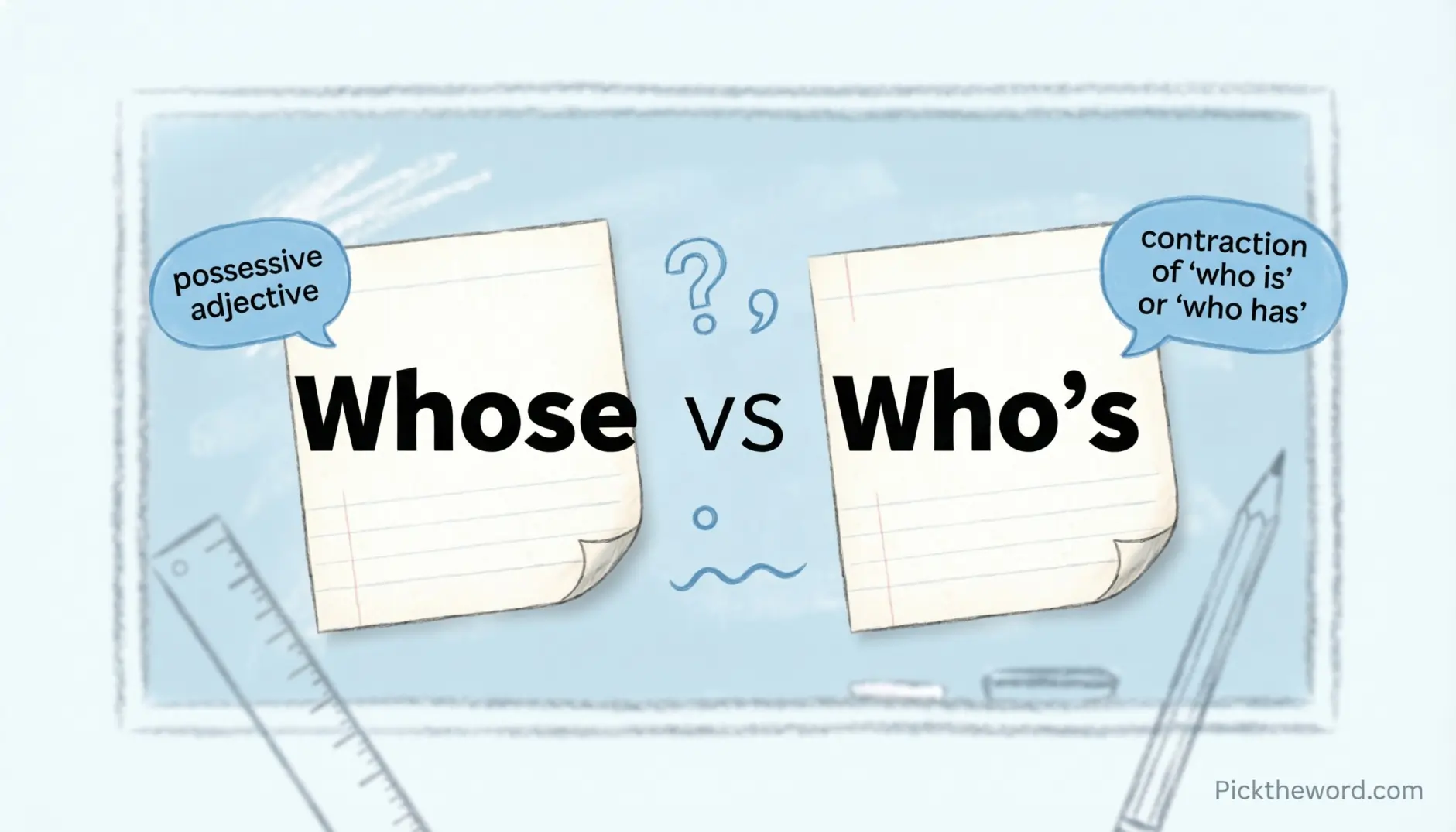
Whose shows possession. It asks or tells who something belongs to.
Who’s is a contraction of who is or who has.
Examples:
- Whose bag is on the chair?
- Who’s coming to dinner tonight?
A quick test:
- If you can replace the word with who is or who has, use who’s.
- If it shows ownership, use whose.
What Does “Whose” Mean?
Whose is a possessive word. It asks about ownership or belonging.
It helps us find out which person owns something.
Examples:
- Whose phone is ringing?
- Do you know whose jacket this is?
- Whose idea was this?
In all these sentences, whose connects a person to an object or idea.
Simple Rule
Use whose when talking about:
- Ownership
- Possession
- Belonging
Think of It Like This
| Word | Meaning |
|---|---|
| Whose | Belonging to whom? |
More Examples
- Whose shoes are at the door?
- I don’t know whose notebook this is.
- Whose turn is it?
- She asked whose car was outside.
Notice how every example talks about something connected to a person.
What Does “Who’s” Mean?
Who’s is a contraction.
A contraction is a shortened form of two words.
“Who’s” Can Mean:
- Who is
- Who has
Examples
- Who’s calling me?
(Who is calling me?) - Who’s finished the homework?
(Who has finished the homework?)
Simple Rule
Use who’s only when you can expand it into:
- who is
- who has
Easy Check
Read the sentence again by replacing who’s with who is.
If the sentence still makes sense, then who’s is correct.
Example
- Who’s at the door?
→ Who is at the door? ✔ - Who’s backpack is this?
→ Who is backpack is this? ✘
So the correct sentence is:
- Whose backpack is this? ✔
Why Do People Confuse “Whose” and “Who’s”?
The confusion happens because the two words:
- Sound exactly alike
- Have very similar spelling
- Are used in questions
These are called homophones — words that sound the same but have different meanings and spellings.
Another Reason
Many learners think apostrophes always show possession.
For example:
- Sarah’s book
- John’s phone
So they wrongly assume:
- who’s = belonging to who
But in this case, the apostrophe does not show possession.
Instead, who’s is simply a contraction.
That’s why:
- whose = possession
- who’s = who is/who has
Whose vs. Who’s: Key Differences
| Feature | Whose | Who’s |
|---|---|---|
| Word Type | Possessive word | Contraction |
| Meaning | Belonging to whom | Who is / Who has |
| Apostrophe | No | Yes |
| Talks About | Ownership | Action or identity |
| Example | Whose keys are these? | Who’s coming with us? |
Is “Whose” or “Who’s” More Common?
Both words are very common in English, but they appear in different situations.
“Whose” Is Common In:
- Questions about ownership
- Academic writing
- Formal English
- Everyday conversations
“Who’s” Is Common In:
- Spoken English
- Informal writing
- Text messages
- Casual conversations
Neither word is “better.” You simply use the correct one depending on the meaning.
Are Both Forms Correct?
Yes. Both whose and who’s are correct English words.
The important thing is using the right word in the right sentence.
Correct Examples
- Whose laptop is this?
- Who’s ready for lunch?
Incorrect Examples
- Who’s laptop is this? ✘
- Whose coming with us? ✘
Historical Background of “Whose” and “Who’s”
English grammar has changed over hundreds of years.
“Whose”
The word whose comes from old forms of English used to show possession. It has been part of the language for centuries.
“Who’s”
Contractions like who’s became more common later, especially in casual and spoken English.
Today, contractions are widely accepted in:
- Everyday writing
- Emails
- Social media
- Informal communication
But formal academic writing often avoids contractions.
British vs American English Usage
There is almost no difference between British English and American English for these words.
Both regions use:
- whose for possession
- who’s for “who is” or “who has”
Comparison Table
| Region | Preferred Usage |
|---|---|
| United States | Same grammar rules |
| United Kingdom | Same grammar rules |
| Canada | Same grammar rules |
| Australia | Same grammar rules |
Global Usage
The grammar rule is standard across English-speaking countries.
So no matter where you learn English:
- whose = possession
- who’s = who is/who has
Audience Recommendation
| Audience | Best Practice |
|---|---|
| Students | Avoid mistakes by using the replacement test (who is / who has) |
| Professionals | Use full forms in formal writing if unsure |
| Casual writers | Contractions are fine in informal writing |
How to Use “Whose” in Different Types of Writing
Formal Writing
- Whose responsibility is this project?
- The manager asked whose report was incomplete.
Academic Writing
- Researchers studied whose methods were most effective.
- The teacher checked whose assignment was missing.
Informal Writing
- Whose snacks are in the fridge?
- Do you know whose hoodie this is?
Workplace Communication
- Whose client meeting was moved?
- Please confirm whose desk needs repair.
Social Media and Texts
- Whose dog is that? So cute!
- Anyone know whose water bottle this is?
How to Use “Who’s” in Different Types of Writing
Formal Writing
Formal writing often avoids contractions, but they may still appear in quotes or casual business communication.
- Who’s responsible for the final review?
Academic Writing
Academic writing usually prefers:
- who is
instead of: - who’s
Informal Writing
- Who’s online right now?
- Who’s bringing the pizza?
Emails
- Who’s available for the meeting tomorrow?
- Who’s handling the client account?
Social Media and Text Messages
- Who’s watching this show tonight?
- Who’s excited for the weekend?
12 Natural Example Sentences
Here are real-life examples to help you understand both words clearly.
- Whose bike is parked outside?
- Who’s coming to the party tonight?
- I wonder whose idea this was.
- Who’s been using my computer?
- Whose phone keeps ringing?
- Do you know who’s at the door?
- She forgot whose turn it was.
- Who’s ready to start the game?
- Whose shoes are these?
- Who’s already finished the project?
- Nobody knew whose bag was missing.
- Who’s going to explain the homework?
Common Mistakes Learners Make
Many English learners make the same mistakes again and again.
Mistake 1: Using “Who’s” for Possession
❌ Who’s pencil is this?
✔ Whose pencil is this?
Why It’s Wrong
“Who’s” means “who is.” The sentence becomes:
- Who is pencil is this? ✘
That makes no sense.
Mistake 2: Forgetting the Contraction Rule
❌ Whose coming with us?
✔ Who’s coming with us?
Why It’s Wrong
The sentence means:
- Who is coming with us?
So you need who’s.
Mistake 3: Overusing Apostrophes
Many learners think apostrophes always show ownership.
But contractions also use apostrophes.
Examples:
- it’s = it is
- she’s = she is
- who’s = who is
Similar and Commonly Confused Words
Here are other confusing English word pairs similar to whose and who’s.
| Confusing Words | Difference |
|---|---|
| Its / It’s | Possession vs. it is / it has |
| Their / They’re | Possession vs. they are |
| Your / You’re | Possession vs. you are |
| Whose / Who’s | Possession vs. who is / who has |
Helpful Pattern
| Possessive Words | Contractions |
|---|---|
| whose | who’s |
| your | you’re |
| their | they’re |
| its | it’s |
Learning one pair can help you understand the others.
Google Trends and Usage Patterns
People search for whose vs who’s very often because it is a common grammar mistake.
Searches usually increase during:
- School exam periods
- Essay writing seasons
- English-learning courses
General Language Trends
- Who’s appears more often in spoken English and casual online writing.
- Whose appears frequently in questions and formal grammar exercises.
Regional Preferences
There are no major regional differences in grammar rules.
However:
- Formal British writing may avoid contractions slightly more often.
- American English uses contractions very naturally in casual communication.
Globally, both forms are understood the same way.
Quick Tips to Remember
Memory Trick :1
If you can say:
- who is
or - who has
Use who’s.
Memory Trick :2
Think of whose like:
- his
- hers
- theirs
All of these show possession.
Memory Trick :3
The apostrophe in who’s replaces missing letters:
- who + is
- who + has
Fast Grammar Rule
| If the sentence talks about… | Use |
|---|---|
| Ownership or possession | whose |
| Who is or who has | who’s |
Frequently Asked Questions (FAQs)
Is “who’s” ever possessive?
No. Who’s is never possessive. It only means:
- who is
- who has
For possession, always use whose.
Can I use “whose” for objects and animals?
Yes. Modern English commonly uses whose for animals and sometimes objects.
Example:
- The company whose office closed moved online.
Is “whose” formal or informal?
It works in both formal and informal English.
You can use it in:
- essays
- conversations
- emails
- business writing
Why does “whose” not have an apostrophe?
Because it is already a possessive word.
Similar examples:
- his
- hers
- theirs
These words also do not use apostrophes.
How can I quickly check which word is correct?
Replace the word with:
- who is
or - who has
If the sentence still makes sense, use who’s.
If not, use whose.
Conclusion
The difference between whose and who’s becomes easy once you remember one simple idea:
- Whose shows possession.
- Who’s means who is or who has.
Even though the two words sound the same, they have completely different grammar roles.
Whenever you feel confused, try the quick replacement test:
- Can it become “who is”?
If yes, use who’s.
If the sentence talks about ownership or belonging, use whose.
With practice, you’ll start choosing the correct word naturally in speaking, writing, emails, and everyday English.

Hi, I’m Virginia Woolf, a language enthusiast passionate about exploring the power of words and their meanings. I specialize in helping readers choose the right words through clear comparisons, synonyms, and practical usage. My goal is to make vocabulary learning simple, engaging, and useful for everyday communication. picktheword.com