Many English learners get confused between start and sit because both are common verbs used in everyday conversations.
However, these words have completely different meanings and cannot replace each other in most situations.
If you have ever wondered whether you should say “start the meeting” or “sit the meeting,” or If “sit your work” is correct, this guide will clear up the confusion.
By the end, you will know exactly when to use start and when to use sit, along with easy examples and memory tricks.
Quick Answer
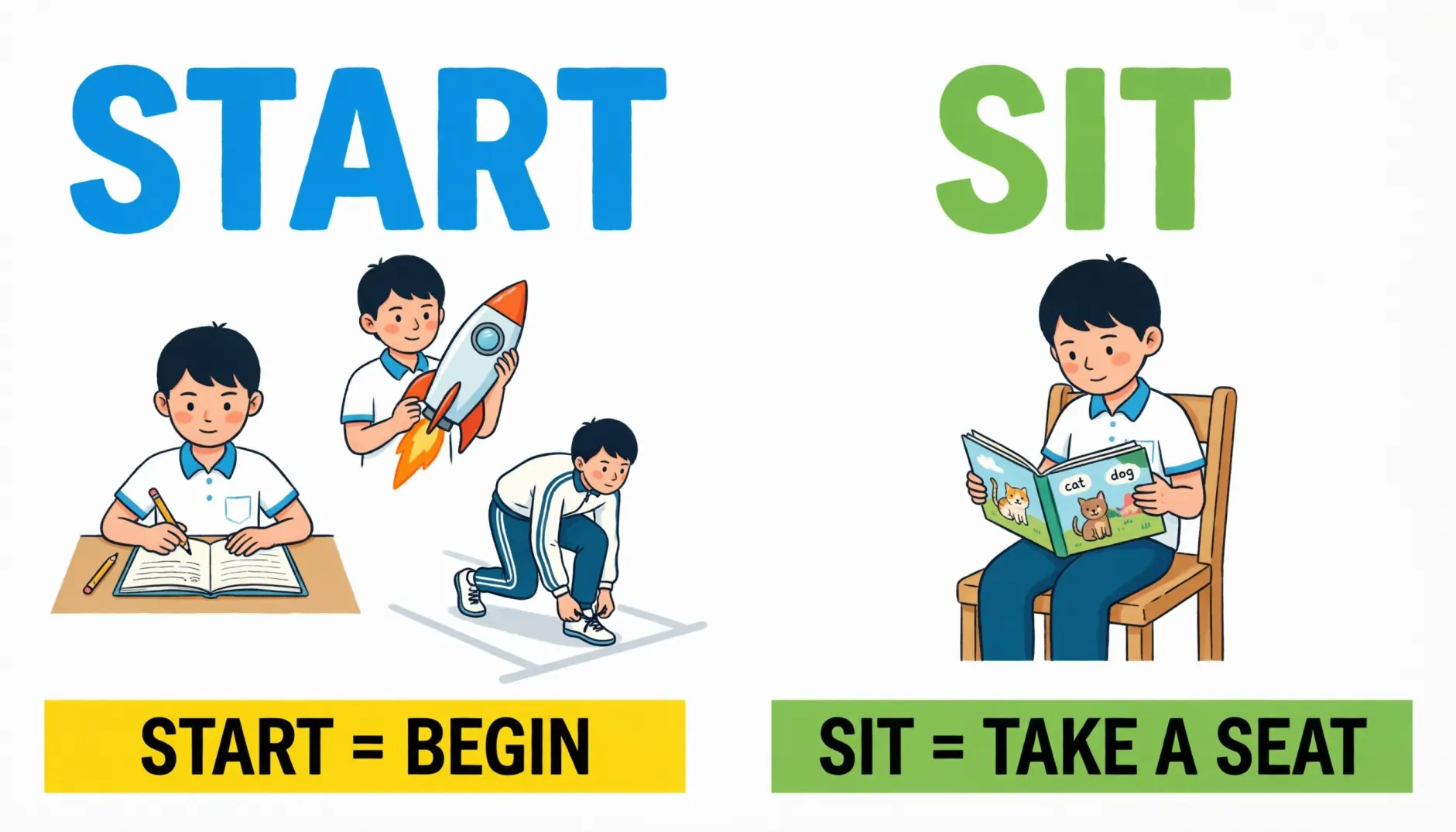
Start means to begin something.
Sit means to rest your body on a chair, seat, or surface.
✅ Let’s start the class.
✅ Please sit on the chair.
❌ Let’s sit the class. (incorrect in this meaning)
❌ Please start on the chair. (incorrect)
The two words have different meanings and are not interchangeable.
What Does “Start” Mean?
The verb start means to begin, commence, or initiate something.
You use it when an action, event, process, journey, or activity begins.
Common Uses of Start
- Start a meeting
- Start a project
- Start a conversation
- Start a car
- Start studying
- Start running
Examples
- We will start the lesson at 9 a.m.
- She started her homework after dinner.
- The movie starts in ten minutes.
- They started a new business last year.
- Please start writing your essay.
In all these examples, start means “begin.”
What Does “Sit” Mean?
The verb sit means to be seated or to place yourself in a seated position.
It refers to a physical position rather than beginning an activity.
Common Uses of Sit
- Sit down
- Sit on a chair
- Sit quietly
- Sit beside someone
- Sit at a desk
Examples
- Please sit here.
- The children sat quietly during the show.
- I usually sit near the window.
- She sat on the sofa and read a book.
- We sat around the table and talked.
In these examples, sit describes a position of the body.
Start vs Sit: What’s the Difference?
| Feature | Start | Sit |
|---|---|---|
| Meaning | To begin something | To be seated |
| Part of Action | Beginning an activity | Body position |
| Common Objects | Meeting, project, class, engine | Chair, bench, sofa |
| Example | Start the lesson | Sit on the chair |
| Can Replace Each Other? | ❌ No | ❌ No |
Compare These Sentences (Start vs Sit)
| Correct Sentence | Meaning |
|---|---|
| Let’s start the meeting. | Begin the meeting |
| Let’s sit in the meeting room. | Take a seat in the room |
| She started her presentation. | She began presenting |
| She sat near the front. | She took a seat there |
The first sentence in each pair talks about beginning, while the second talks about sitting.
Why Do Learners Confuse Start and Sit?
Several reasons cause confusion:
Similar Short Words
Both are short, common verbs that learners encounter early in English study.
Fast Pronunciation
In quick speech, beginners may mishear them.
Translation Issues
In some languages, the same expression may be translated differently, leading learners to use the wrong English verb.
Context Confusion
Students sometimes focus on the activity rather than the action being described.
For example:
- Start studying = begin studying.
- Sit studying = not natural English.
Grammar Rules for Start
Start + Noun
- Start the car.
- Start the project.
- Start the meeting.
Start + Verb ( ing)
- Start working.
- Start reading.
- Start exercising.
Start + To + Verb
- Start to learn.
- Start to improve.
- Start to write.
Both structures are generally acceptable:
✅ She started reading.
✅ She started to read.
Grammar Rules for Sit
Sit + Place
- Sit on the chair.
- Sit on the floor.
- Sit by the window.
Sit + Adverb
- Sit quietly.
- Sit comfortably.
- Sit patiently.
Sit Down
A very common phrase meaning “take a seat.”
- Please sit down.
- Everybody sat down before the presentation began.
Usage Examples in Different Contexts
Formal Writing
- The conference will start at 10 a.m.
- Participants should sit in their assigned seats.
- The program started according to schedule.
Informal Writing
- Let’s start now.
- Come and sit with us.
- I started watching that show yesterday.
Academic Writing
- The experiment started after calibration.
- Students should sit quietly during examinations.
- The lecture started fifteen minutes late.
12 Example Sentences Using Start and Sit
- We will start the meeting at noon.
- Please sit near the teacher.
- She started learning English last year.
- They sat on the grass during lunch.
- The race starts at sunrise.
- Sit down and relax.
- I started reading a new book yesterday.
- He sat beside his friend.
- The class started early today.
- The audience sat quietly throughout the performance.
- She started her presentation confidently.
- We sat around the fire and talked.
Common Mistakes Learners Make
Mistake 1
❌ Sit your homework.
✅ Start your homework.
Why? Homework is something you begin, not something you sit.
Mistake 2
❌ Start on the chair.
✅ Sit on the chair.
Why? A chair is a place to sit.
Mistake 3
❌ Sit the meeting at 9 a.m.
✅ Start the meeting at 9 a.m.
Why? Meetings begin; they do not sit.
Mistake 4
❌ I started on the sofa.
✅ I sat on the sofa.
Why? The sentence describes a seating position.
Related and Commonly Confused Words
Start vs Begin
Both usually mean the same thing.
- Start the class.
- Begin the class.
Both are correct.
Sit vs Seat
Sit is usually something you do yourself.
- Sit here.
Seat often means to place someone somewhere.
- The host seated the guests.
Sit vs Set
These words are often confused because they sound similar.
Sit
- Please sit down.
Set
- Set the book on the table.
Start vs Launch
Both involve beginning something.
- Start a project.
- Launch a product.
“Launch” is often used for businesses, products, and campaigns.
Modern Usage Preferences
In modern English, both start and begin are common, but start is often more natural in everyday conversation.
Examples:
- Let’s start.
- Start the car.
- Start working.
Similarly, sit down is more common in conversation than simply sit, although both are correct.
Examples:
- Please sit down.
- Sit here.
Quick Tips to Remember
Easy Memory Trick
Start = Begin
Think of the letter S in start as starting something.
Easy Memory Trick
Sit = Seat
Think of the letter S in sit as seat.
Simple Rule
If you’re talking about beginning an activity, use start.
If you’re talking about a body position, use sit.
Quick Test
Ask yourself:
“Am I beginning something?”
➡ Use start.
“Am I taking a seat?”
➡ Use sit.
FAQ
Is start the same as sit?
No. Start means to begin something, while sit means to be seated.
Can I say “sit a meeting”?
Usually no. You normally start, attend, or join a meeting.
Is “start studying” correct?
Yes. It means to begin studying.
Is “sit studying” correct?
Generally no. Native speakers would say sit and study or start studying.
Which is more common, start or begin?
Both are common, but start is often used more in everyday conversation.
Can start and sit be used interchangeably?
No. They have completely different meanings.
What is the easiest way to remember the difference?
Remember:
- Start = Begin
- Sit = Take a seat
Conclusion
The difference between start and sit is simple once you focus on their meanings. Start means to begin an action, activity, project, or event.
Sit means to take a seat or remain in a seated position.Whenever you are talking about beginning something, choose start.
Whenever you are talking about where someone is seated, choose sit. With a little practice and the examples in this guide, using these two common verbs correctly will become much easier.