“True or false?” You’ve seen this question in quizzes, exams, social media posts, and even casual chats.
It’s short, simple, and powerful. But many people still wonder what it really means, how to use it correctly, and whether there are any rules behind it.
People search for “true or false” because they want a clear answer format. It helps test knowledge, check facts, or start fun conversations.
Yet confusion can happen especially when using it in writing, teaching, or digital content.
This guide removes that confusion. You’ll learn what “true or false” means, where it comes from, how to use it correctly, and common mistakes to avoid.
If you’re a student, teacher, writer, or content creator, this article will help you use “true or false” with confidence and clarity.
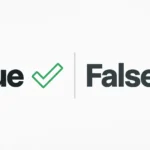
True or False
“True or false” is a simple way to check if a statement is correct or not.
- True = The statement is correct
- False = The statement is incorrect
Examples:
- The sun rises in the east. → True
- Fish can live on land. → False
It is often used in:
- Quizzes
- Exams
- Surveys
- Games
The Origin of True or False
The words “true” and “false” come from old English and Latin roots.
- True comes from Old English trēowe, meaning faithful or accurate.
- False comes from Latin falsus, meaning wrong or mistaken.
The phrase “true or false” became popular in education. Teachers used it to test knowledge quickly. Over time, it spread to games, media, and online content.
There are no spelling differences in this phrase. Both words have stayed the same in English for centuries.
British English vs American English Spelling
| Version | Spelling | Notes |
|---|---|---|
| British English | True or False | Same spelling |
| American English | True or False | Same spelling |
Which Spelling Should You Use?
Since “true or false” has no variations, you can use it anywhere.
- US audience → Use “true or false”
- UK/Commonwealth → Use “true or false”
- Global audience → Use “true or false”
It works in all regions and contexts. No need to adjust spelling.
Common Mistakes with True or False
Here are common errors and how to fix them:
- ❌ Using it as one word → trueorfalse
✔️ Correct: true or false - ❌ Wrong capitalization
✔️ Use lowercase in sentences: true or false question
✔️ Capitalize in titles: True or False Quiz - ❌ Confusing with opinions
✔️ “True or false” is for facts, not opinions - ❌ Unclear statements
✔️ Make statements simple and clear
True or False in Everyday Examples
Emails:
- “Please answer the following as true or false.”
News:
- “The report includes true or false statements for readers.”
Social Media:
- “True or false: Coffee helps you focus?”
Formal Writing:
- “Participants responded using a true or false format.”
True or False – Google Trends & Usage Data
“True or false” is popular worldwide. It is commonly searched in:
- United States → Education and quizzes
- United Kingdom → School tests
- India & Pakistan → Exams and study material
- Global → Social media games and trivia
It is widely used in:
- Online quizzes
- Learning platforms
- Viral posts
Keyword Comparison Table
| Variation | Meaning | Usage Context |
|---|---|---|
| True or False | Correct or incorrect | Exams, quizzes |
| Yes or No | Agreement or denial | Questions, decisions |
| Fact or Fiction | Reality vs imagination | Stories, media |
| Right or Wrong | Judgment of correctness | General use |
FAQs
1. What does “true or false” mean?
It checks if a statement is correct (true) or incorrect (false).
2. Where is “true or false” used?
In quizzes, exams, surveys, and games.
3. Is “true or false” the same worldwide?
Yes, the spelling and meaning are the same everywhere.
4. Can “true or false” be used in casual talk?
Yes, it’s common in conversations and social media.
5. Is it used for opinions?
No, it should be used for facts only.
6. Should I capitalize “true or false”?
Only in titles or headings, not in regular sentences.
7. Is it a question or a format?
It can be both a question type and an answer format.
Conclusion
“True or false” is one of the simplest and most useful phrases in English. It helps people check facts quickly and clearly. From classrooms to social media, it plays a big role in how we test knowledge and share ideas.
The best part is its simplicity. There are no spelling differences, no regional rules, and no complicated grammar. Anyone can use it anywhere in the world. Just remember to use it for clear, factual statements.
Avoid common mistakes like unclear wording or using it for opinions. Keep your statements simple, direct, and easy to understand.
This ensures your “true or false” questions are effective and meaningful. If you are a student, teacher, or content creator, mastering this phrase will improve your communication.
It saves time, removes confusion, and makes learning more engaging.

Hi, I’m Virginia Woolf, a language enthusiast passionate about exploring the power of words and their meanings. I specialize in helping readers choose the right words through clear comparisons, synonyms, and practical usage. My goal is to make vocabulary learning simple, engaging, and useful for everyday communication. picktheword.com