Have you ever typed “hair drier” and wondered if it should actually be “hair dryer”? You are not alone. Many English learners and even native speakers get confused between drier and dryer because both words look correct.
The confusion happens because these words are connected to the adjective dry, but they are used in different ways. In some cases, both forms are technically correct.
In other cases, only one word sounds natural to native speakers.Understanding the difference between drier vs dryer helps you write clearly in school, work emails, blog posts, and everyday conversations.
Quick Answer
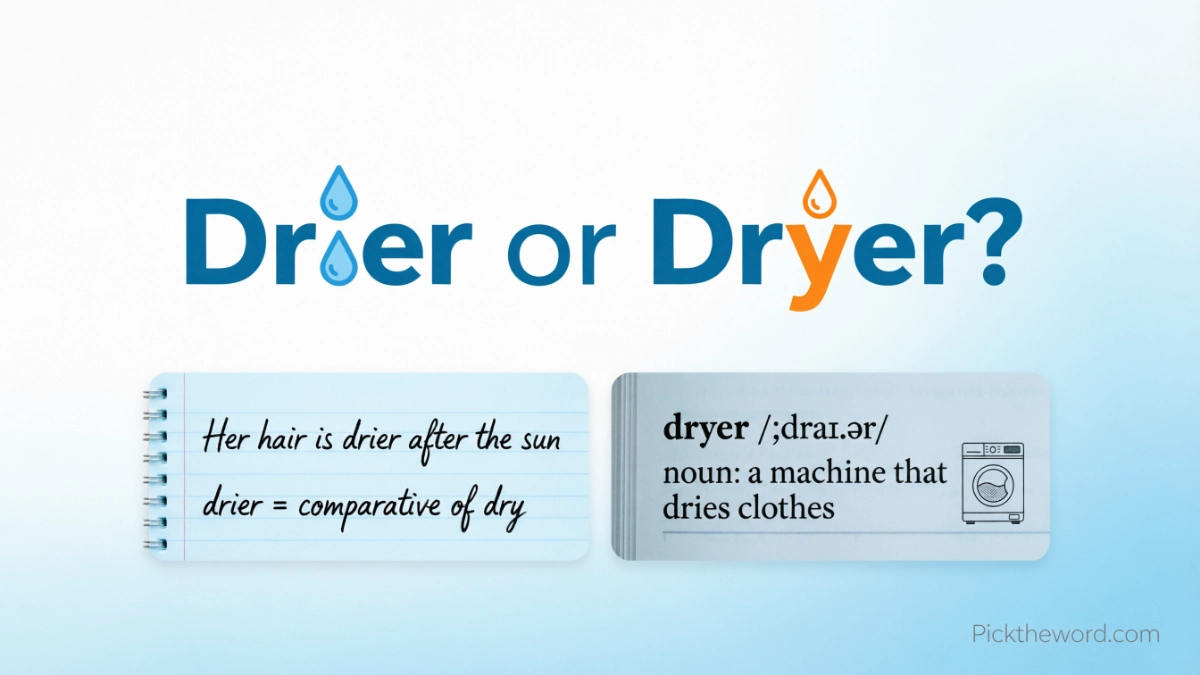
Drier and dryer can both relate to the word dry, but they are usually used differently.
- Drier is most commonly the comparative form of dry.
- Example: Today is drier than yesterday.
- Dryer is usually a noun for a machine or device.
- Example: Put the clothes in the dryer.
In modern English, this is the easiest and safest rule to follow.
What Do “Drier” and “Dryer” Mean?
The word dry can work as both:
- An adjective
- A verb
Because of this, English created two spellings over time.
| Word | Part of Speech | Meaning | Example |
|---|---|---|---|
| Drier | Comparative adjective | More dry | The desert is drier in summer. |
| Dryer | Noun | A machine that dries something | The dryer stopped working. |
This is the main difference learners should remember.
Simple Rule
- Use drier when comparing dryness.
- Use dryer when talking about a machine or device.
Why Do People Confuse “Drier” and “Dryer”?
The confusion happens because English spelling is not always perfectly logical.
When we add er to adjectives, we usually create a comparative word:
- tall → taller
- cold → colder
- dry → drier
But English also uses er to create nouns:
- bake → baker
- wash → washer
- dry → dryer
So both spellings exist naturally in English.
That is why many learners search for:
- Is it drier or dryer?
- Which spelling is correct?
- Hair drier or hair dryer?
- Drier meaning
- Dryer meaning
The good news is that the difference becomes simple once you know the role of each word.
Is “Drier” the Comparative Form of Dry?
Yes. Drier is the comparative adjective form of dry.
It means “more dry.”
Examples
- This towel feels drier now.
- Arizona is much drier than Florida.
- My skin gets drier during winter.
Grammar Pattern
dry → drier → driest
This follows standard English comparative rules.
Important Note
Some learners think dryer can also be the comparative form. While older dictionaries sometimes accepted it, modern English strongly prefers drier for comparisons.
So in normal writing:
✅ Correct: The air is drier today.
❌ Unnatural: The air is dryer today.
Is “Dryer” a Noun?
Yes. Dryer is usually a noun.
It refers to a machine, tool, or device that removes moisture.
Common Examples
- clothes dryer
- hair dryer
- hand dryer
- food dryer
Example Sentences
- The dryer is in the laundry room.
- My hair dryer stopped working.
- Please put the wet clothes in the dryer.
In everyday English, this is the most common meaning of dryer.
Can “Dryer” Ever Be an Adjective?
Technically, yes but it is uncommon in modern English.
Some older dictionaries allowed dryer as a comparative adjective. However, most modern style guides and native speakers prefer:
- drier for comparisons
- dryer for machines
So if you want natural, modern English, use the simple rule above.
Drier vs Dryer: Side by Side Comparison
| Feature | Drier | Dryer |
|---|---|---|
| Main use | Comparative adjective | Noun |
| Meaning | More dry | Machine or device that dries things |
| Common today? | Yes | Yes |
| Example | The weather is drier today. | The dryer is broken. |
| Formal writing | Preferred for comparisons | Preferred for machines |
| Spoken English | Common | Very common |
British vs American English
One reason learners get confused is regional spelling usage.
American English
In American English:
- drier = comparative adjective
- dryer = machine
This is the standard rule taught in schools.
British English
British English follows the same pattern today.
You will commonly see:
- The climate is drier.
- The tumble dryer is upstairs.
Canadian and Australian English
Canadian and Australian English also usually follow modern international usage:
- drier for comparisons
- dryer for appliances
Which Version Is More Common Globally?
Globally, the clearest and most accepted usage is:
- drier = more dry
- dryer = appliance or machine
This is the safest choice for learners, students, bloggers, and professionals.
Usage Examples in Real Life Writing
Here are natural examples showing how both words work in different situations.
Formal Writing
- The western region becomes drier during summer.
- The laboratory installed a new hand dryer.
Informal Writing
- My lips feel much drier today.
- Can you move the clothes to the dryer?
Academic Writing
- Scientists observed drier soil conditions over time.
- The samples were placed in a heated dryer.
Workplace Communication
- The air in the office seems drier after the heating started.
- The staff room dryer needs repair.
Emails and Texts
- This shampoo makes my hair drier.
- I left your hoodie in the dryer.
Social Media Examples
- Winter always makes my skin drier 😩
- Finally bought a new hair dryer!
Natural Example Sentences
- The desert becomes even drier in July.
- My hands feel drier after using sanitizer.
- This towel is much drier now.
- The weather in Islamabad is drier this month.
- We bought a new clothes dryer yesterday.
- The hair dryer is inside the bathroom cabinet.
- Please clean the lint filter in the dryer.
- The hand dryer in the mall is very loud.
- Winter air makes my skin drier than usual.
- The new machine dries clothes faster than the old dryer.
- Today feels cooler and drier.
- I accidentally left my socks inside the dryer overnight.
Common Mistakes Learners Make
| Incorrect | Correct | Why |
|---|---|---|
| The weather is dryer today. | The weather is drier today. | Comparative adjective needed (dry → drier) |
| My drier is broken. | My dryer is broken. | “Dryer” = machine; “drier” = comparative form |
| Put the clothes in the drier. | Put the clothes in the dryer. | Appliance spelling is dryer |
| My skin is dryer in winter. | My skin is drier in winter. | Comparative form required (drier, not noun use) |
Why These Mistakes Happen
Learners often:
- Hear both words pronounced similarly
- Forget the grammar role
- Mix adjective and noun forms
- Learn from inconsistent online sources
Luckily, context usually makes the correct spelling easy.
Hair Drier or Hair Dryer?
This is one of the most searched questions online.
Which Is Correct?
Both have existed historically, but hair dryer is far more common in modern English.
Recommended Usage
✅ Hair dryer
⚠️ Hair drier (rare today)
Most product labels, stores, websites, and dictionaries prefer hair dryer.
Example
- I bought a new hair dryer last week.
Similar and Commonly Confused Words
English has many similar word pairs like this.
1. Adviser vs Advisor
Both are correct, but usage differs by region and style.
2. Grey vs Gray
- Grey = more common in British English
- Gray = more common in American English
3. Toward vs Towards
Both are correct depending on regional preference.
4. Canceled vs Cancelled
- Canceled = American English
- Cancelled = British English
These examples show that English spelling often changes by usage tradition.
Google Trends and Usage Patterns
Search trends show that many people regularly look up:
- drier or dryer
- dryer meaning
- drier meaning
- hair dryer or hair drier
Modern usage strongly favors:
- drier for comparisons
- dryer for appliances
Online dictionaries, educational websites, and grammar guides mostly follow this pattern today.
Product names and shopping websites almost always use dryer for machines.
Quick Tips to Remember
Here are some easy memory tricks.
Think About the Job of the Word
Ask yourself:
- Is it comparing dryness?
- Or naming a machine?
Easy Memory Rule
Drier = more dry
Dryer = drying machine
Visual Trick
The word dryer ends in yer, which can remind you of a machine or device.
Regional Tip
No matter whether you use American, British, Canadian, or Australian English, this rule works well in modern writing.
Frequently Asked Questions
Is it “drier” or “dryer” weather?
The correct phrase is drier weather because you are comparing dryness.
Is “dryer” always a machine?
Most of the time, yes. In modern English, dryer usually refers to a device like a clothes dryer or hair dryer.
Can I use “dryer” instead of “drier”?
In modern writing, it is better not to. Use:
- drier for comparisons
- dryer for machines
Which spelling is more common today?
Modern English strongly prefers:
- drier as the comparative adjective
- dryer as the noun
Is “hair drier” wrong?
Not completely wrong, but hair dryer is much more common and natural today.
Conclusion
The difference between drier and dryer becomes easy once you know their grammar roles.
Use drier when comparing something that is more dry:
- The air is drier today.
Use dryer when talking about a machine or appliance:
- The dryer needs cleaning.
This simple rule works in American, British, Canadian, and Australian English. If you follow it, your writing will sound more natural and professional.

Hi, I’m Virginia Woolf, a language enthusiast passionate about exploring the power of words and their meanings. I specialize in helping readers choose the right words through clear comparisons, synonyms, and practical usage. My goal is to make vocabulary learning simple, engaging, and useful for everyday communication. picktheword.com