Have you ever stopped while writing and wondered:
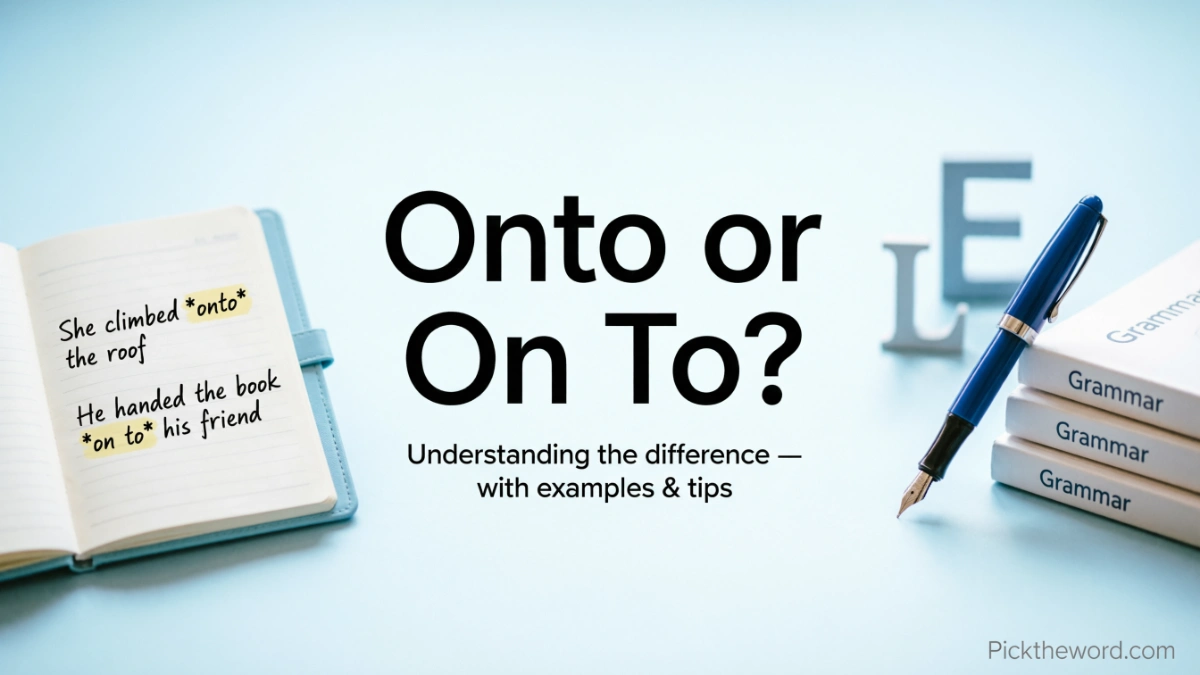
“Should I write onto or on to?”
You are not alone. Many English learners and even native speakers get confused by these two forms. They look almost the same, sound the same, and sometimes both seem correct.
For example:
- She jumped onto the bed.
- She held on to the railing.
Both sentences are correct, but they mean different things.
Understanding the difference matters because using the wrong form can make your writing unclear. Whether you are writing an email, homework assignment, blog post, or social media caption, knowing when to use onto and on to helps you write more naturally and confidently.
In this beginner-friendly grammar guide, you will learn:
- The meaning of onto and on to
- The key differences between them
- Easy grammar rules
- Real-life examples
- Common mistakes to avoid
- UK vs US usage
- Quick memory tricks
Let’s make this confusing grammar topic simple.
Quick Answer
Onto is usually a preposition that shows movement toward a surface.
Example:
- The cat jumped onto the table.
On to is used when on belongs to a verb and to starts the next phrase.
Example:
- Please hold on to your ticket.
A simple trick:
- Use onto for movement.
- Use on to when you can separate the words naturally.
What Does “Onto” Mean?
The word onto is a preposition. It usually shows:
- movement
- direction
- position on a surface
It answers the question:
“Where is something moving?”
Simple Examples
- The child climbed onto the chair.
- Put the books onto the shelf.
- The dog jumped onto the sofa.
In all these examples, something moves from one place to another surface.
Easy Rule
Use onto when:
- there is physical movement
- something goes to a higher or different surface
- you can replace it with “on top of”
Common Verbs Used With “Onto”
- jump onto
- climb onto
- move onto
- step onto
- get onto
- place onto
Why “Onto” Is One Word
Over time, English speakers combined “on” and “to” into one word because they are often used together to show movement.
That is why onto is now considered a standard English word in modern grammar.
What Does “On To” Mean?
The phrase on to uses two separate words.
Here:
- on belongs to the verb
- to begins the next phrase or infinitive
Simple Examples
- Hold on to your bag.
- We moved on to the next lesson.
- She passed the message on to her manager.
In these sentences, “on” is connected to the verb:
- hold on
- move on
- pass on
Then “to” starts another part of the sentence.
Easy Rule
Use on to when:
- the verb naturally ends with “on”
- “to” belongs to the next word or phrase
Common Phrasal Verbs
| Phrasal Verb | Meaning |
| hold on to | keep something |
| move on to | continue to something else |
| pass on to | give information |
| go on to | continue doing something |
| carry on to | continue toward something |
Onto vs On To: What Is the Difference?
This is the main difference:
| Onto | On To |
| One word | Two words |
| Shows movement to a surface | Part of a phrasal verb |
| Preposition | Verb + preposition |
| Physical direction | Continuation or connection |
| “Jump onto the bed” | “Move on to chapter two” |
Simple Comparison
Onto
- The bird flew onto the roof.
- He stepped onto the stage.
These sentences show movement.
On To
- Let’s move on to the next topic.
- She held on to my arm.
These examples involve phrasal verbs.
Why Do Learners Confuse “Onto” and “On To”?
The confusion happens because:
- both forms sound identical
- both contain the same words
- both can appear in similar sentence structures
For example:
- He climbed onto the truck.
- He moved on to another truck.
The meaning changes even though the words sound similar.
Another reason is that spoken English does not clearly separate them. In fast speech, both forms may sound almost the same.
That is why understanding the grammar role is important.
Are “Onto” and “On To” Ever Interchangeable?
Sometimes, yes but not always.
In informal English, some writers use either form in certain situations. However, careful grammar usually prefers one correct version.
Example
- The actor walked onto the stage. ✅
- The actor walked on to the stage. ✅ (less common)
Both are accepted by some style guides because movement is involved.
However, modern English usually prefers onto for movement.
Important Tip
If removing “to” changes the sentence completely, you probably need on to.
Example:
- Hold on.
- Hold on to your keys.
Here, “hold on” is already a complete phrasal verb.
Is “Onto” More Common in Modern English?
Yes.
In modern English:
- onto is widely accepted and very common
- especially in American English
Most grammar experts recommend:
- using onto for movement
- using on to for phrasal verbs
This makes writing clearer and easier to understand.
British vs American English Usage
Both British and American English use:
- onto
- on to
But there are small style differences.
| Region | Preferred Style |
| American English | Uses “onto” more often |
| British English | Slightly more flexible |
| Canadian English | Similar to US usage |
| Australian English | Similar to UK usage |
American English
American writers strongly prefer:
- jump onto
- climb onto
- step onto
British English
British English sometimes allows:
- walk on to the stage
But even in the UK, onto is becoming more common.
Global Recommendation
For clear international English:
- use onto for movement
- use on to with phrasal verbs
This works well for:
- academic writing
- blogs
- business emails
- online content
Usage Examples in Different Writing Styles
Here are practical examples for real-life communication.
Formal Writing
- The researcher moved on to the next experiment.
- Participants stepped onto the platform carefully.
Informal Writing
- I jumped onto the couch after work.
- Hold on to your phone tightly.
Academic Writing
- The discussion moves on to climate policy.
- The chemicals were transferred onto the glass surface.
Workplace Communication
- Please move on to the next task.
- Upload the files onto the company server.
Emails
- I will pass this information on to the manager.
- Please place the documents onto my desk.
Text Messages and Social Media
- Get onto the app quickly!
- Hang on to those concert tickets.
Natural Example Sentences
- The boy climbed onto the fence.
- Please move on to the next page.
- She carefully stepped onto the ice.
- Hold on to your passport at the airport.
- The cat jumped onto the kitchen counter.
- We went on to discuss the final project.
- He loaded the boxes onto the truck.
- Can you pass this message on to Sarah?
- The athlete ran onto the field.
- She held on to the rope tightly.
- The teacher moved on to a new chapter.
- They climbed onto the boat before sunset.
Common Mistakes Learners Make
Many learners mix these forms because they focus only on sound.
Here are common mistakes and corrections.
| Incorrect | Correct | Why |
| Hold onto your bag. | Hold on to your bag. | “Hold on” is a phrasal verb |
| Move onto chapter two. | Move on to chapter two. | “Move on” is the verb |
| Jump on to the table. | Jump onto the table. | Movement to a surface |
| Climb on to the roof. | Climb onto the roof. | Preferred modern usage |
| Pass onto the teacher. | Pass on to the teacher. | “Pass on” is the verb |
Important Learning Tip
Ask yourself:
“Is this movement to a surface, or part of a phrasal verb?”
That question usually gives the correct answer.
Similar or Confused Words
English has many confusing word pairs like this.
Into vs In To
Very similar to:
- onto vs on to
Example:
- She walked into the room.
- She checked in to the hotel.
Everyday vs Every Day
- everyday = common
- every day = each day
Anytime vs Any Time
- anytime = informal adverb
- any time = noun phrase
Learning these pairs helps improve grammar accuracy.
Google Trends and Usage Patterns
Language trends show that:
- onto has become more popular in modern English
- especially online and in American English
Searches for:
- “onto or on to”
- “difference between onto and on to”
- “when to use onto”
are very common because learners often feel uncertain about these forms.
Grammar websites, dictionaries, and style guides generally recommend:
- using onto for movement
- keeping on to for phrasal verbs
Digital writing, blogging, and SEO content have also increased the use of shorter combined forms like onto.
Quick Tips to Remember
Here are easy memory tricks.
Trick 1: Think About Movement
If something moves to a surface:
→ use onto
Example:
- The frog jumped onto the rock.
Trick 2: Check the Verb
If the verb naturally ends with “on”:
→ use on to
Example:
- Move on to the next lesson.
Trick 3: Remove “To”
Try removing “to.”
Example:
- Hold on.
- Hold on to your bag.
This shows “hold on” is a phrasal verb.
Trick 4: Physical vs Abstract
| Physical Movement | Use |
| Jumping, climbing, stepping | onto |
| Abstract Continuation | Use |
| Continue, pass, discuss | on to |
Frequently Asked Questions
Is “onto” one word or two?
“Onto” is usually one word when it shows movement toward a surface.
Example:
- The child ran onto the playground.
Is “on to” grammatically correct?
Yes. “On to” is correct when “on” belongs to the verb.
Example:
- Let’s move on to the next topic.
Can I use “onto” in formal writing?
Yes. “Onto” is accepted in:
- formal writing
- academic English
- professional communication
It is very common in modern English.
Which is more common: “onto” or “on to”?
“Onto” is more common for movement, especially in American English.
“On to” remains common with phrasal verbs like:
- move on to
- hold on to
- pass on to
How can I remember the difference easily?
Use this rule:
- movement → onto
- phrasal verb → on to
This simple trick works in most sentences.
Conclusion
The difference between onto and on to becomes much easier once you understand their grammar roles.
Use onto when showing movement toward a surface:
- jump onto
- climb onto
- step onto
Use on to when “on” is part of a phrasal verb:
- hold on to
- move on to
- pass on to
Even though they sound the same, their meanings are different. Learning this small grammar rule can improve your writing clarity and confidence in both formal and informal English.
The more examples you read and practice, the more natural these forms will feel.

Hi, I’m Virginia Woolf, a language enthusiast passionate about exploring the power of words and their meanings. I specialize in helping readers choose the right words through clear comparisons, synonyms, and practical usage. My goal is to make vocabulary learning simple, engaging, and useful for everyday communication. picktheword.com