Have you ever wondered whether you should write incase or in case?
You are not alone. Many English learners search for this question because both forms look possible. Since people often see similar word combinations in English, it is easy to assume that incase is a single word.
The good news is that the answer is very simple. Once you understand the difference, you will never have to guess again.
Quick Answer
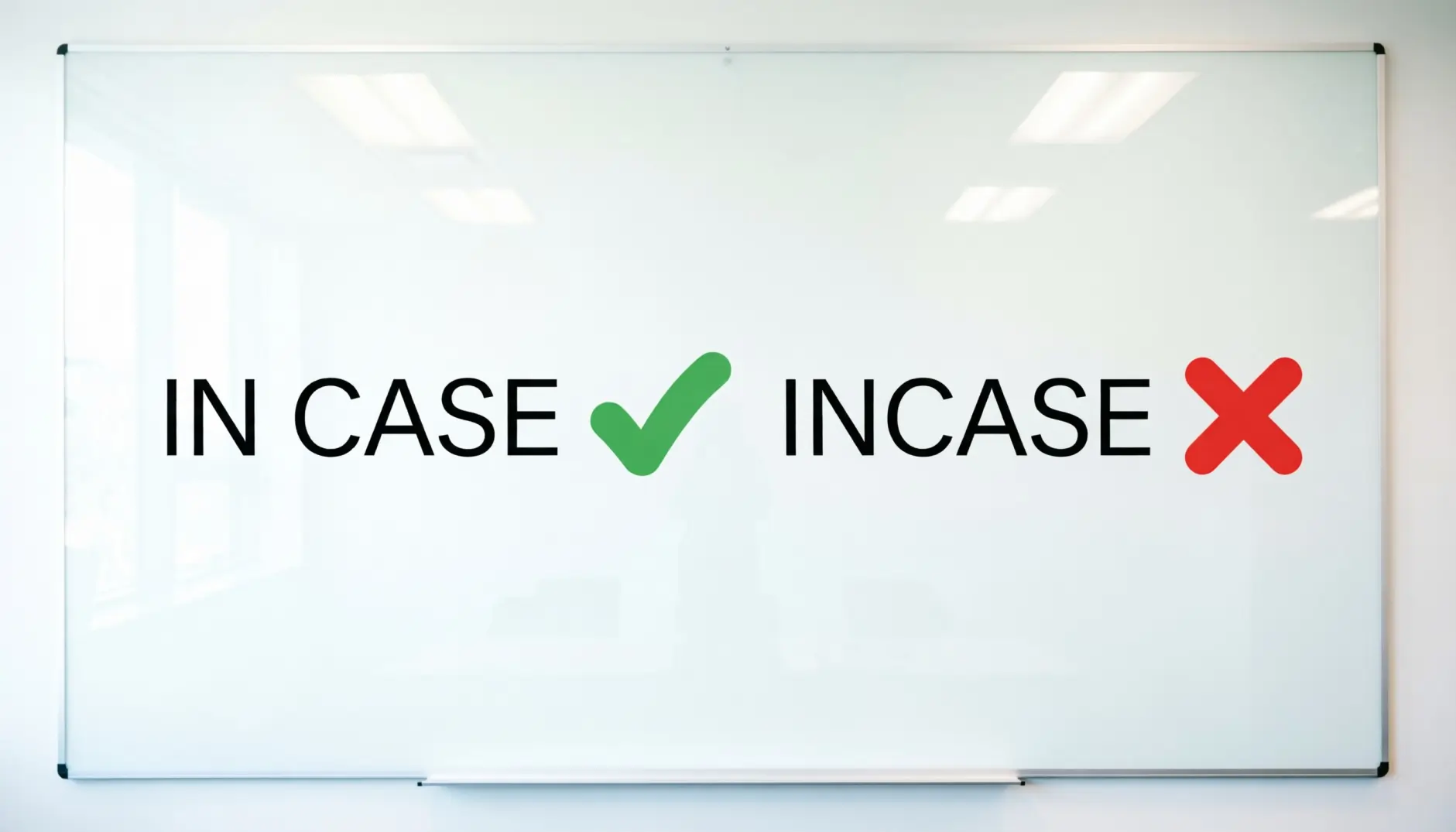
In case is the correct spelling.
✅ In case = used to mean “if something happens” or “as a precaution.”
❌ Incase = not accepted as a standard English word in modern writing.
Example:
- Correct: Take an umbrella in case it rains.
- Incorrect: Take an umbrella incase it rains.
What Does “In Case” Mean?
In case is a phrase used when you want to prepare for a possible situation.
It often means:
- If something happens
- As a precaution
- To be prepared for a possibility
Examples
- Bring a jacket in case it gets cold.
- Save the document in case your computer crashes.
- Carry extra cash in case your card does not work.
- I’ll call you in case I arrive late.
In all these examples, the action is done before a possible event happens.
Is “Incase” Ever Correct?
In modern English, incase is generally considered incorrect.
Most dictionaries, style guides, schools, universities, and professional editors recommend using in case as two separate words.
Correct
- In case you need help, call me.
- Take notes in case you forget.
Incorrect
- Incase you need help, call me.
- Take notes incase you forget.
If you are writing an essay, email, blog post, report, or social media content, always use in case.
In case vs Incase
| Word | Correct? | Meaning |
|---|---|---|
| In case | ✅ Yes | If something happens; as a precaution |
| Incase | ❌ No | Not standard in modern English (usually a spelling mistake) |
The easiest rule is:
Whenever you want to express preparation for a possible situation, write “in case” as two words.
How to Use “In Case” Correctly
1. To Prepare for Something Possible
This is the most common use.
Examples:
- Take your passport in case airport staff ask for it.
- Bring water in case you get thirsty.
- Keep a flashlight in case the power goes out.
2. Before a Possible Future Event
The event may happen or may not happen.
Examples:
- Leave early in case there is traffic.
- Save your work in case the internet disconnects.
- Charge your phone in case you need it later.
3. In Warnings and Advice
Examples:
- Write down the address in case your phone battery dies.
- Keep emergency numbers nearby in case of an accident.
“In Case” vs “If”
Many learners confuse these two expressions.
Although they are similar, they are not always interchangeable.
| Feature | In case | If |
|---|---|---|
| Meaning | Means preparing for a possibility | Means a condition may happen |
| Purpose | Precaution | Condition |
| Action order | Action happens first | Action depends on the condition |
| Focus | Safety / preparation | Situation / result |
Compare These Examples
In case
- Take an umbrella in case it rains.
(You take the umbrella before rain starts.)
If
- Use the umbrella if it rains.
(You use it only when rain happens.)
This small difference is important.
“In Case Of” Meaning
Another common phrase is in case of.
It means if a particular situation happens.
Examples
- In case of emergency, call 911.
- In case of fire, leave the building immediately.
- In case of severe weather, flights may be delayed.
- In case of questions, contact customer support.
Notice that in case of is usually followed by a noun or noun phrase.
Structure
In case of + noun
Examples:
- In case of rain
- In case of delay
- In case of accident
- In case of emergency
Usage Examples in Different Types of Writing
Formal Writing
- Please keep a copy of the agreement in case future reference is needed.
- Employees should back up important files in case of technical issues.
- Carry identification in case security personnel request verification.
Informal Writing
- Bring snacks in case we get hungry.
- Text me in case you’re running late.
- I’ll save you a seat in case you come.
Academic Writing
- Researchers stored duplicate data in case information was lost.
- Students should review their notes in case questions appear on the exam.
- The experiment was repeated in case unexpected results occurred.
Additional Examples
- Take medicine in case you feel sick later.
- Keep the receipt in case you need a refund.
- I packed an extra shirt in case the weather changes.
- We left early in case traffic became heavy.
- Bring your charger in case your battery runs low.
Common Mistakes Learners Make
Mistake 1: Writing “Incase”
❌ Incase you need help, call me.
✅ In case you need help, call me.
Why?
Because the correct expression is always written as two separate words.
Mistake 2: Confusing “In Case” With “If”
❌ Bring an umbrella if it rains tomorrow.
✅ Bring an umbrella in case it rains tomorrow.
Why?
You are preparing before the rain starts.
Mistake 3: Using Wrong Structure After “In Case Of”
❌ In case of it rains.
✅ In case of rain.
✅ In case it rains.
Why?
After in case of, use a noun, not a full clause.
Similar and Commonly Confused Expressions
In Case
- Take a map in case you get lost.
In Case Of
- In case of emergency, press the alarm.
If
- If it rains, stay inside.
Just In Case
This expression means “for extra safety” or “to be extra prepared.”
Examples:
- Take an umbrella just in case.
- I saved the email just in case.
- Bring some cash just in case.
Many native speakers use this phrase frequently in everyday conversation.
British vs American English
There is no difference between British and American English regarding this expression.
Both use:
✅ In case
Both consider:
❌ Incase
incorrect in standard writing.
Whether you are writing for readers in the United States, United Kingdom, Canada, Australia, or elsewhere, use in case.
Modern Usage Preferences
Modern English style guides, educational institutions, publishers, and professional editors overwhelmingly prefer in case as two words.
Spell check tools and grammar checkers also usually flag incase as an error.
For professional and academic writing, always choose in case.
Quick Tips to Remember
Memory Trick :1
Think:
In + Case = Two Words
A “case” is a possible situation.
- In case it rains
- In case you forget
- In case of emergency
Memory Trick :2
If you can replace it with “as a precaution,” use in case.
Example:
- Bring water in case you get thirsty.
- Bring water as a precaution.
Memory Trick :3
Never join the words together.
✅ In case
❌ Incase
FAQ
Is it in case or incase?
In case is correct. Incase is considered a spelling mistake in standard English.
Is incase a real word?
No. Modern English dictionaries and style guides generally do not accept incase as the standard form.
Can I write incase in an essay?
No. Use in case as two words in essays, reports, and academic writing.
What does in case mean?
It means if something happens or as a precaution against a possible situation.
What is the difference between in case and if?
In case focuses on preparation. If focuses on a condition.
Is in case of grammatically correct?
Yes. It is a common phrase used before a noun.
Example:
- In case of emergency.
What does just in case mean?
It means being extra careful or prepared for something that might happen.
Example:
- Bring a charger just in case.
Conclusion
The rule is simple: always write “in case” as two words. It is the correct expression used to talk about preparation, precautions, and possible future situations. The single word form “incase” is generally considered incorrect in modern English.
If you want to say “if something happens” or “to be prepared,” choose in case. Remember this simple rule, and you will avoid one of the most common English spelling mistakes.

Hi, I’m Virginia Woolf, a language enthusiast passionate about exploring the power of words and their meanings. I specialize in helping readers choose the right words through clear comparisons, synonyms, and practical usage. My goal is to make vocabulary learning simple, engaging, and useful for everyday communication. picktheword.com