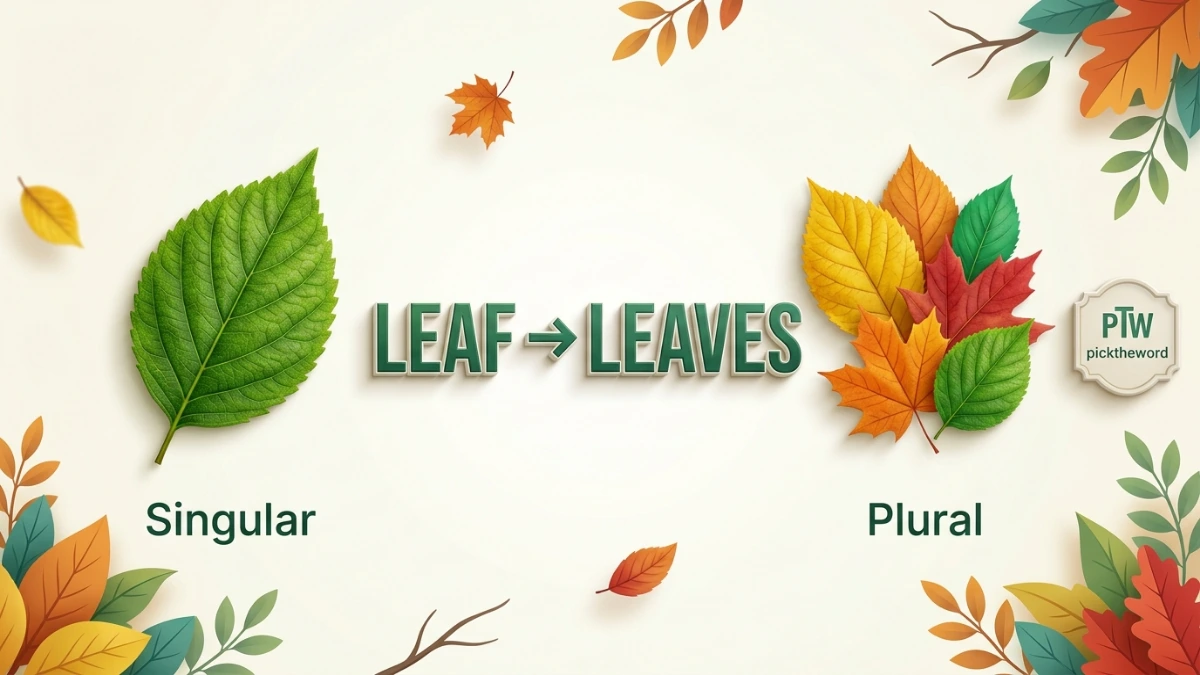
If you are unsure whether the plural of leaf is leafs or leaves, you are not alone. The spelling changes when we make leaf plural, which can make this simple word confusing for English learners.
The good news is that the correct plural form is easy to remember once you know the rule.
Quick Answer:
Leafs or Leaves?
The correct plural of leaf is usually leaves, not leafs.
For example:
We say, “The leaves are falling from the trees.” The spelling changes from f to ves when leaf becomes plural.
Leaf = one
Leaves = more than one
In standard English, leaves is the normal plural form you should use when talking about the parts of plants or trees.
What Is the Plural of Leaf?
The plural of leaf is leaves.
- Singular: leaf
- Plural: leaves
A leaf is the usually flat, green part of a plant or tree that grows from a stem or branch.
For example:
- There is a leaf on the ground.
- There are many leaves on the ground.
Notice that we do not simply add s to leaf. Instead, the f changes to v, and es is added:
leaf → leaves
This is an example of an irregular plural noun. The word does not follow the simple pattern of adding s, as in book → books or tree → trees.
Why Does Leaf Become Leaves?
Some English nouns ending in f or fe change their spelling when they become plural. In several common words, the f changes to v before es is added.
For example:
| Singular | Plural |
|---|---|
| leaf | leaves |
| knife | knives |
| wife | wives |
| life | lives |
| wolf | wolves |
| loaf | loaves |
| half | halves |
So the pattern can sometimes look like this:
f → v + es
That is why:
leaf → leaves
However, this is not a rule that works for every word ending in f. English has many exceptions.
For example:
- roof → roofs
- chief → chiefs
- belief → beliefs
- chef → chefs
So it is better to learn common plural forms individually rather than assuming every f word changes to ves.
Leafs vs. Leaves: What Is the Difference?
For everyday English, leaves is the form you almost always need when the word means the parts of a plant or tree.
Leaves is the plural of leaf:
The leaves are turning yellow.
Leafs is generally not the standard plural when you mean plant leaves. However, leafs can appear in a different context as a verb or as part of a proper name.
For example:
Leafs can be the thirdperson singular form of the verb leaf, meaning to make or turn into leaves, although this use is uncommon in everyday English.
Also, Leafs appears in the proper name Toronto Maple Leafs, the name of a professional ice hockey team.
So if you are writing about trees, plants, gardens, autumn, or nature, remember:
Use “leaves,” not “leafs.”
How to Use Leaf and Leaves in a Sentence
Use leaf when you are talking about one plant leaf.
- I found a green leaf.
- The insect is sitting on a leaf.
- One leaf fell from the tree.
Use leaves when you are talking about two or more.
- The tree has many leaves.
- The leaves are falling.
- We collected dry leaves from the garden.
A useful way to check your sentence is to ask:
“Am I talking about one or more than one?”
If it is one, use a leaf. If it is more than one, use leaves.
Examples of Leaf and Leaves
Here are natural examples showing how the two forms work in different types of writing.
Everyday and Informal Examples
- A yellow leaf fell onto my car.
- The leaves are blowing across the yard.
- I picked up a leaf from the sidewalk.
- The children played in a pile of leaves.
Formal Writing Examples
- Each leaf has a unique shape and structure.
- The dry leaves were removed from the garden.
- A damaged leaf may change color before it falls.
- The leaves provide shade during the summer.
Academic or Scientific Writing Examples
- A leaf is an important part of a plant’s structure.
- Green leaves contain chlorophyll, which helps plants absorb light.
- The researchers examined the leaves for signs of disease.
- The shape and size of leaves can vary between plant species.
These examples show that leaf and leaves work naturally in casual, formal, and academic English.
Common Mistakes: Leafs vs. Leaves
The most common mistake is simply adding s to leaf.
Incorrect: The leafs are falling from the trees.
Correct: The leaves are falling from the trees.
Incorrect: I collected several leafs from the garden.
Correct: I collected several leaves from the garden.
Incorrect: The tree has green leafs.
Correct: The tree has green leaves.
Another common mistake is using leaves when only one leaf is being discussed.
Incorrect: I found three leaf on the ground.
Correct: I found three leaves on the ground.
Incorrect: There are leaves on the table.
Correct: There is a leaf on the table.
The reason learners make these mistakes is understandable: many English nouns form plurals simply by adding s, such as tree → trees. But leaf belongs to a group of nouns with a different plural spelling.
Leaf or Leaves? A Simple Grammar Rule
The basic rule is:
Leaf = singular
Leaves = plural
You can also look at the words that come before the noun.
Use a or one with singular leaf:
- a leaf
- one leaf
- this leaf
- that leaf
Use plural leaves with numbers greater than one or plural determiners:
- two leaves
- many leaves
- several leaves
- these leaves
- those leaves
Compare:
| One | More than one |
| a leaf | two leaves |
| one leaf | many leaves |
| this leaf | these leaves |
| that leaf | those leaves |
This makes the difference much easier to recognize.
Is “Leafs” Ever Correct?
Yes, but leafs is not the normal plural form of leaf when talking about parts of plants.
In most everyday situations:
leaf → leaves
The spelling leafs may appear as a verb in unusual contexts or in proper names. One famous example is Toronto Maple Leafs, which is the official name of the hockey team.
This is why you may sometimes see leafs online and wonder whether it is correct.
For ordinary English writing, however, if you mean more than one part of a tree or plant, choose leaves.
Example:
- The leaves on the maple tree are red.
Similar Words That Follow the Same Pattern
Several common English words have plural forms that resemble leaf → leaves.
Here are some useful examples:
- knife → knives
- wife → wives
- life → lives
- wolf → wolves
- half → halves
- calf → calves
- loaf → loaves
- shelf → shelves
But remember that not every noun ending in f changes to ves.
For example:
- roof → roofs
- chef → chefs
- chief → chiefs
- belief → beliefs
- proof → proofs
There is no single rule that correctly predicts every plural form. Learning the common words as vocabulary items is the safest approach.
British vs. American English: Is There a Difference?
There is no important BritishAmerican spelling difference for the ordinary plural of leaf.
Both British English and American English normally use:
leaf → leaves
For example:
- British English: The leaves are falling.
- American English: The leaves are falling.
So unlike words such as color/colour or traveling/travelling, you do not need to choose between British and American spelling here.
If you are writing about trees or plants, leaves is the standard choice in both varieties of English.
Quick Tips to Remember Leaf vs. Leaves
Here are a few easy ways to remember the correct form.
1. Think “one leaf, many leaves.”
Say the pair together whenever you are learning the word:
leaf → leaves
2. Remember the spelling change.
The f changes to v, and es is added:
lea + f → lea + v + es
3. Do not use “leafs” for tree leaves.
If you are talking about leaves on a plant, garden, or tree, use leaves.
4. Check the number.
One = leaf
Two or more = leaves
5. Learn exceptions separately.
The f → ves pattern is common but does not apply to every word ending in f.
FAQs
Is “leafs” or “leaves” correct?
Leaves is correct when the plural of leaf means more than one part of a plant or tree.
For example:
“The leaves are green.”
What is the plural of leaf?
The standard plural of leaf is leaves.
Why is the plural of leaf “leaves”?
Leaf has an irregular plural form. The f changes to v, and es is added, giving us leaves.
Can I say “leafs”?
Usually not when you mean multiple plant leaves. Leaves is the standard plural. Leafs can appear in unusual verb contexts or proper names, such as Toronto Maple Leafs.
Is “leafs” grammatically wrong?
It is generally wrong if you use it as the ordinary plural of leaf. In that meaning, use leaves. However, leafs can be correct in certain other contexts.
What is the singular of leaves?
The singular form of leaves is leaf.
One leaf → two leaves
Do British and American English use “leaves”?
Yes. Both British and American English use leaves as the standard plural of leaf.
Conclusion
If you are wondering whether to write leafs or leaves, the answer is simple:
Leaves is the standard plural of leaf when you mean more than one part of a tree or plant.
Remember the basic pattern:
One leaf → two leaves
The f changes to v, and es is added. Although leafs can appear in special contexts, such as a proper name, it is not the normal plural you should use for tree or plant leaves.
So next time you write about autumn, gardening, trees, or plants, choose leaves with confidence.