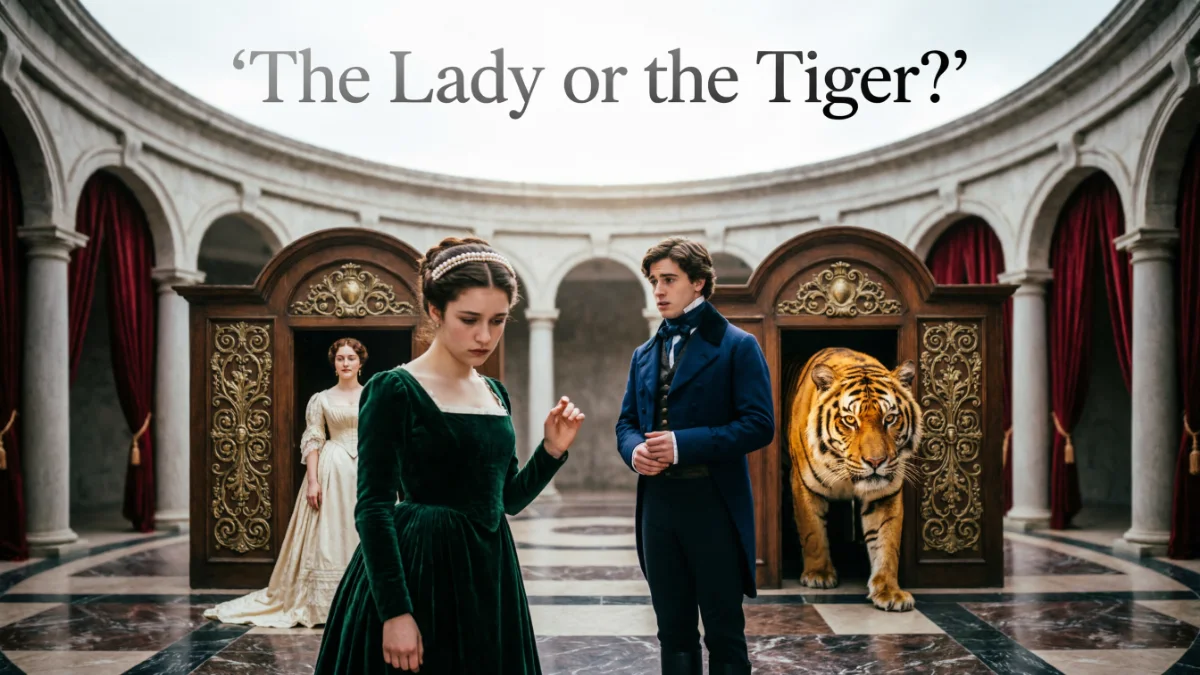
“The Lady or the Tiger?” is one of the most famous short stories by American writer Frank R. Stockton. Many readers search for the story because its title sounds like a simple choice, but the real question is much deeper: Which door did the young man choosethe one hiding a lady or the one hiding a tiger?
The story is famous because Stockton does not give readers a definite answer. Instead, he ends the story at the most important moment and asks us to decide what happened. This unusual ending has made “The Lady or the Tiger?” a popular story for students, teachers, book discussions, and literary analysis.
The story also raises interesting questions about love, jealousy, justice, human nature, and decision-making. If you are confused about the plot, the ending, or what the title means, this guide explains everything in simple language.
Quick Answer
“The Lady or the Tiger?” is a short story by Frank R. Stockton about a young man who must choose between two doors in an unusual arena. One door hides a beautiful woman, while the other hides a hungry tiger. The story ends without revealing which door he chooses, leaving the reader to decide whether love or jealousy controls the princess.
What Is “The Lady or the Tiger?” About?
“The Lady or the Tiger?” is a short story about a semi-barbaric king, his daughter, and a young man who falls in love with her.
The king has created a strange system of justice. When someone is accused of a crime, that person is taken to an arena and placed in front of two identical doors.
Behind one door is a beautiful lady.
Behind the other is a fierce tiger.
The accused person must choose one door without knowing what is behind it.
If the person chooses the door with the lady, the person is declared innocent and must marry her immediately. If the person chooses the door with the tiger, the tiger kills the person, proving that the person is guilty.
The king believes this system is fair because the person makes the final choice. However, the system is clearly cruel and based more on chance than true justice.
The central character is the king’s daughter, a princess who falls deeply in love with a young man who is considered socially beneath her.
When the king discovers their relationship, the young man is sent to the arena.
The princess secretly learns which door contains the lady and which contains the tiger. During the young man’s trial, she gives him a small signal telling him which door to choose.
He trusts her and opens the indicated door.
Then the story stops.
Stockton asks the reader to decide what was behind that door.
Was it the lady?
Or was it the tiger?
That unanswered question is the heart of the story.
Who Wrote “The Lady or the Tiger?”
Frank R. Stockton wrote “The Lady or the Tiger?” The story was first published in 1882 in The Century Magazine.
Stockton was an American writer known for humorous and imaginative stories. He often used unusual situations to explore human behavior.
“The Lady or the Tiger?” became particularly famous because of its ending. Readers expected the writer to tell them whether the princess saved her lover or sent him to his death. Instead, Stockton left the decision open.
This technique is called an ambiguous ending.
An ambiguous ending does not clearly explain what happens. Instead, it allows readers to interpret the final event for themselves.
What Does the Title “The Lady or the Tiger?” Mean?
The title refers directly to the young man’s final choice.
There are two doors:
- The lady is behind one door.
- The tiger is behind the other door.
The lady represents survival, marriage, and a possible future with another woman.
The tiger represents death.
However, the title has a deeper meaning too.
The real choice is not simply between an animal and a person. It represents the princess’s emotional conflict.
She has two possible desires:
She may want her lover to live.
At the same time, she may be unable to accept seeing him marry another woman.
This creates the central conflict of the story.
If she tells him to choose the door with the lady, he survives but marries another woman.
If she tells him to choose the door with the tiger, he dies, but he never belongs to anyone else.
That is why the final choice is so difficult.
The Main Characters
The King
The king is powerful, proud, and imaginative, but his idea of justice is cruel.
He creates the arena because he enjoys the idea of letting people face their fate. He believes his system is fair because the accused person chooses a door.
However, the process is not really based on evidence or reason. A person can live or die simply because of what happens to be behind a door.
The king also represents absolute power. He can create his own rules and force others to obey them.
The Princess
The princess is the most important character because the ending depends on her decision.
She is intelligent, passionate, and strong-willed. She loves the young man but also has a jealous side.
Unlike her father, she understands exactly what is behind each door. She secretly discovers the locations of the lady and the tiger.
When her lover looks toward her for help, she gives him a signal.
The story does not tell us exactly why she chooses that door.
This makes the princess the central mystery of the story.
The Young Man
The young man is a brave commoner who falls in love with the princess.
Their relationship is forbidden because of their different social positions. The princess’s father considers their love unacceptable.
The young man eventually faces the king’s terrible trial.
He trusts the princess completely, believing that she knows which door is safe.
His fate therefore depends on her feelings.
The Lady
The lady behind one door is not given much personality or background.
Her importance comes from what she represents.
If the young man chooses her door, he will live and be forced to marry her.
She therefore represents life, marriage, and the loss of the princess’s lover to another woman.
The Tiger
The tiger represents death and punishment.
It is also part of the king’s cruel system of justice.
The tiger is not simply an animal in the story. It becomes a symbol of the danger waiting behind one of the choices.
The Plot of “The Lady or the Tiger?” Explained
The story begins by describing a powerful king who has developed a strange form of justice.
When someone is accused of a crime, that person is brought before the public in an arena.
Two doors stand in front of the accused person.
Behind one is a tiger.
Behind the other is a woman chosen by the king.
The person must select one door.
If the tiger appears, the person is killed.
If the lady appears, the person is considered innocent and must marry her immediately.
The king believes this system produces justice because the accused person chooses his or her own fate.
The story then focuses on the king’s daughter.
The princess falls in love with a young man who does not have the same social position as she does. Their relationship is discovered, and the young man is eventually placed on trial.
The princess secretly investigates the two doors.
She discovers which door contains the tiger and which contains the lady.
On the day of the trial, the young man enters the arena.
Thousands of people watch.
He looks toward the princess because he knows she has discovered the secret.
She gives him a signal.
The young man immediately moves toward the door she indicates.
He opens it.
And then Stockton ends the story.
We never learn what was behind the door.
That is the mystery readers have argued about for generations.
Why Is the Ending So Famous?
Most stories answer the main question before they end.
Stockton does the opposite.
He gives readers enough information to understand the situation but refuses to tell them the final result.
The princess clearly knows where the lady and tiger are.
She also clearly loves the young man.
But she is extremely jealous.
If she sends him toward the lady, he will survivebut he will marry someone else.
If she sends him toward the tiger, he will die.
The reader therefore has to decide which emotion is stronger.
Love may make the princess want her lover to live.
But jealousy may make her unable to accept him marrying another woman.
The ending works because both possibilities are believable.
Stockton does not tell us that the princess is completely kind or completely cruel. She is emotionally complicated.
Did the Princess Choose the Lady or the Tiger?
There is no officially confirmed answer in the story.
The young man follows the princess’s signal, but Stockton never tells us what was behind the door.
This means there are two major interpretations.
Interpretation 1: She Chose the Lady
Under this interpretation, the princess chooses the lady because she truly loves the young man.
She wants him to live, even though she knows he will marry another woman.
This interpretation presents the princess as someone capable of putting another person’s life above her own feelings.
It also suggests that her love is stronger than her jealousy.
Interpretation 2: She Chose the Tiger
Under this interpretation, the princess chooses the tiger.
She cannot tolerate the idea of seeing the man she loves marry another woman.
Her jealousy becomes stronger than her desire to save him.
This interpretation presents the princess as passionate but also possessive.
Which Interpretation Is Correct?
Stockton intentionally leaves the answer uncertain.
That is the point.
Readers can use the princess’s personality, actions, and emotions to support either interpretation.
The story is less about discovering the “correct” door and more about asking:
What would a person do when love and jealousy come into conflict?
Themes in “The Lady or the Tiger?”
The story has several important themes that make it useful for literary study.
Love and Jealousy
The biggest theme is the conflict between love and jealousy.
The princess loves the young man, but she is also jealous of the other woman.
Her final decision depends on which feeling is stronger.
The story shows that love is not always simple or purely selfless.
Choice and Fate
The young man technically has a choice.
He can choose either door.
But he does not really have enough information to make an informed decision.
The princess knows the truth and guides him.
This creates an interesting question:
Are we truly in control of our choices when we do not know the consequences?
Justice and Cruelty
The king calls his system justice, but readers can see that it is cruel.
A person’s life depends on a random choice.
There is no careful investigation, evidence, or fair trial in the modern sense.
The story therefore questions whether authority can call something “justice” simply because it creates rules.
Power
The king controls almost everything.
He controls the legal system, the arena, and the lives of the people who enter it.
The princess also has a small amount of power because she knows what is behind the doors.
The young man, however, has very little control over his situation.
Human Nature
The story asks readers to think about how people behave when powerful emotions take control.
Would someone sacrifice their own happiness to save another person?
Would jealousy cause someone to make a cruel decision?
There is no easy answer because human emotions are complicated.
Symbolism in the Story
The two doors are powerful symbols.
| Symbol | Meaning |
| The lady | Life, marriage, survival, and loss |
| The tiger | Death, punishment, and jealousy |
| The two doors | Choice, uncertainty, and fate |
| The arena | Public judgment and cruel justice |
| The princess’s signal | Trust, love, and emotional conflict |
| The king | Power and absolute authority |
The two doors are especially important.
They represent more than two physical choices. They represent two possible futures.
One future gives the young man life but separates him from the princess.
The other ends his life but prevents him from marrying another woman.
Examples of How to Discuss the Story
Here are natural examples you can use in schoolwork, discussions, or literary analysis.
- “The Lady or the Tiger?” is a short story by Frank R. Stockton.
- The story focuses on a princess who must make an emotionally difficult choice.
- The young man has to choose between two doors in the king’s arena.
- One door hides a tiger, while the other hides a lady.
- The princess knows what is behind both doors.
- The young man trusts the princess’s signal.
- The ending is ambiguous because Stockton never reveals what happens next.
- The story explores the conflict between love and jealousy.
- The tiger can be interpreted as a symbol of death and punishment.
- The lady represents survival but also the loss of the princess’s lover.
- The king’s system of justice is based on chance rather than evidence.
- Readers can reasonably argue that either the lady or the tiger was behind the chosen door.
Formal, Informal, and Academic Usage
Although the title is mainly associated with literature, you may need to mention it in different types of writing.
Formal Writing
In formal writing, capitalize the important words in the title:
Frank R. Stockton wrote “The Lady or the Tiger?” in 1882.
Informal Writing
In casual conversation, you might say:
“Have you ever read ‘The Lady or the Tiger?’”
Or:
“I still can’t decide whether she chose the lady or the tiger.”
Academic Writing
In an essay, you might write:
In “The Lady or the Tiger?”, Frank R. Stockton uses an ambiguous ending to explore the conflict between love and jealousy.
Another example:
The two doors symbolize the difficult choices created by the princess’s conflicting emotions.
Common Mistakes When Discussing the Story
Mistake 1: Saying the Ending Is Confirmed
Incorrect:
“Stockton confirms that the princess chose the tiger.”
Better:
“Stockton leaves it unclear whether the princess chose the lady or the tiger.”
The story does not provide a definite answer.
Mistake 2: Calling the Story a Modern Court Trial
Incorrect:
“The young man receives a normal fair trial.”
Better:
“The young man faces the king’s unusual and cruel system of justice.”
The arena is deliberately different from a modern legal system.
Mistake 3: Assuming the Princess Is Completely Good
Incorrect:
“The princess definitely saves him because she loves him.”
Better:
“The princess loves him, but her jealousy makes her decision uncertain.”
Her emotional conflict is the main mystery.
Mistake 4: Assuming the Tiger Only Represents Physical Danger
Incorrect:
“The tiger is just an animal used to punish people.”
Better:
“The tiger represents death, punishment, and one possible result of the princess’s decision.”
Mistake 5: Treating One Interpretation as the Author’s Confirmed Answer
Incorrect:
“The author tells us exactly what happened.”
Better:
“The author deliberately leaves the ending open to interpretation.”
Why Do Readers Find the Story Confusing?
The biggest source of confusion is the ending.
Readers naturally expect the final door to reveal the answer.
Instead, Stockton asks the reader to think about the princess’s personality.
Was she loving enough to let her lover live?
Or was she jealous enough to send him to his death?
Another reason the story can feel confusing is that the princess has two strong emotions at the same time.
She loves the young man.
She also hates the thought of him marrying another woman.
Both feelings can exist together.
This is what makes the story interesting rather than simply giving us a good character and a bad character.
Similar and Related Literary Terms
If you are studying “The Lady or the Tiger?”, several literary terms may help.
Ambiguous Ending
An ambiguous ending leaves the final result uncertain.
This is the most important literary technique in the story.
Open Ending
An open ending does not completely resolve the story.
Readers are invited to imagine or interpret what happens.
Conflict
The princess experiences internal conflict because she struggles between love and jealousy.
There is also external conflict between the young man and the king’s system of justice.
Symbolism
Symbolism occurs when an object, character, or event represents a deeper idea.
The lady and tiger symbolize different possible futures.
Irony
There is irony in the king’s system.
He believes his method is fair and impartial, but the result is based on chance and can be extremely cruel.
Modern Usage and Why the Story Is Still Popular
“The Lady or the Tiger?” remains popular because its central problem is easy to understand but difficult to solve.
People still face choices involving love, jealousy, trust, sacrifice, and uncertainty.
The story also works well in classrooms because students can defend different interpretations using evidence from the text.
There is no need to agree on one answer to appreciate the story.
In fact, disagreement is part of its design.
The title itself has also become a common way to describe a situation in which someone must choose between two very different outcomes.
For example, a teacher might jokingly describe a difficult decision as a “lady or tiger” situation.
Quick Tips to Remember
Here are some easy points to remember for a test or class discussion:
- Author: Frank R. Stockton
- Publication: 1882
- Genre: Short story
- Main characters: The king, the princess, and the young man
- Main problem: The young man must choose between two doors.
- Behind one door: A lady
- Behind the other: A tiger
- Princess’s role: She knows what is behind both doors.
- Main themes: Love, jealousy, choice, power, justice, and human nature
- Ending: Ambiguous
- Final answer: The story does not tell us whether the lady or tiger was chosen.
Easy Memory Trick
Think:
Lady = life
Tiger = death
Then remember the real question:
Will the princess choose love or jealousy?
That is the central mystery of the story.
FAQ
What is “The Lady or the Tiger?” about?
It is about a young man who must choose between two doors in a king’s arena. One door hides a lady and the other hides a tiger. His choice determines whether he lives or dies.
Who wrote “The Lady or the Tiger?”
Frank R. Stockton wrote the story. It was published in 1882.
Did the princess choose the lady or the tiger?
The story does not give a definite answer. Stockton intentionally leaves the ending ambiguous so readers can decide what they believe happened.
What is the main theme of “The Lady or the Tiger?”
One of the main themes is the conflict between love and jealousy. The princess loves the young man but does not want him to marry another woman.
What does the tiger symbolize?
The tiger mainly symbolizes death, punishment, danger, and one possible result of the princess’s decision.
What does the lady symbolize?
The lady symbolizes life and survival, but she also represents the young man’s possible marriage to someone other than the princess.
Why does “The Lady or the Tiger?” have an open ending?
Stockton uses an open ending to make readers think about human emotions and behavior. Instead of giving one answer, he asks readers to decide what the princess would do.
Conclusion
“The Lady or the Tiger?” is much more than a story about a man choosing between two doors. Frank R. Stockton uses the strange situation to explore love, jealousy, choice, power, justice, and human nature.
The most important thing to remember is that the story does not tell us whether the princess sent the young man toward the lady or the tiger. The ending is intentionally ambiguous.
If she chose the lady, her love may have been stronger than her jealousy. If she chose the tiger, her jealousy may have been stronger than her love.
There is no confirmed answer in the original story. That uncertainty is exactly what makes “The Lady or the Tiger?” memorable.
So, if someone asks, “Did he get the lady or the tiger?”, the safest answer is:
We do not know and that is the point.