Are you unsure whether to write awhile or a while? You’re not alone. These two expressions sound exactly the same, but they are not used the same way.
Many English learners write sentences like “Stay awhile” and “Stay a while” without knowing which one is correct.
The good news is that the difference is actually very simple. Once you learn one easy grammar rule, you’ll know which one to use every time.
In this guide, you’ll learn the meaning of each form, when to use it, common mistakes to avoid, and easy tricks to remember the difference.
Quick Answer
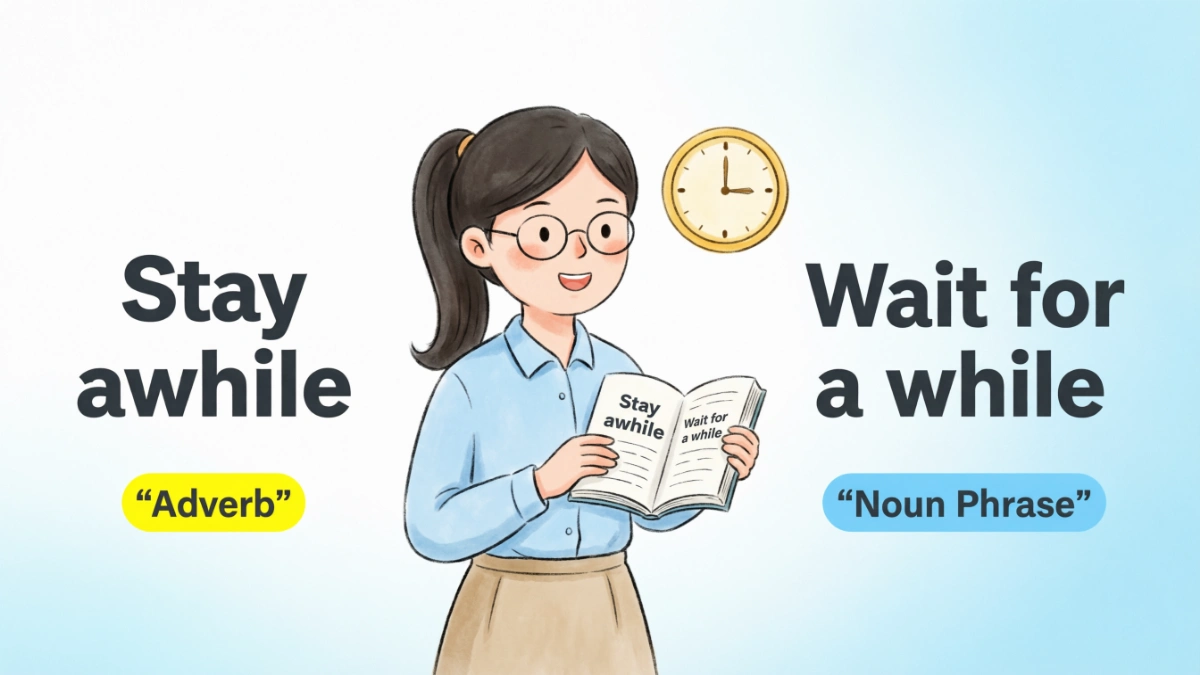
Awhile is an adverb that means for a short time. A while is a noun phrase that means a period of time.
- ✅ Stay awhile.
- ✅ Wait a while.
A simple memory trick is this:
- If you can replace it with “for a while,” use a while.
- If no for is needed, use awhile.
What Do “Awhile” and “A While” Mean?
Although they sound the same, they have different grammar jobs.
What Does “Awhile” Mean?
Awhile is one word. It is an adverb.
It means for a short period of time.
Examples:
- Please stay awhile.
- Sit here awhile.
- Let’s rest awhile before hiking again.
In each sentence, awhile tells us how long an action happens.
What Does “A While” Mean?
A while is two words.
It is a noun phrase that means a period of time.
Examples:
- We waited a while.
- It may take a while.
- I haven’t seen her for a while.
Because it is a noun phrase, it often follows words like:
- for
- after
- in
- quite
- a long
Examples:
- for a while
- after a while
- quite a while
- in a while
The Main Difference Between “Awhile” and “A While”
The easiest way to remember the difference is to look at the word before it.
| Awhile | A While |
| One word | Two words |
| Adverb | Noun phrase |
| Means “for a short time” | Means “a period of time” |
| Usually follows a verb directly | Often follows a preposition like for |
| Stay awhile. | Wait for a while. |
Notice these examples:
✅ Come in and stay awhile.
✅ We stayed for a while.
The meaning is almost the same, but the grammar is different.
The Simple Grammar Rule
This rule solves almost every question.
Use awhile after a verb.
Examples:
- Sit awhile.
- Rest awhile.
- Stay awhile.
- Relax awhile.
Use a while after a preposition.
Examples:
- for a while
- after a while
- in a while
Examples in sentences:
- We talked for a while.
- After a while, everyone relaxed.
- I’ll see you in a while.
Never write:
❌ Stay a while? Actually, this is acceptable in modern English because stay can take a while as a noun phrase (“stay for a while” with for omitted). However, stay awhile is the more traditional adverb form.
This is one reason learners become confused.
Why Are People Confused?
There are three main reasons.
They Sound Exactly the Same
When spoken, nobody hears the space between the words.
For example:
- Stay awhile.
- Stay a while.
They sound identical.
Both Talk About Time
Both expressions refer to a short amount of time.
Because the meaning is similar, learners often think they are interchangeable.
Modern English Is More Flexible
Today’s English is less strict than older grammar books.
Native speakers often say:
- Stay awhile.
- Stay a while.
Both sound natural in everyday conversation, although traditional grammar still distinguishes between them.
When Should You Use “Awhile”?
Use awhile when it directly modifies the verb.
Examples:
- Please stay awhile.
- Sit awhile and relax.
- Wait awhile before answering.
- Rest awhile after lunch.
- Let’s chat awhile.
- Come inside and warm up awhile.
Notice there is no preposition before awhile.
When Should You Use “A While”?
Use a while when you need a noun phrase that names a period of time.
Examples:
- We waited a while.
- It takes a while to learn English.
- I haven’t visited them for a while.
- After a while, the rain stopped.
- It has been quite a while.
- We’ll be here for a while.
Whenever you see words like for, after, or in, a while is usually the correct choice.
Can Both Ever Be Correct?
Yes.
Some verbs allow both forms.
Example:
- Stay awhile.
- Stay a while.
Both are widely accepted today.
Why?
Because stay a while is understood as a shortened version of:
Stay for a while.
The word for is simply omitted.
The same happens with verbs like:
- wait
- sit
- rest
- linger
So you’ll see both forms in books, newspapers, and everyday speech.
Awhile vs A While in Formal Writing
In formal writing, following the traditional grammar rule makes your writing look more polished.
Preferred:
- Please remain awhile.
- We spoke for a while.
This distinction is especially useful in:
- school assignments
- business writing
- professional emails
- academic papers
In casual conversation, both forms are often accepted when the meaning is clear.
British vs American English
There is no major difference between British and American English in the meanings of awhile and a while.
Both varieties understand and use both forms.
However:
- Formal editors in both regions usually follow the traditional grammar distinction.
- Everyday speakers in both regions often use either form after verbs like stay or sit.
So this is not really a regional spelling issue. It is mainly a grammar choice.
Usage Examples
Formal Writing
- Please remain awhile until the meeting begins.
- We discussed the proposal for a while.
- The committee waited a while before making a decision.
- Rest awhile before continuing your presentation.
Informal Writing
- Stay awhile and watch the movie.
- I’ll be back in a while.
- We talked for a while after dinner.
- Sit awhile and have some coffee.
Academic Writing
- Researchers observed the participants for a while before recording results.
- Students should think awhile before answering difficult questions.
- It may take a while to understand the concept completely.
- After a while, the experiment reached stable results.
Everyday Example Sentences
- Please stay awhile.
- We’ll be gone for a while.
- Sit awhile and relax.
- It takes a while to master grammar.
- Wait awhile before crossing the road.
- After a while, everyone laughed.
- Let’s talk awhile.
- I haven’t seen him for a while.
- Rest awhile before exercising again.
- It has been quite a while since we met.
- The children played for a while.
- Come inside and stay awhile.
Common Mistakes
| Incorrect | Correct | Why? |
| We talked for awhile. | We talked for a while. | For is followed by the noun phrase a while. |
| Stay for awhile. | Stay for a while. | Use a while after for. |
| Sit a while. | Sit awhile or sit a while (both accepted today). | Traditional grammar prefers awhile, but modern English often accepts both. |
| After awhile, we left. | After a while, we left. | After takes the noun phrase. |
Why Learners Make These Mistakes
Most learners focus on pronunciation instead of grammar.
Since both forms sound identical, they often forget to check whether the expression is acting as an adverb or a noun phrase.
Similar or Commonly Confused Words
Several English word pairs cause confusion because they look or sound alike.
Everyday vs Every Day
- Everyday = ordinary
- Every day = each day
Anytime vs Any Time
- Anytime = adverb (mainly informal)
- Any time = noun phrase
Already vs All Ready
- Already = previously
- All ready = completely prepared
Altogether vs All Together
- Altogether = completely
- All together = everyone in one place
Like awhile and a while, these pairs have different grammar even though they sound similar.
Modern Usage Preferences
Modern English is becoming more flexible than older grammar books.
You’ll often see:
- Stay awhile.
- Stay a while.
Both are common in novels, websites, blogs, advertisements, and everyday conversation.
However, if you’re writing for school, work, or exams, following the traditional grammar rule is the safest choice.
That approach is also recommended by many style guides and dictionaries.
Quick Tips to Remember
- Awhile = one word = adverb.
- A while = two words = noun phrase.
- If for comes before it, write a while.
- If it follows a verb directly, awhile usually works.
- In formal writing, keep the traditional distinction.
- In casual conversation, you may sometimes see both forms after verbs like stay or sit.
Easy memory trick:
If you can say “for a while,” write two words. Otherwise, one word often works.
Frequently Asked Questions (FAQs)
Is “awhile” one word or two?
Awhile is one word. A while is two words. They have different grammar functions.
Which is correct: “stay awhile” or “stay a while”?
Both are accepted in modern English. Traditional grammar prefers stay awhile, while stay a while is understood as stay for a while with the word for omitted.
Can I say “for awhile”?
Traditional grammar recommends for a while because a while is the noun phrase used after the preposition for.
Is “awhile” formal?
Yes. It is perfectly correct in formal writing when used as an adverb.
Is there a British or American difference?
No. Both British and American English use awhile and a while with the same meanings.
Why do dictionaries sometimes accept both?
Because modern English usage has become more flexible, especially after verbs like stay, sit, and wait.
Which form should English learners use?
Follow the traditional rule. It is easy to remember, always correct in formal writing, and accepted everywhere.
Conclusion
The difference between awhile and a while is much easier than it first appears. Awhile is an adverb that means for a short time, while a while is a noun phrase meaning a period of time. If you remember that prepositions like “for,” “after,” and “in” are followed by “a while,” you’ll avoid most mistakes. For everyday conversation, you may hear both forms after certain verbs, but using the traditional grammar rule will keep your English clear, natural, and correct in every situation.