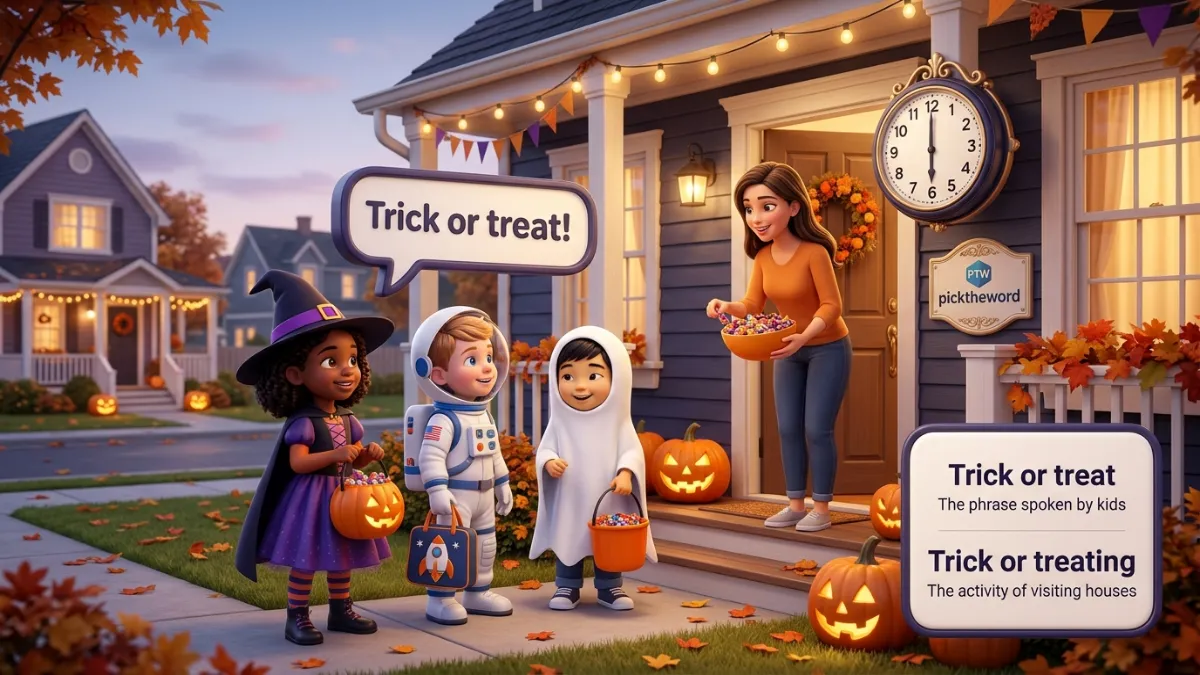
If you are wondering what time trick or treating starts, you are not alone. Many families want to know the best time to go door to door on Halloween, especially when young children are involved.
The usual trick or treating time is around 5:30 or 6:00 p.m. to 8:00 or 9:00 p.m.
However, the exact time can change depending on where you live, the age of the children, the weather, and local Halloween traditions.
Quick Answer
Trick or treating usually starts around 5:30 or 6:00 p.m. on Halloween and often ends around 8:00 or 9:00 p.m. In many neighborhoods, younger children go earlier, while older children may stay out later.
There is no single worldwide trick or treating time. Your local neighborhood may have its own schedule, so it is a good idea to check local Halloween announcements or ask nearby families.
What Time Does Trick or Treating Usually Start?
Most trick or treating happens in the early evening on October 31, which is Halloween.
A common schedule looks like this:
| Time | What usually happens |
|---|---|
| 4:30 or 5:30 p.m. | Some families get ready and younger children may begin going out |
| 5:30 or 6:30 p.m. | Trick or treating commonly begins |
| 6:30 or 8:00 p.m. | Busiest time in many neighborhoods |
| 8:00 or 9:00 p.m. | Trick or treating starts winding down |
| After 9:00 p.m. | Most children have gone home |
These are general times, not strict rules.
If you have very young children, 5:30 or 6:00 p.m. can be a good starting point. It may still be light outside, and children are less likely to become tired or overwhelmed.
Older children and teenagers may go later, especially in neighborhoods where Halloween activities continue into the evening.
Why Does Trick or Treating Start in the Evening?
There is a simple reason:
Halloween is celebrated in the evening, and children traditionally go door to door after dark or near sunset.
Going out in the evening also creates the classic Halloween atmosphere. Costumes, decorations, pumpkins, and lights are easier to enjoy as it gets dark.
However, complete darkness is not necessary. In fact, families with small children often prefer to start before it becomes completely dark.
The best time depends on the people involved.
For example:
- Toddlers:
Earlier is usually better.
- Young children:
Around 5:30 or 7:30 p.m. may work well.
- Older children:
They may go from about 6:00 or 8:30 p.m. or later.
- Teenagers:
Some may continue later, depending on local rules.
- Busy neighborhoods:
The main activity may happen between 6:00 and 8:00 p.m.
Always put safety first. Children should be visible, stay with trusted adults when appropriate, and avoid walking through dark or unsafe areas.
What Time Does Trick or Treating End?
There is also no universal ending time.
In many places, 8:00 or 9:00 p.m. is when trick or treating begins to slow down. Some neighborhoods may finish earlier, especially when many young children live there.
If you are giving out candy, a useful rule is to watch for signs that the neighborhood is winding down. Fewer children walking around and fewer decorated homes with lights on usually mean that trick or treating is nearly finished.
Some families use a simple signal:
Turning off the porch light when they no longer want to give out candy.
So, if you are asking, “What time should I stop trick or treating?”
A reasonable answer is around 8:00 or 9:00 p.m., unless your local community has a different tradition.
Is Trick or Treating at 5 PM Too Early?
Usually, 5 p.m. is a little early for traditional trick or treating, but it is not necessarily wrong.
For very young children, starting around 5 p.m. may be perfectly practical. Parents may prefer to go out before it gets dark, especially if the children have an early bedtime.
Some communities also organize special daytime or early evening Halloween events. In those cases, children may start trick or treating earlier than usual.
If you are unsure, look at what other families in your neighborhood are doing. A house with its porch light on and Halloween decorations outside is often a good sign that trick or treaters are welcome.
Is Trick or Treating at 8 PM Too Late?
8 p.m. is generally not too late for trick or treating in many neighborhoods.
In fact, 8 p.m. can still be part of the busiest period, particularly for older children.
However, the answer depends on your location and the age of the children. A group of small children knocking on doors at 8:45 p.m. may be less common than a group of older children.
A good rule is to respect the neighborhood. If most houses have turned off their lights and children are no longer outside, it is probably time to head home.
What Does “Trick or Treating” Mean?
Trick or treating is a Halloween tradition in which children visit homes and ask for candy or other treats.
The phrase comes from the traditional expression “trick or treat.” The idea is that the child is asking for a treat, while jokingly suggesting that a trick could happen if no treat is given.
Today, the tradition is mostly about costumes, candy, decorations, and having fun with neighbors.
Trick or Treat vs. Trick or Treating
These expressions are related but have slightly different uses.
Trick or treat is what children traditionally say when someone opens the door.
Example:
“Trick or treat!”
Trick or treating describes the activity itself.
Example:
“We are going trick or treating tonight.”
This is why the question is usually written as “What time is trick or treating?” rather than “What time is trick or treat?”
Natural Examples of “Trick or Treating”
Here are some examples showing how people naturally use the phrase.
Everyday and informal examples:
- “What time are you going trick or treating?”
- “We usually go trick or treating around 6 p.m.”
- “The kids want to start trick or treating early.”
- “What time does trick or treating start in your neighborhood?”
- “We will probably finish trick or treating by 8:30.”
- “Are your children going trick or treating this Halloween?”
More formal examples:
- “Parents should check local guidelines before taking their children trick or treating.”
- “The community recommends that trick or treating begin after sunset.”
Academic or informational examples:
- “Trick or treating is a popular Halloween tradition in the United States.”
- “The usual time for trick or treating varies by community.”
- “Younger children may participate in trick or treating earlier in the evening.”
- “Local weather conditions can affect the timing of Halloween activities.”
Notice that “trick or treating” normally works as the name of the activity.
Common Mistakes About Trick or Treating
English learners sometimes get confused because trick or treat can refer to both a phrase and an activity.
Incorrect:
“What time is trick or treat?”
This sounds unnatural when you are asking about the activity.
Better:
“What time is trick or treating?”
Here, trick or treating is the activity you are asking about.
Incorrect:
“What time does trick or treating starts?”
There are two verbs here:
Does and starts. After “does,” use the base form of the verb.
Correct:
“What time does trick or treating start?”
The same rule appears in questions such as:
- “What time does the movie start?”
- “What time does school begin?”
- “What time does the party finish?”
Incorrect:
“What time trick or treating?”
This question is missing a verb.
Correct:
“What time is trick or treating?”
or:
“What time does trick or treating start?”
The second version is especially clear because it directly asks about the starting time.
“What Time Is Trick or Treating?” vs. “What Time Does Trick or Treating Start?”
Both questions can be understood, but there is a small difference.
“What time is trick or treating?”
Asks generally about the scheduled or usual time for the activity.
“What time does trick or treating start?”
Specifically asks when the activity begins.
For everyday conversation, both are natural enough.
If you want to be especially clear, you can say:
“What time does trick or treating start in your neighborhood?”
This makes your meaning obvious.
Another useful question is:
“What time are you going trick or treating?”
This asks about another person’s plans rather than the neighborhood’s official or usual schedule.
Regional Differences in Trick or Treating Times
Trick or treating times can vary significantly from one place to another.
In the United States, Halloween trick or treating commonly takes place during the early evening, often starting around sunset or shortly before it.
In Canada, timing can also vary by community, with many families going out during the early evening.
In the United Kingdom, Halloween is celebrated, but traditional trick or treating is generally less widespread than in the United States. The timing can therefore be more dependent on the individual community or event.
Weather can also make a big difference. A cold, rainy, or snowy Halloween may cause families to go out for a shorter period or attend indoor events instead.
Some towns, neighborhoods, schools, or community organizations may also set specific Halloween hours.
Because of these differences, there is no single correct answer to “What time is trick or treating?”
How to Choose the Best Time for Your Family
If your neighborhood does not have a specific schedule, choose a time that works for your family.
For young children, consider going out around 5:30 or 6:00 p.m. This gives them plenty of time without keeping them out too late.
For school age children, 6:00 or 8:00 p.m. is often a comfortable window.
For older children, you may choose a later time, provided it is safe and fits local expectations.
Before leaving, check:
- The weather
- Local Halloween schedules
- Your child’s age and bedtime
- How dark it will be
- Whether an adult should accompany the children
- Whether nearby homes are participating
A little planning can make Halloween much easier and more enjoyable.
Quick Tips to Remember
Here are the easiest points to remember:
- Typical start: Around 5:30 or 6:00 p.m.
- Busiest period: Often around 6:00 or 8:00 p.m.
- Typical ending: Around 8:00 or 9:00 p.m.
- Young children: Consider going earlier.
- Older children: They may go later.
- Local rules matter: Your community may have different hours.
- Porch lights: A lit porch often signals that a home is welcoming trick or treaters.
- Grammar tip: Use “trick or treating” when talking about the activity.
- Question tip: “What time does trick or treating start?” is a very clear way to ask.
A simple memory trick is:
Trick or treat = the words children say.
Trick or treating = the activity children do.
FAQ
What time does trick or treating usually start?
Trick or treating commonly starts around 5:30 or 6:00 p.m., although the exact time depends on the neighborhood and local traditions.
What time does trick or treating usually end?
Many neighborhoods wind down around 8:00 or 9:00 p.m. Families with young children may finish earlier.
Is 5 p.m. too early for trick or treating?
Not necessarily. Five o’clock can be a good time for toddlers and young children, especially if parents want to go out before it gets dark.
Is 8 p.m. too late for trick or treating?
Usually not. In many places, 8 p.m. is still a normal trick or treating time. However, you should follow local customs and respect homes that have turned off their lights.
What should I say when I go trick or treating?
The traditional phrase is “Trick or treat!” Children usually say this when someone opens the door.
What is the difference between “trick or treat” and “trick or treating”?
“Trick or treat” is the phrase children say when they visit a home. “Trick or treating” describes the activity of going from house to house for treats.
Is “What time is trick or treating?” Grammatically correct?
Yes. It is a natural question asking about the usual or scheduled time for the activity. You can also say, “What time does trick or treating start?”
Conclusion
So, what time is trick or treating?
In many neighborhoods, children start around 5:30 or 6:00 p.m. and finish around 8:00 or 9:00 p.m. The best time can change depending on the neighborhood, weather, children’s ages, and local Halloween traditions.
If you are asking about the English phrase, remember the simple difference:
“Trick or treat” is what children say, while “trick or treating” is the activity they are doing.
When in doubt, check your local Halloween schedule and follow the timing used by nearby families. That way, you can enjoy Halloween without worrying about whether you are too early or too late.

Hi, I’m Virginia Woolf, a language enthusiast passionate about exploring the power of words and their meanings. I specialize in helping readers choose the right words through clear comparisons, synonyms, and practical usage. My goal is to make vocabulary learning simple, engaging, and useful for everyday communication. picktheword.com