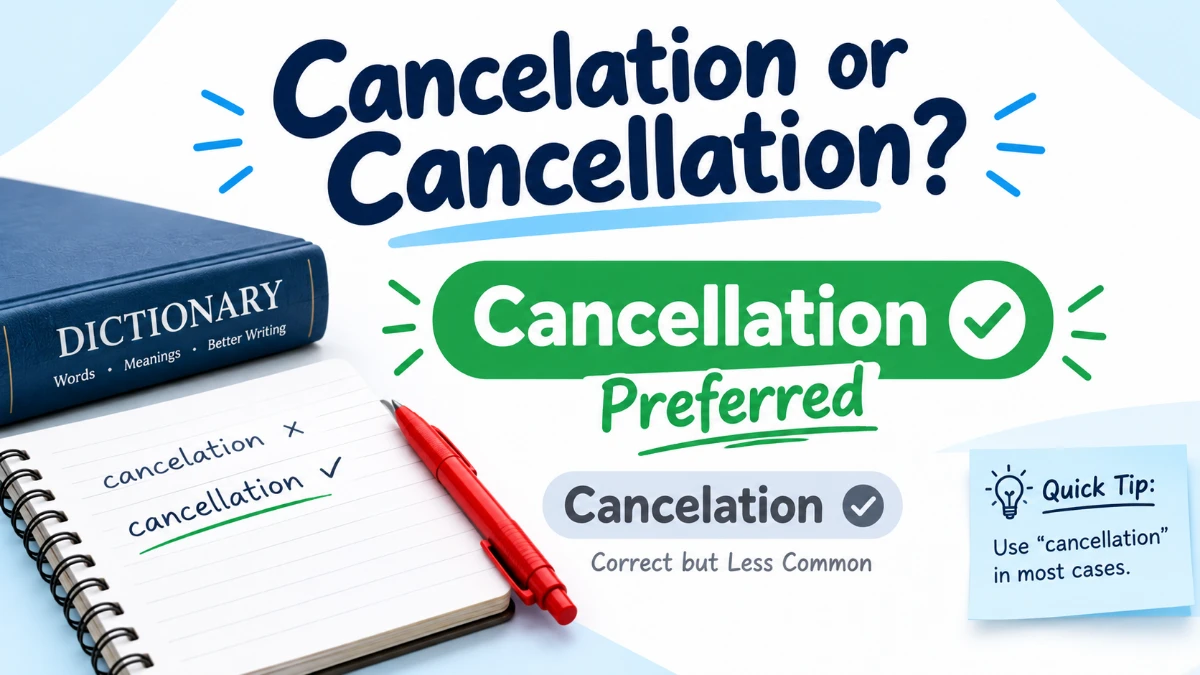
The short answer is that both spellings are correct, but cancellation is much more common and widely accepted in both American and British English.
This difference often confuses English learners because many words ending in l follow different spelling rules depending on the region.
If you have ever wondered which spelling you should use in an email, school paper, or business document, this guide will make it simple.
Quick Answer
Cancellation is the preferred spelling in modern English and is the one you should use most of the time.
Although cancelation is also recognized as a correct spelling, it is much less common. If you’re unsure, choose cancellation because it is accepted almost everywhere.
What Do “Cancelation” and “Cancellation” Mean?
Both words have exactly the same meaning.
They refer to the act of canceling something or the process of making something no longer valid or planned.
Examples include:
- Canceling a meeting
- Canceling a flight
- Canceling a subscription
- Canceling an appointment
- Canceling an order
No matter which spelling you use, the meaning does not change.
Is “Cancelation” or “Cancellation” Correct?
Both spellings are correct, but they are not equally common.
| Spelling | Correct? | Common Usage |
|---|---|---|
| Cancellation | Yes | Standard and strongly preferred |
| Cancelation | Yes | Correct but much less common |
Today, dictionaries recognize both spellings. However, publishers, businesses, schools, and most professional writers almost always use cancellation.
If you want to avoid mistakes, use cancellation.
Why Are There Two Spellings?
The confusion comes from the verb cancel.
When adding the suffix ation, English sometimes doubles the final l.
This creates:
- cancel → cancellation
Some people also write:
- cancel → cancelation
Both forms developed over time, but cancellation became the standard spelling in everyday English.
British vs American English
Unlike many English words, this spelling difference is not mainly about American and British English.
Both countries strongly prefer cancellation.
| English Variety | Preferred Spelling |
|---|---|
| American English | Cancellation |
| British English | Cancellation |
| Canadian English | Cancellation |
| Australian English | Cancellation |
Although cancelation appears in some dictionaries, it is uncommon in every major variety of English.
ety of English.
If you write for an international audience, cancellation is the safest choice.
Why Is “Cancellation” More Common?
There are several reasons:
- Most dictionaries list it as the primary spelling.
- Schools usually teach this version.
- Businesses and government organizations use it.
- Newspapers and publishers prefer it.
- Most native English speakers expect this spelling.
That is why you will often see:
- Flight cancellation
- Order cancellation
- Policy cancellation
- Subscription cancellation
- Event cancellation
These phrases appear much more often than versions with cancelation.
Grammar Rule Behind the Spelling
The noun comes from the verb cancel.
Verb:
- cancel
Noun:
- cancellation
Notice that the l is doubled before adding ation.
This follows the same pattern as many English words.
Examples:
| Verb | Noun |
|---|---|
| cancel | cancellation |
| install | installation |
| compile | compilation |
| translate | translation |
Not every word follows the same rule, which is why English spelling can sometimes feel confusing.
When Should You Use “Cancellation”?
Use cancellation whenever you are writing:
- Business emails
- Academic papers
- News articles
- School assignments
- Websites
- Legal documents
- Professional reports
It is considered the safest and most natural spelling.
Examples of “Cancellation” in Sentences
Here are natural examples from different situations.
Formal Writing
- We received your cancellation request yesterday.
- The cancellation policy is explained on our website.
- Please send written confirmation of your cancellation.
- Flight cancellation insurance may cover your expenses.
Informal Writing
- Sorry about the cancellation.
- The party cancellation surprised everyone.
- I heard about the concert cancellation this morning.
- Thanks for understanding the cancellation.
Academic Writing
- The researchers recorded the cancellation of several sessions.
- The study examined the financial effects of project cancellation.
- Students were informed about the course cancellation by email.
- Weather caused the cancellation of the outdoor experiment.
Can You Still Use “Cancelation”?
Yes.
Some dictionaries list cancelation as an accepted alternative spelling.
However, because it is uncommon, many readers may think it is a spelling mistake.
For that reason, most writing experts recommend avoiding it unless you are following a style guide that specifically allows it.
Common Mistakes Learners Make
Here are some frequent errors.
| Incorrect | Correct | Why? |
|---|---|---|
| cancelation fee (in formal writing) | cancellation fee | Preferred spelling |
| event cancelation notice | event cancellation notice | More standard |
| cancelation policy | cancellation policy | Used in professional English |
| Your booking is under cancelation. | Your booking is under cancellation. | Standard usage |
Many learners assume cancelation is wrong because spell checkers often highlight it. While it is technically correct, cancellation is the spelling most software, editors, and publishers expect.
Similar or Commonly Confused Words
Several related words cause similar confusion.
Cancel
This is the verb.
- I need to cancel my reservation.
Canceling or Cancelling
Both are correct.
- Canceling is preferred in American English.
- Cancelling is preferred in British English.
Canceled or Cancelled
Again, both are correct.
- Canceled is mainly American English.
- Cancelled is mainly British English.
Cancellation
The noun used by both American and British English.
This is why learners often find it surprising that both varieties usually prefer cancellation, even though they spell the verb forms differently.
Modern Usage Preferences
Modern English strongly favors cancellation.
You will almost always find this spelling in:
- Newspapers
- Universities
- Airlines
- Hotels
- Banks
- Government websites
- Online stores
- Contracts
- Customer service policies
The alternative spelling appears only occasionally.
If you want your writing to sound natural and professional, use cancellation.
Quick Tips to Remember
- Cancellation is the preferred spelling.
- Cancelation is correct but uncommon.
- When unsure, always choose cancellation.
- Professional writing almost always uses cancellation.
- Spell check tools usually prefer cancellation.
- Remember: Double the L for the noun.
Memory Trick
Think of it this way:
Cancel has one L, but cancellation gets two Ls.
Whenever you write the noun, remember the extra L.
FAQs
Is cancelation a real word?
Yes. It is a correct but uncommon spelling of the noun.
Which spelling should I use?
Use cancellation because it is the standard spelling in most modern writing.
Is cancellation American or British English?
Both American and British English usually prefer cancellation.
Why does cancellation have two Ls?
The noun traditionally doubles the final L before adding ation, giving us cancellation.
Is cancelation wrong?
No. Most dictionaries recognize it, but it is rarely used.
Which spelling appears in business writing?
Almost all businesses use cancellation in contracts, policies, and customer communications.
Does Microsoft Word or Grammarly prefer cancellation?
Yes. Most spelling and grammar tools recommend cancellation as the standard form.
Conclusion
Both cancelation and cancellation are correct, but they are not equally common. Cancellation is the standard spelling used in schools, businesses, professional writing, and everyday English around the world.
If you want your writing to look polished and natural, choose cancellation. It is the spelling readers expect and the one you will see in nearly every modern publication.