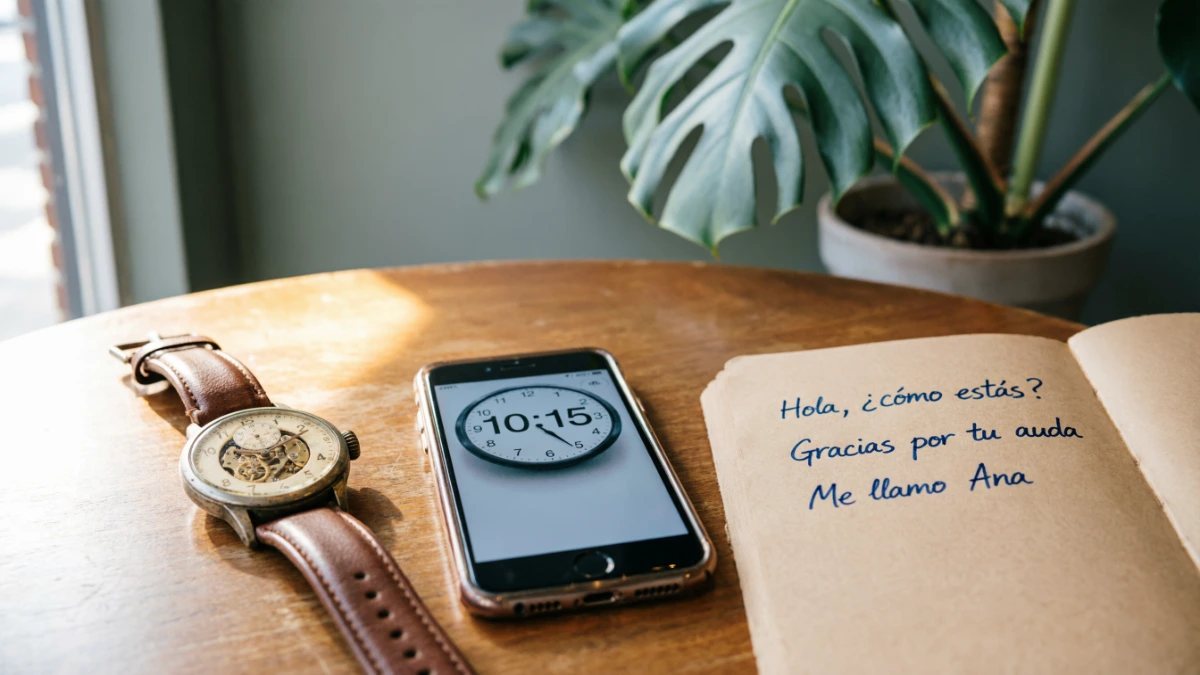
You’re texting a Spanish speaking friend to plan a coffee date, and you freeze. You know how to say “hello” and “thank you,” but when they ask “¿Qué hora es?” or you need to tell them the time, your mind goes blank.
It’s one of those everyday phrases that textbooks rush through, leaving you unsure whether to say “es” or “son,” or how to handle something like 2:45.
Learning how to say what time it is in Spanish isn’t complicated once you understand a few core rules. Spanish time expressions follow a consistent pattern, with just a couple of exceptions to memorize.
If you need to ask, answer, or talk about scheduling a meeting, this guide covers every situation you’ll actually run into from formal Spanish to everyday slang.
QUICK ANSWER
To ask the time in Spanish, say “¿Qué hora es?” To answer, use “Es la una” for 1:00, or “Son las…” plus the hour for any other time (e.g., “Son las tres” = It’s 3:00). Add “y [minutes]” for time past the hour or “menos [minutes]” for time before the next hour.
Asking “What Time Is It?” in Spanish

The standard question is “¿Qué hora es?” This is understood everywhere Spanish is spoken and works in both casual and formal settings.
In practice: If you stop someone on the street in Mexico City or Madrid and ask “¿Qué hora es?”, you’ll get a straightforward answer like “Son las cinco” (It’s five o’clock). No extra explanation needed this phrase is universally recognized.
Why it works: Spanish uses “qué” (what) plus “hora” (hour/time) in a simple question structure, mirroring the English pattern closely enough that it’s easy to remember.
Variations you’ll also hear:
- “¿Tienes hora?” “Do you have the time?” (casual, common when asking a stranger)
- “¿Me podrías decir la hora?” “Could you tell me the time?” (more polite/formal)
- “¿Qué horas son?” Common in parts of Latin America, especially Mexico and Central America (slang/regional variant, explained more below)
Answering with “Es la una” vs. “Son las…”
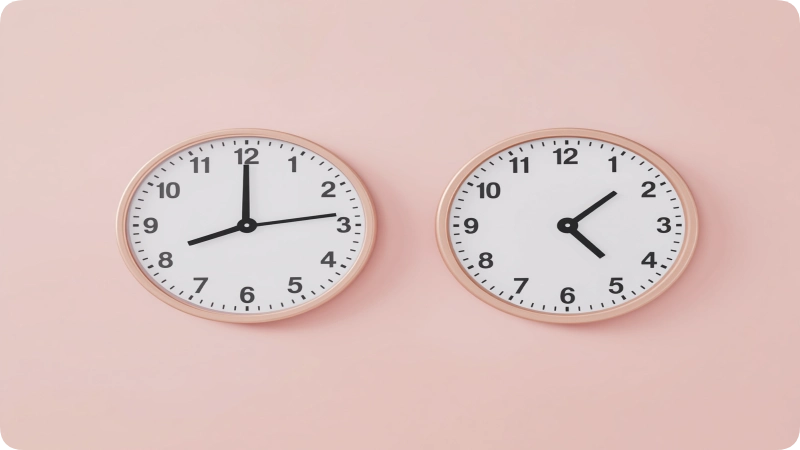
This is where most learners get confused. The rule is simple: use “es” only for one o’clock, and “son” for every other hour.
- Es la una. It’s one o’clock.
- Son las dos. It’s two o’clock.
- Son las tres. It’s three o’clock.
- Son las doce. It’s twelve o’clock.
Why it works: In Spanish, time is grammatically treated as plural once you pass “one,” so the verb “ser” (to be) shifts from singular (“es”) to plural (“son”) to match. Native speakers do this automatically, and once you practice it a few times, it becomes second nature.
Quick Take: Think of it as counting hours like objects one hour “is,” but two or more hours “are.”
Telling Time Past the Hour (Using “y”)
Use “y” (and) to express minutes after the hour.
- Son las tres y cinco. It’s 3:05.
- Son las cuatro y diez. It’s 4:10.
- Son las seis y cuarto. It’s 6:15 (quarter past six).
- Son las siete y media. It’s 7:30 (half past seven).
- Son las ocho y veinte. It’s 8:20.
Why it works: “Y” functions the same way it would in English if you said “three and five (minutes).” The structure stays consistent no matter the hour.
In practice: A common daily exchange between coworkers might go: “¿Qué hora es?” “Son las nueve y cuarto, la reunión empieza en quince minutos.” (It’s 9:15, the meeting starts in fifteen minutes.)
Telling Time Before the Hour (Using “menos”)
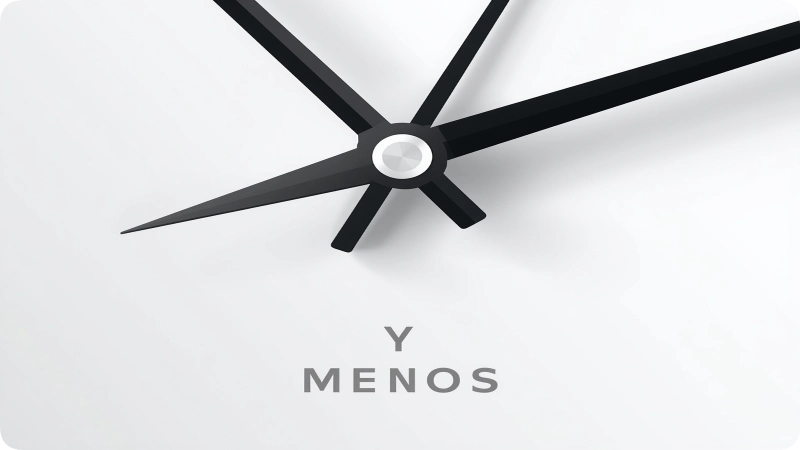
For the last 30 minutes before the next hour, Spanish often counts backward using “menos” (minus/to).
- Son las tres menos cuarto. It’s 2:45 (quarter to three).
- Son las cinco menos diez. It’s 4:50 (ten to five).
- Son las ocho menos veinte. It’s 7:40 (twenty to eight).
Why it works: Instead of saying “seven forty,” Spanish frames it as “twenty minutes until eight,” which native speakers find more natural for the second half of the hour.
Quick Take: Both systems (y/menos and straight minute counting like “son las siete cuarenta”) are used in daily speech “menos” is more traditional, while digital style counting is increasingly common, especially among younger speakers.
Specifying AM, PM, and Time of Day
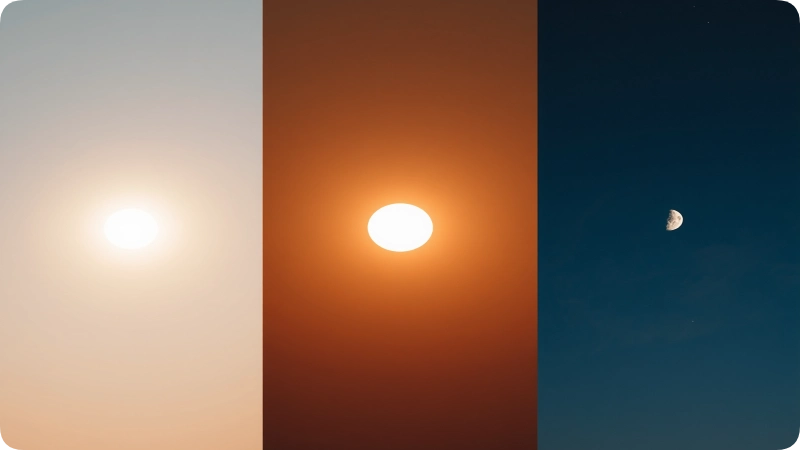
Spanish doesn’t use “AM/PM” in casual conversation. Instead, it adds a phrase describing the general time of day.
- de la mañana in the morning (roughly midnight to noon)
- de la tarde in the afternoon (roughly noon to sunset)
- de la noche at night (roughly sunset to midnight)
Examples:
- Son las siete de la mañana. It’s 7:00 AM.
- Son las tres de la tarde. It’s 3:00 PM.
- Son las diez de la noche. It’s 10:00 PM.
Why it works: This system adapts to context and culture rather than a fixed clock split, which is why “de la tarde” can stretch later in some countries where evenings start after dark.
Saying “It’s Exactly [Time]” On the Dot
To emphasize precision, add “en punto.”
- Son las cuatro en punto. It’s exactly four o’clock.
- La reunión es a las diez en punto. The meeting is at exactly ten o’clock.
Why it works: “En punto” literally means “on the point,” functioning just like “on the dot” or “sharp” in English. It’s especially useful in professional or scheduling contexts where punctuality matters.
Asking and Answering “At What Time…?”
To ask when something happens, use “¿A qué hora…?” this is different from asking the current time.
- ¿A qué hora es la cena? At what time is dinner?
- ¿A qué hora nos vemos? At what time are we meeting?
To answer, use “a las” (or “a la” for one o’clock):
- La cena es a las ocho. Dinner is at eight.
- Nos vemos a la una. We’ll meet at one.
In practice: Planning a video call with a colleague in Colombia might sound like: “¿A qué hora te viene bien?” “A las tres de la tarde, hora de Colombia.” (What time works for you? Three in the afternoon, Colombia time.)
Talking About the 24 Hour Clock (Military Time)
In formal, written, or travel contexts (train schedules, flight boards, official documents), Spanish often uses the 24 hour clock.
- Las quince horas. 15:00 (3:00 PM)
- El vuelo sale a las veintiuna horas. The flight departs at 21:00 (9:00 PM).
Why it works: This avoids the need for “de la mañana/tarde/noche” and removes ambiguity, which is especially useful for schedules and official communication.
Regional Slang for Asking the Time
Spanish varies by country, and casual speech reflects that.
- “¿Qué horas son?” Very common in Mexico and Central America, using a plural “horas” instead of the standard singular “hora.” Grammatically informal but widely understood and accepted in casual speech.
- “¿Qué hora tienes?” “What time do you have?” common across many Spanish speaking countries when asking someone to check their watch or phone.
- “¿Sabes la hora?” “Do you know the time?” casual and friendly.
Quick Take: None of these slang variations will confuse a native speaker they’re regional flavor, not separate rules.
Responding When You Don’t Know the Time
Sometimes you simply don’t have the answer.
- No sé qué hora es. I don’t know what time it is.
- No tengo reloj. I don’t have a watch/clock.
- No tengo idea, se me olvidó el celular. I have no idea, I forgot my phone.
Why it works: These responses keep the conversation natural and polite instead of leaving an awkward silence.
Using Time Expressions in Scheduling Conversations
Beyond just stating the time, you’ll often need full sentences to confirm plans.
- ¿Te parece bien a las cinco? Does five o’clock work for you?
- Perfecto, nos vemos a esa hora. Perfect, see you at that time.
- Voy a llegar un poco tarde, como a las seis y media. I’m going to arrive a bit late, around 6:30.
Why it works: Native speakers rarely just state a time in isolation they wrap it in confirmation or context, which sounds far more natural than a flat statement.
WHAT NOT TO SAY
- “Es las tres.” Incorrect verb agreement. Since “tres” is plural, it must be “Son las tres,” not “Es las tres.” Only use “es” with “la una.”
- “Qué tiempo es?” This is a common beginner mistake. “Tiempo” means “time” in a general or weather sense (e.g., “¿qué tiempo hace?” = what’s the weather like?), not clock time. Always use “hora” for asking the time.
- Forgetting “de la mañana/tarde/noche” in ambiguous contexts. Saying only “Son las ocho” without context can confuse listeners about AM or PM. Add the time of day phrase when it matters, especially in writing.
- Mixing “y” and “menos” incorrectly, like saying “Son las tres y cuarenta y cinco” instead of “Son las cuatro menos cuarto.” Both are technically understood, but the “menos” version sounds more natural to native ears for the last 15–20 minutes of the hour.
- Using overly literal translations, such as “¿Qué es el tiempo?” This phrase doesn’t exist in this context and will sound confusing rather than incorrect stick to “¿Qué hora es?”
Quick Reference Table
| Situation | Best Response | When to Use & Tone |
|---|---|---|
| Asking the time (standard) | ¿Qué hora es? | Any setting, formal or casual |
| Asking the time (casual/regional) | ¿Qué horas son? / ¿Tienes hora? | Casual, especially Mexico & Central America |
| It’s 1:00 | Es la una | Only time “es” is used for hours |
| It’s 2:00–12:00 | Son las [number] | Standard plural construction |
| It’s 3:15 | Son las tres y cuarto | Quarter past the hour |
| It’s 7:30 | Son las siete y media | Half past the hour |
| It’s 4:45 | Son las cinco menos cuarto | Quarter to the next hour |
| Exactly on time | Son las [hour] en punto | Emphasizing precision |
| At what time…? | ¿A qué hora…? | Asking about a scheduled event |
| Something happens at 8:00 | Es a las ocho | Answering “at what time” |
| 24-hour/formal time | Las quince horas | Schedules, travel, official documents |
FAQs
How to answer what time it is in Spanish?
Use “Es la una” for one o’clock, or “Son las…” plus the number for any other hour. Add minutes with “y” (past the hour) or “menos” (before the hour), and specify “de la mañana/tarde/noche” for clarity.
How do you say “at what time is it” in Spanish?Say “¿A qué hora es?” This asks when a specific event happens, which is different from “¿Qué hora es?” (asking the current time).
How to respond to “qué hora es”?
Respond with “Son las…” plus the hour, such as “Son las cuatro y media” (It’s 4:30). If you don’t know, say “No sé qué hora es” or “No tengo reloj.”
How do you say “what time is it” in Spanish slang?
Casual and regional versions include “¿Qué horas son?” (common in Mexico and Central America), “¿Tienes hora?”, and “¿Sabes la hora?” All are understood as friendly, informal versions of the standard question.
How to say what time it is in Spanish audio?
While this guide is text based, you can hear native pronunciation through free tools like Forvo, Google Translate’s audio playback, or YouTube videos from native Spanish teachers, which pair the written phrases here with correct pronunciation.
Is Google Translate accurate for telling time in Spanish?
Google Translate generally gets simple time phrases correct, like “Son las tres” for “It’s three o’clock.” However, it can miss regional slang or natural phrasing, so it’s best used for basic translations rather than nuanced conversation.
What time is it in Spanish on Duolingo?
Duolingo teaches the standard “Es la una / Son las…” system covered in this guide, along with “y” and “menos” for minutes. It typically introduces the 24 hour clock and regional slang in later, more advanced lessons.
How do you say “what time to meet” in Spanish?
Ask “¿A qué hora nos vemos?” (At what time are we meeting?) or “¿A qué hora quedamos?”, which is common in Spain for making plans.
How do you say “yes, what time” in Spanish?
You’d say “Sí, ¿a qué hora?” confirming you’re available and asking for the specific time being proposed.
Why does Spanish use “es” for one o’clock but “son” for all other hours?
Spanish time expressions agree in number with the hour itself. Since “una” (one) is singular, it takes the singular verb “es.” Every other number is treated as plural, requiring “son.”
CONCLUSION
Telling time in Spanish comes down to one core principle: match your verb (“es” or “son”) to whether you’re talking about one o’clock or any other hour, then build outward with “y” and “menos” for the minutes.
Once that pattern clicks, you can handle how to say what time it is in Spanish in almost any situation from a quick text to a friend to confirming a business meeting.
Regional slang like “¿Qué horas son?” or “¿Tienes hora?” will vary depending on where you are, but the core structure taught here works everywhere Spanish is spoken.
Practice a few real exchanges out loud, and asking or answering the time will start to feel as natural as it does in your own language.

Hi, I’m Virginia Woolf, a language enthusiast passionate about exploring the power of words and their meanings. I specialize in helping readers choose the right words through clear comparisons, synonyms, and practical usage. My goal is to make vocabulary learning simple, engaging, and useful for everyday communication. picktheword.com