You are sitting in chemistry class, staring at the formula NH3, and your teacher asks: “Is ammonia polar or nonpolar?” Everyone goes quiet.
You vaguely remember something about electronegativity and bond angles, but the answer feels fuzzy.
You are definitely not alone this is one of the most searched chemistry questions by students at every level.So let’s clear it up right now, simply and permanently.
Quick Answer
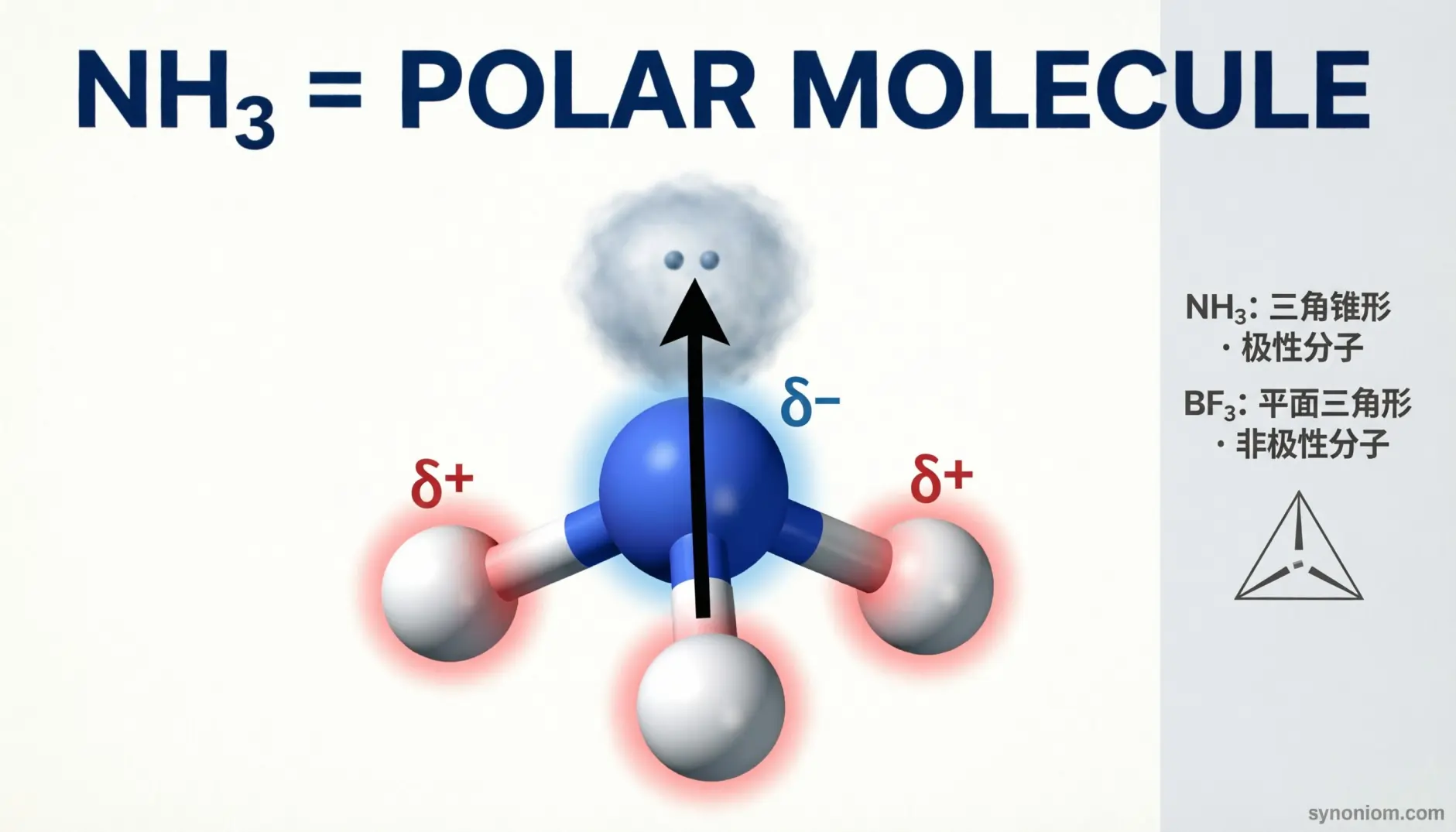
It has a trigonal pyramidal shape, a lone pair of electrons on the nitrogen atom, and an uneven distribution of electrical charge across the molecule. All of this together creates a net dipole moment which is exactly what makes a molecule polar.
What Does Polar and Nonpolar Actually Mean?
Before diving into NH3 specifically, it helps to understand what these two terms mean in plain language.
Think of a polar molecule like a magnet with a positive end and a negative end. The electrons in the molecule are not shared equally they are pulled more toward one side. This creates what chemists call a dipole moment, meaning one part of the molecule carries a slight negative charge and another part carries a slight positive charge.
A nonpolar molecule, on the other hand, is more like a balanced seesaw. The electrons are distributed evenly, so there is no positive or negative end. The charges cancel each other out perfectly.
So the key question for any molecule is: do the charges cancel out, or do they create an imbalance?
For NH3, they do not cancel out and here is why.
Why NH3 Is Polar: The Full Explanation
The Structure of NH3
NH3 stands for ammonia. It has one nitrogen atom (N) bonded to three hydrogen atoms (H). That part seems simple enough.
But here is what most students miss: nitrogen also has a lone pair of electrons two electrons that are not shared with any hydrogen atom. This lone pair sits on top of the nitrogen atom like an invisible fourth “arm,” and it plays a huge role in making the molecule polar.
Because of this lone pair, NH3 takes on a trigonal pyramidal shape. Picture a pyramid with three hydrogen atoms forming the base and the nitrogen atom sitting at the top. The lone pair pushes the three N H bonds downward, creating an asymmetrical (uneven) shape.
That asymmetry is the root cause of NH3’s polarity.
Electronegativity Difference
Electronegativity simply means how strongly an atom pulls electrons toward itself. Nitrogen is significantly more electronegative than hydrogen.
Here are the values:
- Nitrogen (N): 3.04
- Hydrogen (H): 2.20
The difference is about 0.84. Any difference greater than 0.4 between two bonded atoms creates a polar covalent bond. So each of the three N H bonds in ammonia is polar on its own nitrogen pulls the shared electrons closer to itself, making the nitrogen end slightly negative (δ−) and each hydrogen end slightly positive (δ+).
The Dipole Moment Does Not Cancel
Now here is where it gets interesting. In some molecules, even though individual bonds are polar, the overall molecule is still nonpolar. This happens when the polar bonds point in symmetrical directions and cancel each other out like in CO2 or CCl4.
But in NH3, that does not happen.
Because of the pyramidal shape and the lone pair on nitrogen, all three bond dipoles point in the same general direction toward the nitrogen atom. Instead of canceling, they add together, creating a net dipole moment of 1.46 Debye (a unit used to measure dipole moment in chemistry).
This confirmed, measurable dipole moment is solid proof that NH3 is polar.
NH3 vs. Similar Molecules: Polar or Nonpolar?
Students often get confused when comparing NH3 with similar-looking molecules. This table should help:
| Molecule | Name | Shape | Lone Pairs | Polar / Nonpolar |
|---|---|---|---|---|
| NH₃ | Ammonia | Trigonal pyramidal | 1 on N | Polar |
| BF₃ | Boron trifluoride | Trigonal planar | 0 on B | Nonpolar |
| NF₃ | Nitrogen trifluoride | Trigonal pyramidal | 1 on N | Polar |
| CH₄ | Methane | Tetrahedral | 0 on C | Nonpolar |
| H₂O | Water | Bent | 2 on O | Polar |
| CO₂ | Carbon dioxide | Linear | 0 on C | Nonpolar |
The key takeaway from this table: shape matters enormously. BF3 and NH3 both have three atoms bonded to a central atom, but BF3 is flat and symmetrical while NH3 is pyramidal and asymmetrical. That single structural difference changes everything.
The Lone Pair: The Most Important Factor
Students often focus only on bond polarity and forget about the lone pair. This is the most common mistake when analyzing NH3.
The lone pair on nitrogen does two things:
First, it takes up space and repels the three N H bonds, pushing them downward and creating the pyramidal shape. This is explained by VSEPR theory (Valence Shell Electron Pair Repulsion) a topic worth exploring if you are studying molecular geometry.
Second, the lone pair itself is a region of high electron density. It contributes to the overall negative charge on the nitrogen end of the molecule, reinforcing the dipole moment rather than reducing it.
So even if you forgot everything else, remember this: the lone pair on nitrogen is what prevents the dipole moments from canceling, making NH3 polar.
Real-World Properties That Confirm NH3 Is Polar
You do not just have to take the theory’s word for it. The physical properties of ammonia are consistent with polar behavior:
High boiling point for its size:
NH3 boils at −33°C. For such a small, lightweight molecule, that is relatively high. Polar molecules experience stronger intermolecular forces (called dipole-dipole interactions and hydrogen bonding), which require more energy to overcome.
Hydrogen bonding:
Because nitrogen is electronegative and carries a partial negative charge, NH3 forms hydrogen bonds with water molecules. This is why ammonia dissolves so readily in water polar dissolves in polar. This is a well-known chemistry rule: “like dissolves like.”
Solubility in water:
Ammonia dissolves extremely well in water, forming a basic solution. Nonpolar molecules like oils and waxes do not dissolve in water. The fact that NH3 does confirms its polar nature.
10 Example Sentences Using NH3 and Polarity Concepts
These sentences reflect how this topic naturally appears in academic and classroom writing:
- NH3 is a polar molecule because its trigonal pyramidal shape creates an uneven charge distribution.
- The lone pair on the nitrogen atom in NH3 prevents the bond dipoles from canceling.
- Because NH3 is polar, it dissolves easily in water following the “like dissolves like” rule.
- The net dipole moment of NH3 is 1.46 Debye, which confirms its polarity.
- Unlike CO2, which is linear and nonpolar, NH3 is pyramidal and polar.
- Students often confuse NH3 with BF3, but BF3 is trigonal planar and nonpolar while NH3 is not.
- The electronegativity difference between nitrogen and hydrogen makes each N H bond polar.
- NH3 forms hydrogen bonds with water molecules, a property unique to polar compounds.
- VSEPR theory predicts the pyramidal shape of NH3, which explains its polarity.
- Ammonia’s relatively high boiling point for its molecular weight results from strong dipole-dipole interactions.
- In the lab, the polar nature of NH3 makes it an effective solvent for certain ionic compounds.
- Comparing NH3 and CH4 clearly shows how lone pairs affect molecular shape and polarity.
Common Mistakes Students Make
Mistake 1: Thinking symmetrical bonds always mean nonpolar
Incorrect thinking: “NH3 has three identical N H bonds, so they must cancel and make it nonpolar.” Why it’s wrong: The bonds are identical, but they do not point symmetrically in all directions. The lone pair distorts the geometry, so the dipoles do not cancel.
Mistake 2: Ignoring the lone pair in the geometry
Incorrect: Treating NH3 as if it has a flat, symmetrical shape like BF3. Correct: NH3 has a pyramidal shape specifically because the lone pair occupies one of the four electron positions around nitrogen.
Mistake 3: Confusing electron geometry with molecular geometry
The electron geometry of NH3 is actually tetrahedral (three bonding pairs + one lone pair = four electron groups). However, the molecular geometry the shape you see when you look at just the atoms is trigonal pyramidal. Polarity depends on molecular geometry, not electron geometry.
Mistake 4: Assuming a large electronegativity difference alone makes a molecule polar
Electronegativity difference creates polar bonds, but polarity at the molecular level also requires an asymmetrical shape. Both conditions must be present.
Quick Tips to Remember
The pyramid trick:
If the molecule looks like a pyramid (one atom on top, three below), there is almost certainly a lone pair involved and the molecule is likely polar. NH3 is the perfect example.
The cancellation test:
Ask yourself: do the bond dipoles point in directions that cancel each other out? If yes, the molecule is nonpolar (like CO2). If no, it is polar (like NH3).
The “like dissolves like” confirmation:
If a molecule dissolves easily in water, it is polar. Ammonia dissolves freely in water, confirming polarity.
Lone pair = unbalanced:
Whenever a central atom has a lone pair, the molecular geometry becomes asymmetrical, and the molecule is usually polar.
Debye number check:
Any molecule with a dipole moment greater than zero is polar. NH3’s dipole moment is 1.46 D clearly above zero.
FAQs
Is NH3 polar or nonpolar and why?
NH3 is polar because its trigonal pyramidal shape and the lone pair on nitrogen create an uneven distribution of charge. The bond dipoles add together rather than cancel, producing a net dipole moment of 1.46 Debye.
Is the N H bond polar or nonpolar?
Each individual N H bond is polar covalent. Nitrogen has an electronegativity of 3.04 and hydrogen has 2.20, creating a difference of 0.84 well above the 0.4 threshold for polar bond classification.
Why is NH3 polar but BF3 is nonpolar?
Both have three bonds around a central atom, but BF3 has no lone pair on boron, giving it a flat, symmetrical trigonal planar shape where bond dipoles cancel perfectly. NH3 has a lone pair on nitrogen, creating a pyramidal shape where dipoles do not cancel.
Does NH3 have hydrogen bonding?
Yes. Because nitrogen is highly electronegative and the molecule is polar, NH3 molecules form hydrogen bonds with each other and with water molecules. This explains its high solubility in water and its relatively high boiling point.
What is the shape of NH3?
The molecular geometry of NH3 is trigonal pyramidal. The electron geometry is tetrahedral when you include the lone pair. The bond angle is approximately 107°, slightly less than the 109.5° of a perfect tetrahedron because the lone pair exerts extra repulsion.
Is ammonia a polar solvent?
Yes, ammonia acts as a polar solvent. In liquid form, it dissolves many ionic and polar compounds, similar to water, though less effectively.
Can NH3 be nonpolar in any situation?
No. The structure of NH3 always produces an asymmetrical shape with a lone pair on nitrogen. There is no structural configuration in which NH3 becomes nonpolar.
Conclusion
So there it is NH3 is definitively polar, and the reason comes down to three connected ideas: the electronegativity difference between nitrogen and hydrogen creates polar N H bonds, the lone pair on nitrogen forces a pyramidal shape, and that pyramidal shape prevents the bond dipoles from canceling each other out.
The result is a measurable net dipole moment that makes ammonia one of the most commonly studied polar molecules in chemistry.
Next time this question comes up in an exam, a homework problem, or a class discussion you will know not just the answer but exactly why the answer is what it is. And that understanding is far more valuable than simply memorizing “NH3 is polar.”