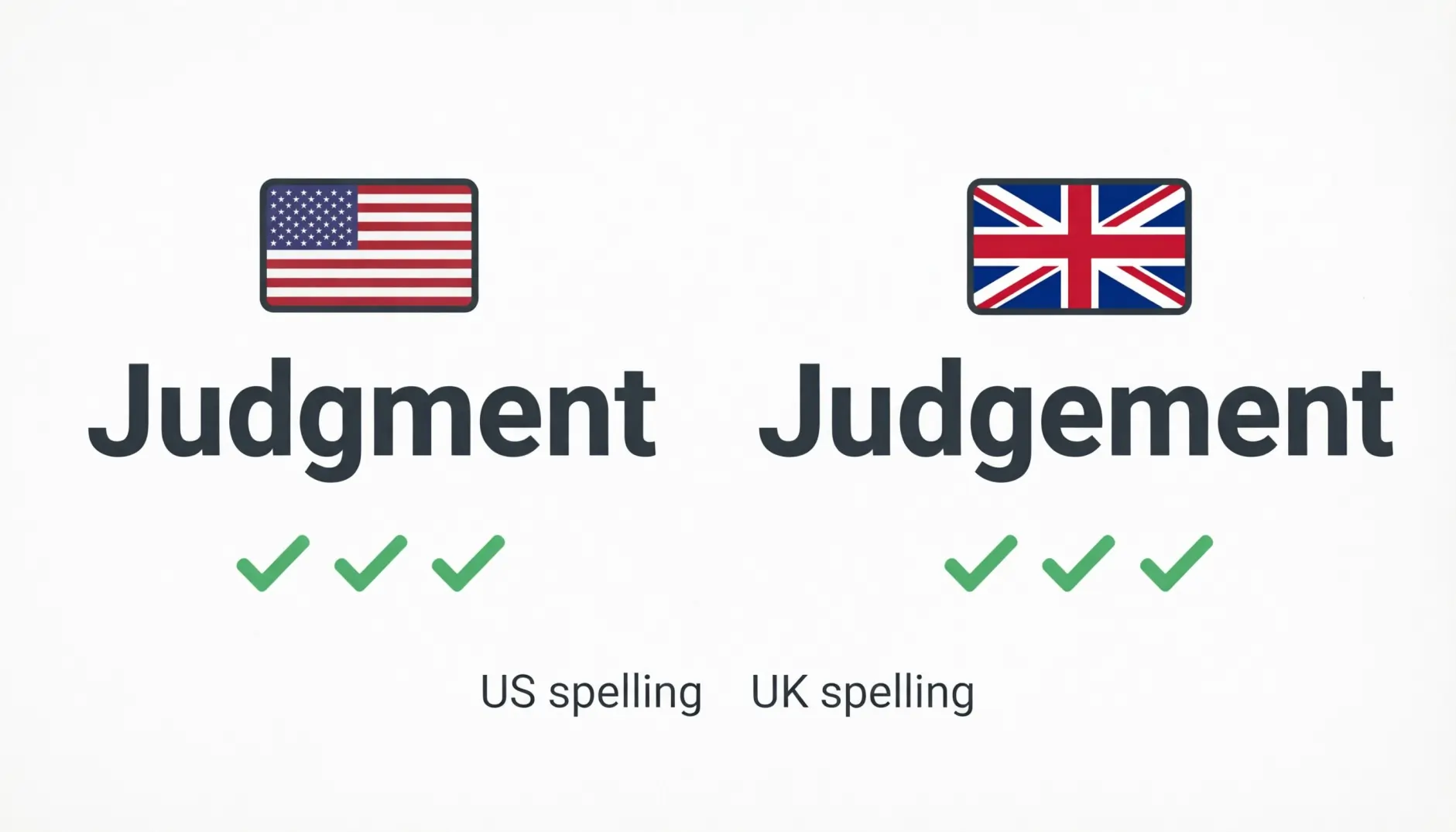
Have you ever seen both judgment and judgement and wondered which one is correct?
The short answer is that both spellings exist, but they are not used equally everywhere. This often confuses English learners because dictionaries, websites, books, and legal documents may use different versions.
The good news is that the difference is mostly about regional spelling preferences, not meaning. Once you understand where each spelling is commonly used, choosing the right one becomes much easier.
Quick Answer
Both “judgment” and “judgement” are correct spellings of the same word.
- Judgment is the preferred spelling in American English.
- Judgement is an accepted spelling in British English, although judgment is also widely used in Britain, especially in legal contexts.
If you’re writing for an international audience, judgment is usually the safest choice.
What Does “Judgment” Mean?
The word judgment (or judgement) refers to:
- An opinion or decision about something
- The ability to make good decisions
- A decision made by a court or judge
Examples
- I trust her judgment.
- The teacher’s judgment was fair.
- The court issued its final judgment.
In all these examples, the meaning stays the same regardless of spelling.
Judgment vs Judgement: What’s the Difference?
There is no difference in meaning between the two spellings.
The main difference is regional and stylistic usage, not meaning.
| Spelling | Common Usage | Notes |
|---|---|---|
| Judgment | Preferred in American English | Most common form in US writing |
| Judgement | Common in British English | Traditional British spelling (less common in modern US usage) |
| Judgment | Standard in legal writing in many countries | Widely used in law and formal documents |
Think of it as a spelling variation rather than a grammar rule.
Why Are There Two Spellings?
Many English words have different spellings in different regions.
Historically, both judgment and judgement have appeared in English writing for centuries.
The confusion comes from the word judge. Since judge ends in ge, many people naturally expect the noun form to be judgement.
However, the spelling judgment became the standard form in many dictionaries and legal systems.
Today, both forms are recognized, but judgment is more widely preferred.
American English vs British English
American English
In the United States, judgment is the standard spelling.
Examples:
- Use good judgment when making decisions.
- The jury reached a judgment.
Using judgement in American writing may look unusual or incorrect to many readers.
British English
In British English, both spellings appear.
However:
- Judgement is often used in general writing.
- Judgment is frequently preferred in legal documents and many modern style guides.
Comparison Table
| Region | Preferred Spelling |
|---|---|
| United States | Judgment |
| Canada | Judgment is more common |
| Australia | Judgement often appears |
| United Kingdom | Both are used |
| Legal Writing | Judgment is usually preferred |
Is “Judgement” Wrong?
No.
Judgement is not wrong.
It is an accepted spelling, especially in British English.
The important thing is consistency. If you’re writing a document, essay, or article, choose one spelling and use it throughout.
Good Examples
- Her judgment helped the team succeed.
- Her judgement helped the team succeed.
Both are correct depending on your audience.
When Should You Use “Judgment”?
Use judgment when:
- Writing in American English
- Writing academic papers for international readers
- Writing legal documents
- Following most modern style guides
Examples
- Good judgment comes from experience.
- The judge announced the judgment.
- His judgment was respected by everyone.
When Should You Use “Judgement”?
Use judgement when:
- Following British English spelling conventions
- Writing for audiences that prefer traditional British spelling
- Following an organization’s style guide that uses this version
Examples
- Her judgement proved correct.
- I admire his judgement.
- Their judgement influenced the final decision.
Grammar Rule: Noun Form of “Judge”
The word judge is a noun and a verb.
Word Forms
| Word Type | Example |
|---|---|
| Verb | to judge |
| Noun | judgment / judgement |
| Adjective | judgmental |
Example
- Do not judge people too quickly.
- Use your best judgment before deciding.
Usage Examples
Formal Writing
- The committee exercised sound judgment.
- The court delivered its final judgment.
- Her professional judgment was highly valued.
Informal Writing
- Trust your judgment.
- My judgement told me something was wrong.
- That’s a matter of personal judgment.
Academic Writing
- Researchers must use careful judgment when analyzing data.
- Ethical judgment plays an important role in decision making.
- The study discusses human judgement in complex situations.
More Example Sentences
- His judgment saved the company money.
- The judge issued a written judgment.
- Good judgment develops over time.
- I questioned my own judgment.
- Her judgement impressed the interview panel.
- Sound judgment is important in leadership.
- The final judgment cannot be appealed.
- Parents often rely on their best judgment.
- Their judgement turned out to be accurate.
- Experience improves judgment.
- The board trusted her professional judgment.
- Everyone respected his judgement.
Common Mistakes
Many learners make mistakes because both spellings exist.
Mistake 1: Thinking One Is Always Wrong
❌ Judgment is correct and judgement is wrong.
✅ Both spellings are accepted.
Why?
The choice depends mostly on regional spelling preferences.
Mistake 2: Mixing Spellings in One Document
❌ The court’s judgment was final. Later, the judgement was published.
✅ The court’s judgment was final. Later, the judgment was published.
Why?
Consistency makes writing look professional.
Mistake 3: Using Judgement in American Academic Writing
❌ The study relies on human judgement.
✅ The study relies on human judgment.
Why?
Most American institutions prefer judgment.
Similar and Commonly Confused Words
Several English words cause confusion because of spelling differences.
| Word Pair | Difference |
|---|---|
| Judgment / Judgement | Same meaning, different spelling preference |
| Adviser / Advisor | Both correct, usage varies |
| Toward / Towards | Regional preference (US vs UK usage) |
| Aging / Ageing | American vs British spelling |
| Practice / Practise | Different meanings in British English |
Understanding these variations helps you recognize regional English styles.
Modern Usage Preferences
Today, judgment is generally more common worldwide.
Reasons include:
- Strong influence of American English
- Use in legal systems
- Preference in many style guides
- Wider appearance in academic publishing
Even in countries that use British English, judgment is often seen in professional and legal writing.
Because of this, many writers choose judgment when writing for an international audience.
Quick Tips to Remember
Memory Trick :1
Think of:
America = Judgment
No extra e before ment.
Memory Trick :2
If you’re unsure, use judgment.
It is the most widely accepted spelling internationally.
Memory Trick :3
Remember:
- Judgment → more common worldwide
- Judgement → common British alternative
Easy Rule
✔ American English → judgment
✔ British English → judgement or judgment
✔ Legal writing → usually judgment
FAQ
Which is correct: judgment or judgement?
Both are correct spellings. Judgment is preferred in American English, while judgement is an accepted British variant.
Is judgement a spelling mistake?
No. It is a legitimate spelling, especially in British English.
Which spelling should I use in an essay?
If your school follows American English, use judgment. If it follows British English, check your style guide and stay consistent.
Why do legal documents usually use judgment?
Many legal systems and legal style guides traditionally prefer judgment as the standard spelling.
Is judgment more common than judgement?
Yes. Judgment is generally more common in modern writing worldwide.
Can I use judgement in British English?
Yes. Many British writers use judgement, and it is considered correct.
Do the two words have different meanings?
No. They have exactly the same meaning. The difference is only spelling.
Conclusion
The confusion between judgment and judgement comes from regional spelling preferences, not from meaning.
Both spellings are correct, but judgment is the preferred form in American English and the more widely used spelling internationally. Judgement remains a valid British English alternative.
If you’re ever unsure, choose judgment, especially for academic, professional, or international writing. Most importantly, be consistent and use the same spelling throughout your document.

Hi, I’m Virginia Woolf, a language enthusiast passionate about exploring the power of words and their meanings. I specialize in helping readers choose the right words through clear comparisons, synonyms, and practical usage. My goal is to make vocabulary learning simple, engaging, and useful for everyday communication. picktheword.com