Have you ever written a sentence like “Please be patience” and wondered if it was correct?
Many English learners confuse patient and patience because the words look and sound similar. They are connected in meaning, but they are used differently in grammar.
This confusion is very common in school writing, emails, social media posts, and daily conversations. Knowing the difference helps you sound more natural and confident in English.
Quick Answer
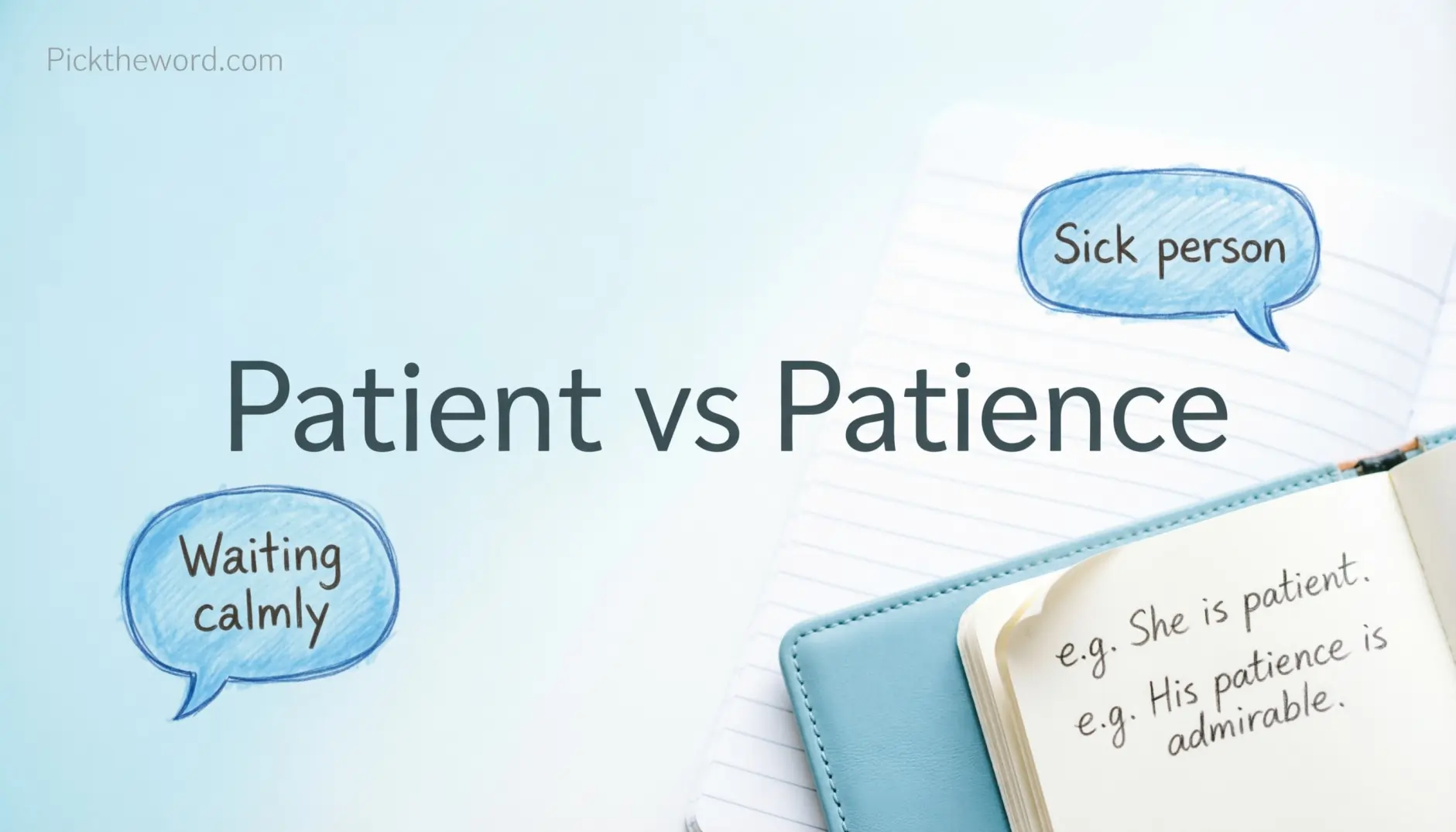
Patient is usually an adjective that describes a calm person who can wait without getting angry.
Patience is a noun that means the ability to stay calm while waiting.
Examples:
- She is very patient with children.
- You need more patience when learning English.
What Does “Patient” Mean?
The word patient describes someone who stays calm while waiting, solving problems, or dealing with difficulties.
It is most commonly used as an adjective.
Simple Definition
Patient = calm while waiting or handling problems
Examples
- My teacher is very patient.
- Please be patient while the website loads.
- He stayed patient during the long meeting.
Grammar Role
| Word | Part of Speech | Meaning |
| Patient | Adjective | Calm and able to wait |
Important Rule
Use patient to describe a person’s behavior or attitude.
Correct:
- She is patient.
Incorrect:
- She has patient.
What Does “Patience” Mean?
The word patience is a noun. It means the ability to wait calmly without becoming upset.
Simple Definition
Patience = the skill or quality of staying calm
Examples
- Learning English takes patience.
- Thank you for your patience.
- I do not have enough patience today.
Grammar Role
| Word | Part of Speech | Meaning |
| Patience | Noun | The ability to wait calmly |
Important Rule
Use patience when talking about the quality, skill, or idea itself.
Correct:
- You need patience.
Incorrect:
- You need patient.
What Is the Difference Between Patient and Patience?
The main difference is grammar.
- Patient describes someone.
- Patience names the quality.
Simple Comparison Table
| Feature | Patient | Patience |
| Part of speech | Adjective | Noun |
| Meaning | Calm while waiting | Ability to wait calmly |
| Used to describe | A person or behavior | A quality or skill |
| Example | She is patient. | She has patience. |
Easy Memory Trick
- Patient ends in -t → think of a trait.
- Patience ends in -ce → think of a concept or quality.
Why Do People Confuse Patient and Patience?
There are several reasons learners mix these words up.
. They Sound Similar
The pronunciation is close, especially in fast speech.
- Patient → PAY-shunt
- Patience → PAY-shuns
. They Share the Same Root
Both words come from the same Latin origin related to suffering and enduring calmly.
. Both Talk About Calmness
The meanings are connected, so learners often choose the wrong form.
. Some Languages Use One Word for Both Ideas
In many languages, the adjective and noun forms are very similar or even identical.
Are Both Words Correct?
Yes. Both patient and patience are correct English words.
However, they are not interchangeable.
Compare These Sentences
| Incorrect | Correct |
| She is patience. | She is patient. |
| I need patient. | I need patience. |
| Please have patient. | Please have patience. |
| Be patience with him. | Be patient with him. |
The correct choice depends on whether you need an adjective or a noun.
Can “Patient” Also Be a Noun?
Yes. This is another reason learners get confused.
The word patient can also mean a person receiving medical treatment.
Examples
- The doctor examined the patient.
- The hospital has many patients today.
Comparison
| Word | Meaning |
| Patient (adjective) | Calm while waiting |
| Patient (noun) | A sick person receiving care |
| Patience | Ability to stay calm |
Context usually makes the meaning clear.
British vs American English Usage
Both patient and patience are used the same way in British and American English.
There is no spelling difference between the UK and US versions.
UK vs US Comparison
| Region | Patient | Patience |
| United States | Standard usage | Standard usage |
| United Kingdom | Standard usage | Standard usage |
| Canada | Same as US/UK | Same as US/UK |
| Australia | Same as US/UK | Same as US/UK |
Which Version Is More Common Globally?
The spellings and meanings are standard worldwide. English speakers in most countries use them in the same way.
How to Use Patient in Sentences
Here are natural examples of patient in everyday English.
Formal Writing
- Our staff will remain patient during the process.
- A good manager should be patient with employees.
Informal Writing
- Try to be patient, okay?
- My mom is really patient with me.
Academic Writing
- Teachers must stay patient with young learners.
- Successful researchers are often patient and careful.
Workplace Communication
- Thank you for being patient during the delay.
- Please remain patient while we fix the issue.
Social Media and Texting
- Be patient. Good things take time.
- I’m trying to stay patient today.
How to Use Patience in Sentences
Now let’s look at natural examples of patience.
Formal Writing
- We appreciate your patience and understanding.
- Great leadership requires patience.
Informal Writing
- I have no patience left today.
- Thanks for your patience!
Academic Writing
- Language learning demands time and patience.
- Scientists need patience during experiments.
Workplace Communication
- Thank you for your patience while we review your request.
- Your patience is appreciated.
Social Media and Texting
- Patience is a superpower.
- Sometimes life teaches us patience.
Natural Example Sentences
Here are more real-life examples to help you remember the difference.
- She was very patient with the new students.
- I do not have the patience to wait in long lines.
- Please be patient while the page loads.
- Raising children takes a lot of patience.
- He stayed patient during the interview process.
- Thank you for your patience today.
- Good teachers are usually patient and kind.
- You need patience to improve your writing skills.
- My brother is not very patient when driving.
- Her patience helped the team succeed.
- Stay patient and keep practicing English.
- Building confidence takes time and patience.
Common Mistakes Learners Make
Many learners know the meanings but still use the wrong form in sentences.
Using Patience as an Adjective
Incorrect:
- She is patience.
Correct:
- She is patient.
Why?
Because you are describing a person. You need an adjective.
Using Patient as a Noun for the Quality
Incorrect:
- I need more patient.
Correct:
- I need more patience.
Why?
Because you are talking about the quality itself.
Forgetting “Be” Before Patient
Incorrect:
- Please patient.
Correct:
- Please be patient.
Why?
Adjectives often need a linking verb like be.
Confusing Medical Meaning
Incorrect:
- The hospital patience waited outside.
Correct:
- The hospital patients waited outside.
Why?
Here, patients means people receiving treatment.
Similar and Commonly Confused Words
English has several related words that can confuse learners.
Patiently
Patiently is an adverb.
Example:
- She waited patiently.
Impatient
This means not willing to wait calmly.
Example:
- He became impatient after ten minutes.
Patience vs Tolerance
| Word | Meaning |
| Patience | Calm waiting |
| Tolerance | Accepting something difficult |
Endurance
This word often relates to physical or mental strength over time.
Example:
- Marathon runners need endurance.
Historical Background of the Words
Both words come from the Latin word pati, which means “to suffer” or “to endure.”
Over time:
- Patient became the adjective for calm behavior.
- Patience became the noun for the quality itself.
This shared history explains why the words look alike.
Google Trends and Usage Patterns
People often search:
- “patient or patience”
- “difference between patient and patience”
- “be patient or be patience”
- “patience meaning”
- “patient meaning”
These searches are common because learners hear both words often in spoken English.
In online writing and social media, mistakes like “be patience” appear regularly. Search engines also show that many learners want quick grammar explanations and real examples.
Globally, patient is more common in everyday speech because people frequently describe behavior. Meanwhile, patience is very common in motivational quotes, customer service messages, and educational content.
Quick Tips to Remember
Easy Grammar Rule
- Patient = describes someone
- Patience = names the quality
Memory Trick
Think:
- “Be patient.”
- “Have patience.”
This simple pair helps many learners remember the difference.
Another Helpful Tip
If you can replace the word with “calm,” use patient.
Example:
- She is calm.
- She is patient.
If you can replace the word with “ability,” use patience.
Example:
- He has the ability to wait.
- He has patience.
Regional Usage Tip
The usage is the same in American, British, Canadian, and Australian English, so you do not need to learn separate spellings.
FAQ
Is it “be patient” or “be patience”?
The correct phrase is “be patient.”
You need the adjective patient after the verb “be.”
Correct:
- Please be patient.
Incorrect:
- Please be patience.
What is the difference between patient and patience?
Patient describes a calm person.
Patience is the ability to stay calm while waiting.
Can patient be a noun?
Yes. A patient can also mean a person receiving medical treatment.
Example:
- The doctor spoke to the patient.
Is patience a skill?
Yes. Patience is often seen as an important life skill because it helps people stay calm and make better decisions.
Which word is more common in daily English?
Both are common, but patient appears more often in daily conversation because people frequently describe behavior and attitudes.
Conclusion
The difference between patient and patience is simple once you understand their grammar roles.
- Patient is usually an adjective that describes calm behavior.
- Patience is a noun that means the ability to wait calmly.
A quick way to remember is:
- Be patient
- Have patience
With regular practice and real examples, choosing the correct word becomes much easier. Small grammar improvements like this can make your English sound more natural and confident.