Do you say:
- “I’m laying on the bed”
or - “I’m lying on the bed”?
This is one of the most common grammar mistakes in English. Even native speakers confuse laying and lying because the verbs lay and lie change forms in unusual ways.
If you have ever paused while writing an email, social media post, or school assignment because you were unsure which word to use, you are not alone.
The good news is that the difference is actually simple once you understand one key grammar rule.
Quick Answer
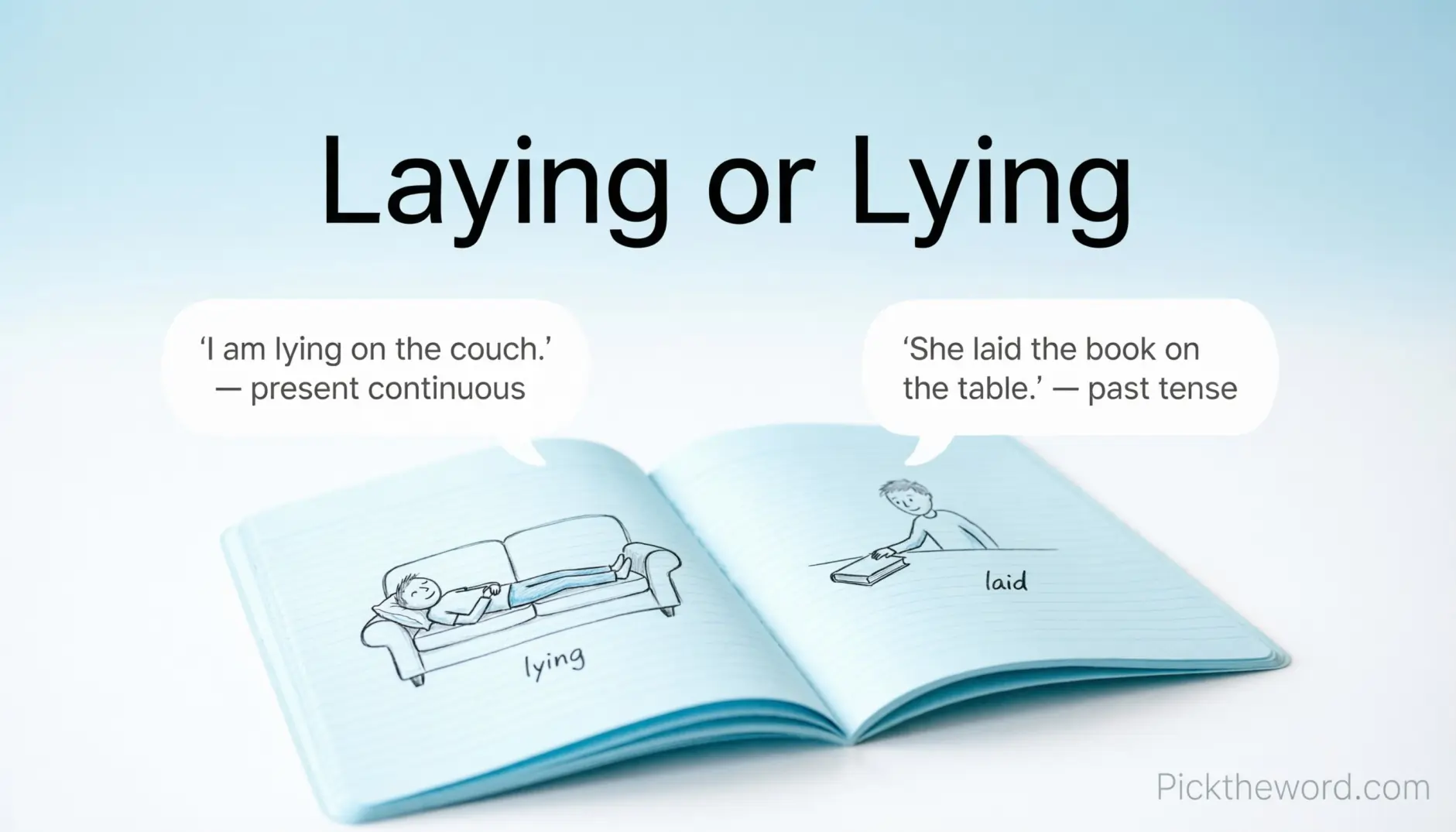
Lying means resting or being in a flat position.
Laying means putting something down.
Examples:
- “The dog is lying on the floor.”
- “She is laying the books on the table.”
A quick trick:
- If there is an object receiving the action, use laying.
- If there is no object, use lying.
What Does “Lying” Mean?
The word lying comes from the verb lie, which means:
- to rest
- to recline
- to be in a flat position
It does not need an object.
Simple Examples
- The baby is lying in the crib.
- I was lying on the couch yesterday.
- Your phone is lying on the desk.
In all these examples, nobody is placing something somewhere. The subject is simply resting in a position.
Grammar Pattern: Lie
| Verb | Present | Present Participle | Past |
|---|---|---|---|
| Lie | lie | lying | lay |
This table is one reason learners get confused. The past tense of lie is lay, which looks exactly like the present tense of another verb.
What Does “Laying” Mean?
The word laying comes from the verb lay, which means:
- to put something down
- to place something somewhere
This verb always needs an object.
Simple Examples
- She is laying the plates on the table.
- He is laying bricks in the garden.
- The farmer is laying straw on the ground.
Notice that something receives the action:
- plates
- bricks
- straw
That is the key difference.
Grammar Pattern: Lay
| Verb | Present | Present Participle | Past |
|---|---|---|---|
| Lay | lay | laying | laid |
What Is the Main Difference Between Laying and Lying?
The difference comes down to one simple question:
Is There an Object?
| Word | Meaning | Needs an Object? |
|---|---|---|
| Lying | Resting or reclining | No |
| Laying | Putting something down | Yes |
Compare These Sentences
| Incorrect | Correct |
|---|---|
| I am laying on the sofa. | I am lying on the sofa. |
| She is lying the book on the desk. | She is laying the book on the desk. |
Why Do People Confuse Laying and Lying?
There are several reasons.
1. The Verb Forms Are Irregular
English verbs are not always logical.
For example:
- lie → lay → lain
- lay → laid → laid
Because lay appears in both verb systems, learners mix them up easily.
2. Spoken English Often Uses Them Incorrectly
Many people say:
- “I’m laying down.”
In casual speech, this is common. However, traditional grammar considers:
- “I’m lying down.”
to be correct.
3. They Sound Similar
The words are close in pronunciation, especially in fast conversation.
Are Both “Laying” and “Lying” Correct?
Yes, both are correct but they are used differently.
Use “Lying” When:
- someone is resting
- no object follows the verb
Example:
- The cat is lying under the chair.
Use “Laying” When:
- someone places something somewhere
- an object follows the verb
Example:
- She is laying the clothes on the bed.
Easy Step by Step Rule for Learners
Here is the easiest method.
Step 1: Find the Action
Ask:
“What is happening?”
Step 2: Look for an Object
Ask:
“Is something receiving the action?”
Step 3: Choose the Correct Word
- No object → lying
- Object present → laying
Practice
Sentence 1
“The boy is ___ on the grass.”
No object exists.
Correct answer:
✅ lying
Sentence 2
“She is ___ the baby in the crib.”
Object = baby
Correct answer:
✅ laying
Laying vs Lying in Everyday English
Many English learners hear both forms used casually.
Informal Speech
People often say:
- “I’m laying in bed.”
This is very common in conversation, songs, and social media.
Formal Grammar
Traditional grammar prefers:
- “I’m lying in bed.”
Should You Worry?
For casual conversation, many native speakers may not notice.
But in:
- academic writing
- business communication
- professional emails
- exams
using the correct form matters.
British vs American English Usage
Both British and American English follow the same grammar rule.
UK and US Usage
| Region | Preferred Grammar |
|---|---|
| United States | lying down |
| United Kingdom | lying down |
| Canada | lying down |
| Australia | lying down |
The grammar rule is the same globally.
However, informal spoken English in all regions may use “laying” incorrectly.
Which Form Is More Common Globally?
In careful writing, lying is considered the standard form when talking about resting.
Examples:
- lying in bed
- lying on the beach
- lying on the floor
The incorrect use of “laying” is widespread in speech, especially online and in casual conversation.
Still, dictionaries and grammar guides recommend:
- lying for resting
- laying for placing something
Usage Examples in Different Situations
Formal Writing
- The patient was lying comfortably after surgery.
- The worker was laying tiles across the hallway.
Informal Writing
- I’m lying on the couch watching TV.
- She’s laying everything out for the party.
Academic Writing
- The document was lying on the professor’s desk.
- Researchers were laying the foundation for future studies.
Workplace Communication
- I am laying the files on your desk.
- The package is lying in the storage room.
Emails and Texts
- I’m lying in bed right now.
- He’s laying the decorations outside.
Social Media
- Just lying by the pool all day.
- She’s laying out her outfits for vacation.
12 Natural Example Sentences
- The keys are lying on the kitchen counter.
- She is laying fresh towels in the bathroom.
- My dog loves lying near the window.
- They were laying cables underground.
- He spent the afternoon lying on the beach.
- The teacher is laying the papers on each desk.
- Your jacket is lying on the chair.
- We are laying a new carpet this weekend.
- The child was lying quietly after lunch.
- She kept laying books all over the room.
- The phone has been lying there for hours.
- Workers are laying bricks outside the building.
Common Mistakes With Laying and Lying
Mistake 1: Using “Laying” Without an Object
❌ I’m laying on the bed.
✅ I’m lying on the bed.
Why?
No object receives the action.
Mistake 2: Using “Lying” With an Object
❌ She is lying the bag on the chair.
✅ She is laying the bag on the chair.
Why?
The bag receives the action.
Mistake 3: Confusing Past Tenses
❌ Yesterday, I laid on the sofa all day.
✅ Yesterday, I lay on the sofa all day.
Why?
Past tense of “lie” is “lay.”
Similar or Commonly Confused Words
The Biggest Confusion:
| Verb | Meaning |
|---|---|
| Lie | Rest or recline in a position |
| Lay | Put something down |
Laid
Laid is the past tense of lay.
Example:
- She laid the book on the shelf.
Lain
Lain is the past participle of lie.
Example:
- The cat has lain there for hours.
This form is less common in everyday speech.
Verb Form Comparis Lie vs. Lay: Verb Forms
| Base Verb | Meaning | Present Participle | Past Tense | Past Participle |
|---|---|---|---|---|
| Lie | Rest or recline | lying | lay | lain |
| Lay | Put something down | laying | laid | laid |
Google Trends and Usage Patterns
Search interest for “laying or lying” stays consistently high because learners regularly struggle with these forms.
Online searches commonly include:
- laying vs lying
- lying or laying in bed
- laying down or lying down
- difference between lay and lie
In informal internet writing, many people use “laying” when grammar rules would prefer “lying.” However, grammar experts, dictionaries, schools, and style guides still recommend the traditional distinction.
Globally, “lying down” remains the preferred standard in edited English.
Quick Tips to Remember
Memory Trick :1
Laying = placing
Both words suggest action toward something.
Memory Trick :2
If you can ask:
“What are they laying?”
then “laying” is probably correct.
Example:
- She is laying the blanket down.
Memory Trick :3
No object?
Use lying.
Example:
- He is lying on the floor.
Quick Grammar Rule
| Situation | Correct Word |
|---|---|
| Resting or reclining | lying |
| Placing something down | laying |
Is “Laying Down” Ever Correct?
Yes, but only when an object exists.
Correct
- She is laying down the baby.
Incorrect
- He is laying down on the couch.
Traditional grammar prefers:
- He is lying down on the couch.
How Can You Practice Correct Usage?
Here are simple ways to improve.
Read Carefully
Notice how books, newspapers, and professional writers use these verbs.
Pause Before Writing
Ask:
“Is something being placed somewhere?”
Practice With Daily Actions
- lying in bed
- lying on the sofa
- laying clothes out
- laying dishes on the table
Small practice helps the rule become natural.
FAQ
Is it “lying in bed” or “laying in bed”?
The grammatically correct phrase is:
- lying in bed
Because no object receives the action.
Why do people say “laying down”?
Many native speakers use it casually in speech. However, traditional grammar usually prefers “lying down” unless an object is involved.
Is “laying” always wrong?
No. “Laying” is correct when someone places something somewhere.
Example:
- She is laying the books on the shelf.
What is the difference between lay and lie?
- Lie = rest or recline
- Lay = place something down
Which form should I use in formal writing?
Use:
- lying for resting
- laying for placing objects
This is the safest choice for professional and academic English.
Conclusion
The difference between laying and lying becomes much easier once you focus on one simple rule:
- Lying = resting
- Laying = placing something down
If an object receives the action, use laying. If no object exists, use lying.
Even native speakers confuse these words sometimes, so do not feel discouraged. With regular practice, the correct choice will start to feel natural.