Many English learners hesitate when choosing between lie down and lay down because the two expressions sound almost identical but follow different grammar rules.
The confusion becomes even greater since lay is both a verb on its own and the past tense of lie. Fortunately, you don’t need to memorize complicated grammar to use them correctly.
Once you understand the basic difference, it becomes much easier to speak and write with confidence.
This guide explains the meaning of lie down and lay down in simple language, shows how each is used in everyday situations, highlights common mistakes, and provides easy examples and memory tricks to help you remember the correct choice every time.
Quick Answer
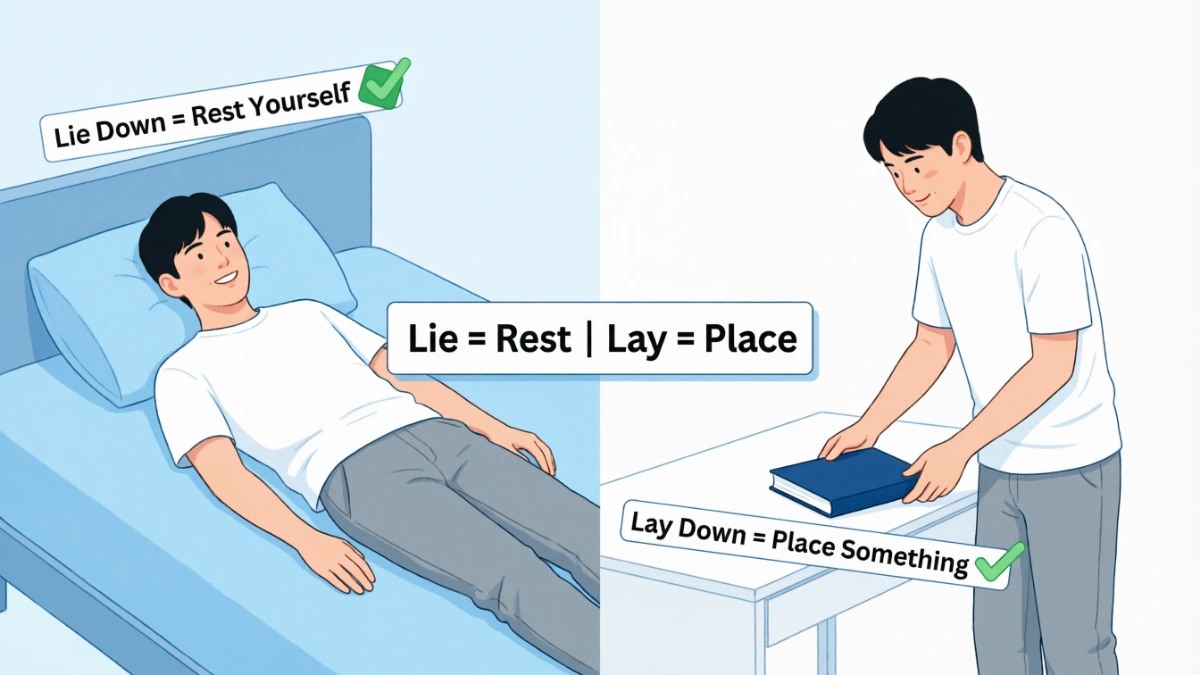
Use lie down when someone rests or reclines by themselves.
- ✅ I need to lie down for a while.
- ✅ The dog is lying down on the floor.
Use lay down when someone puts or places something somewhere.
- ✅ Please lay down your phone.
- ✅ She laid down the book on the desk.
Simple rule:
- Lie = no object (just the person or animal)
- Lay = needs an object (something is being placed)
What Does “Lie Down” Mean?
Lie down means to move into a flat or resting position. The person or animal does the action themselves.
Nobody or nothing is being placed by another person.
Formula
Subject + lie down
Examples:
- I want to lie down after work.
- Please lie down on the bed.
- The baby is lying down quietly.
- The cat lies down near the window every afternoon.
Think of lie down as meaning rest yourself.
What Does “Lay Down” Mean?
Lay down means to put or place something onto a surface.
Unlike lie, the verb lay always needs an object.
Formula
Subject + lay + object + down
Examples:
- Please lay down your backpack.
- She laid down the newspaper.
- Lay down your cards.
- He carefully laid down the glass.
If you can answer the question “Lay down what?”, you’re probably using it correctly.
The Main Difference Between Lie Down and Lay Down
| Lie Down | Lay Down |
|---|---|
| Means to rest yourself | Means to place something |
| No object needed | Object required |
| Action happens to yourself | Action happens to another thing |
| “I lie down.” | “I lay down the blanket.” |
Compare These Examples
| Correct Sentence | Why? |
|---|---|
| I need to lie down. | I am resting myself. |
| Please lay down your coat. | The coat is the object. |
| The baby is lying down. | No object. |
| She laid down the pen. | The pen is being placed. |
Why Are These Words So Confusing?
Many learners mix them up because the past tense of lie is lay.
Lie vs. Lay
| Verb | Present | Past | Past Participle |
|---|---|---|---|
| Lie (recline) | lie | lay | lain |
| Lay (place) | lay | laid | laid |
This creates confusion because:
- Today: I lie down.
- Yesterday: I lay down.
But:
- Today: I lay the book down.
- Yesterday: I laid the book down.
The word lay can be either:
- the present tense of lay (place something), or
- the past tense of lie (rest).
The meaning depends on the sentence.
How to Know Which One to Use
Ask yourself one simple question:
Am I placing something?
If yes, use lay.
If no, and someone is simply resting, use lie.
Examples
Resting
- I need to lie down.
- The child is lying down.
- They lay down after lunch. (past tense of lie)
Placing something
- Lay down the blanket.
- Please lay down your keys.
- She laid down the dishes carefully.
Verb Forms You Should Remember
Lie (to Recline)
| Tense | Form |
|---|---|
| Base | lie |
| Present Participle | lying |
| Past | lay |
| Past Participle | lain |
Examples:
- I usually lie down after dinner.
- She is lying down now.
- Yesterday I lay down early.
- I have lain awake all night.
Lay (to Place)
| Tense | Form |
|---|---|
| Base | lay |
| Present Participle | laying |
| Past | laid |
| Past Participle | laid |
Examples:
- I lay the baby in the crib.
- She is laying the table.
- He laid the book down.
- They have laid new flooring.
Usage Examples
Formal Writing
- Patients should lie down during the examination.
- Please lay down all electronic devices before entering.
- Visitors should lie down only in designated areas.
Informal Writing
- I’m going to lie down for twenty minutes.
- Can you lay down your phone and listen?
- The dog loves to lie down beside me.
- She laid down her shopping bags.
Academic Writing
- Participants were instructed to lie down before the test.
- Researchers asked subjects to lie down quietly.
- Students should lay down all materials before leaving.
- The technician carefully laid down the equipment.
12 Everyday Example Sentences
- I need to lie down because I have a headache.
- Please lie down on the couch.
- The cat is lying down in the sunshine.
- We lay down for an hour after hiking.
- The baby has lain asleep all afternoon.
- Please lay down your backpack.
- She laid down her notebook.
- They laid down fresh carpet yesterday.
- Don’t lay down in the middle of the road.
- I usually lie down after lunch.
- He laid down the tools carefully.
- The children wanted to lie down on the grass.
Common Mistakes
❌ I am going to lay down for a nap.
✅ I am going to lie down for a nap.
Why?
You are resting yourself, not placing something.
❌ Please lie down your books.
✅ Please lay down your books.
Why?
Books are objects being placed somewhere.
❌ She laid down because she felt sick.
✅ She lay down because she felt sick.
Why?
This is the past tense of lie, not lay.
❌ The dog is laying on the floor.
✅ The dog is lying on the floor.
Why?
The dog is resting, not placing something.
Similar or Commonly Confused Words
Lie vs Lay
- Lie = recline or rest.
- Lay = place something.
Lie vs Lying
- Lie is the base form.
- Lying is the present participle.
Example:
- I want to lie down.
- I am lying down now.
Lay vs Laid
- Lay is present tense.
- Laid is past tense.
Example:
- I lay the book down every evening.
- Yesterday I laid it on the shelf.
Lie (not telling the truth)
Don’t confuse these phrases with lie meaning to tell something false.
Example:
- He told a lie.
This is a completely different meaning.
British vs American English
Both British English and American English use the same grammar rules.
However, in everyday speech, especially in casual American English, many native speakers incorrectly say:
- “I’m going to lay down.”
Although this is common in conversation, standard English grammar still considers lie down the correct form when someone is resting.
If you’re writing for school, work, exams, or professional communication, always follow the standard rule.
Modern Usage Preferences
In formal writing, grammar books, dictionaries, and style guides consistently recommend:
- Lie down for resting.
- Lay down for placing something.
Casual speech sometimes blurs the difference, but careful writers usually keep them separate.
Quick Tips to Remember
- Lie = Rest yourself.
- Lay = Place something.
- If there’s no object, choose lie.
- If something is being placed, choose lay.
- Ask yourself: “Lay down what?”
- Remember: People lie. Objects get laid down.
Frequently Asked Questions
Is it “lie down” or “lay down for a nap”?
The correct phrase is lie down for a nap because you are resting yourself.
Why do people say “lay down” when they mean “lie down”?
Many native speakers mix the two verbs in casual conversation. However, standard grammar still prefers lie down.
Is “lay down” ever correct?
Yes. Use it when placing something.
Example:
- Lay down your bag.
What is the past tense of “lie down”?
The past tense is lay.
Example:
- Yesterday I lay down after lunch.
What is the past tense of “lay down”?
The past tense is laid.
Example:
- She laid down the blanket.
Can “lay down” be used without an object?
In standard English, no. It normally needs something to be placed.
How can I remember the difference?
Think:
- Lie = Rest.
- Lay = Place.
If you’re putting something somewhere, use lay.
Conclusion
The difference between lie down and lay down becomes much easier once you remember one simple rule.
Use lie down when someone rests or reclines. Use lay down when someone places an object on a surface.
Even native English speakers sometimes mix them up in everyday conversation, but following the standard grammar rule will make your writing clearer and more accurate.
Whenever you’re unsure, ask yourself one question: Am I resting, or am I placing something? The answer will tell you which verb to choose.

Hi, I’m Virginia Woolf, a language enthusiast passionate about exploring the power of words and their meanings. I specialize in helping readers choose the right words through clear comparisons, synonyms, and practical usage. My goal is to make vocabulary learning simple, engaging, and useful for everyday communication. picktheword.com